
College Algebra • MATH 1050
At Utah State University, College Algebra covers most foundational algebraic equations and formulas. This page is a summary of most topics covered in College Algebra.
Helpful Links
College Algebra Topics
CBE Review Workshops
- Algebra and Trignometry Text Book - Download a PDF version of the Algebra Textbook
- Paul's Online Notes- Definitions and Examples for College Algebra Topics
- Khan Academy- Video Reviews of Various College Algebra Topics
- Desmos- Online Graphing and Evaluation Tool
Common Relations
Linear
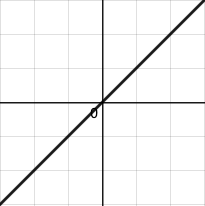
Function: \(\displaystyle f(x)=a x+b \)
Parent Function: \(\displaystyle f(x)=x \)
Parabola
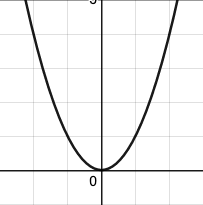
Function: \(\displaystyle f(x)=a x^{2}+b x+c \)
Parent Function: \(\displaystyle f(x)=x^{2} \)
Cubic
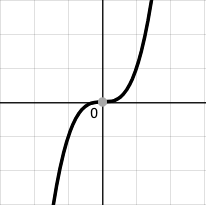
Function: \(\displaystyle f(x)=a x^{3}+b x^{2}+c x+d \)
Parent Function: \(\displaystyle f(x)=x^{3} \)
Square Root
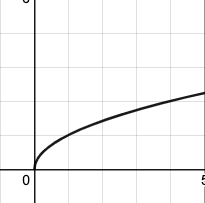
Function: \(\displaystyle f(x)=a \sqrt{x-b}+c \)
Parent Function: \(\displaystyle f(x)=\sqrt{x} \)
Absolute Value
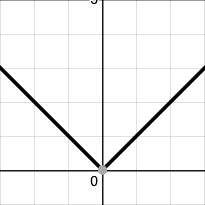
Function: \(\displaystyle f(x)=a|x-h|+k \)
Parent Function: \(\displaystyle f(x)=|x| \)
Circle
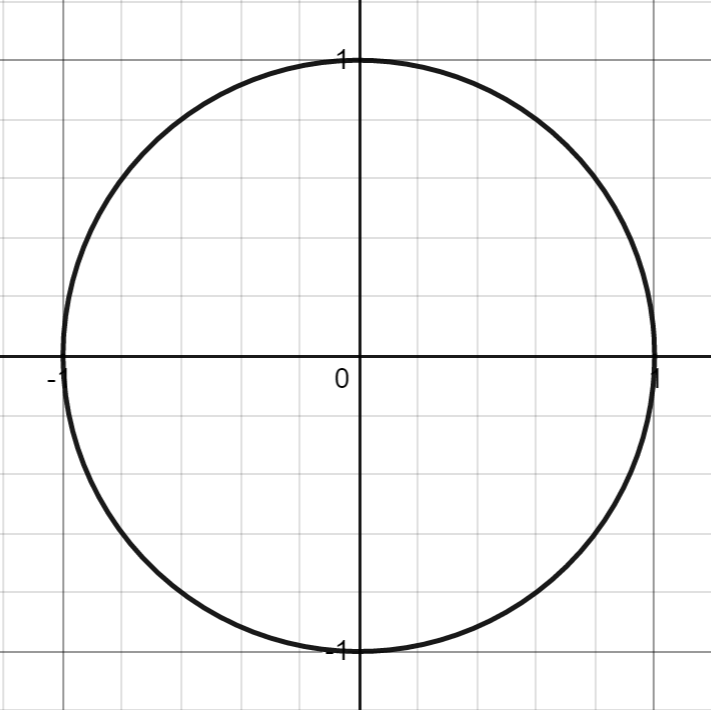
Equation: \(\displaystyle (x-h)^{2}+(y-k)^{2}=r^{2} \)
Parent Function: \(\displaystyle x^{2}+y^{2}=1 \)
Reciprocal
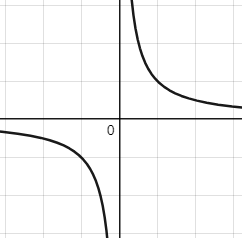
Equation: \(\displaystyle f(x) = \frac{1}{x-h}+k \)
Parent Function: \(\displaystyle f(x) = \frac{1}{x} \)
Greatest Integer
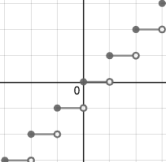
Equations: \(\displaystyle f(x) = \lfloor x-h \rfloor +k \)
Parent Function: \(\displaystyle f(x) = \lfloor x \rfloor \)
Transformations
Assume \(a\) is a positive real number.
Shifts
If \(g(x)=f(x+a)\) then the graph of \(g\) is the same as the graph of \(f\) but shifted to the left \(a\) units.
If \(g(x)=f(x-a)\) then the graph of \(g\) is the same as the graph of \(f\) but shifted to the right \(a\) units.
If \(g(x)=f(x)+a\) then the graph of \(g\) is the same as the graph of \(f\) but shifted up (a\) units.
If \(g(x)=f(x)-a\) then the graph of \(g\) is the same as the graph of \(f\) but shifted down (a\) units.
Reflections
If \(g(x)=f(-x)\) then the graph of \(g\) is the same as the graph of \(f\) but reflected acroes the y-axis.
If \(g(x)=-f(x)\) then the graph of \(g\) is the same as the graph of \(f\) but reflected across the \(\mathrm{x}\)-axis.
Compress & Stretch
If \(g(x)=f(a x)\) then the graph of \(g\) is the same as the graph of \(f\) but compressed toward the \(y\)-axis by a factor of (a\) when \(a>1\) and stretched away from the \(y\)-axis by a factor of \(a\) when \(a<1\).
If \(g(x)=a f(x)\) then the graph of \(g\) is the same as the graph of \(f\) but stretched away from the \(\mathrm{x}\)-axis by a factor of \(a\) when \(a>1\) and compressed toward the \(\mathrm{x}\)-axis by a factor of \(a\) when \(a<1\).
Quadratic Functions & Parabolas
Graph Characteristics of \(f(x)=A(x-h)^{2}+k\)
Vertex
- At the point \((h, k)\)
- A maximum when \(A<0\) (the parabola opens down)
- A minimum when \(A>0\) (the parabola opens up)
Width
- The parabola gets narrower as the absolute value of \(A\) get bigger
-The parabola gets wider as the abeolute value of \(A\) get bigger
Intercepts
- If there are \(x\)-intercepts, they are symmetric to the line \(x=h\).
- The x-intercepts are the real number solutions to the equation \(0=A(x-h)^{2}+k \Rightarrow x=h \pm \sqrt{-\frac{k}{A}}\)
-The y-intercept is \(f(0)=A(0-h)^{2}+k=A h^{2}+k\)
Graph Characteristics of \(f(x)=A(x-a)(x-b)\)
Vertex
- The coordinates of the vertex are \(\left(\frac{a+b}{2}, f\left(\frac{a+b}{2}\right)\right)\)
- A maximum when \(A<0\) (the parabola opens down)
- A minimum when \(A>0\) (the parabola opens up)
Width
- The parabola gets narrower as the absolute value of \(A\) get bigger.
- The parabola gets wider as the absolute value of \(A\) get smaller.
Intercepts
- The \(x\)-intercepts are \(A\) and \(b\). The parabola intersects the \(x\)-axis at \((a, 0)\) and \((b, 0)\)
- The parabola passes through the x-intercepts if \(a \neq b\) and bounces off of the \(\mathrm{x}\)-axis if \(a=b\).
- The y-intercept is \(f(0)=A(0-a)(0-b)=A(a)(b)\)
Graph Characterics of \(f(x)=a x^{2}+b x+c\)
Vertex
- The coordinates of the vertex are \(\left(\frac{-b}{2 a}, f\left(\frac{-b}{2 a}\right)\right)\)
- A maximum when \(A<0\) (the parabola opens down)
- A minimum when \(A>0\) (the parabola opens up)
Width
- The parabola gets narrower as the absolute value of a get bigger.
- The parabola gets wider as the absolute value of a get smaller.
Intercepts
- The x-intercepts are \(\frac{-b}{2 a}-\frac{\sqrt{b^{2}-4 a c}}{2 a}\) and \(\frac{-b}{2 a}+\frac{\sqrt{b^{2}-4 a c}}{2 a}\).
- There are \(2 x\)-intercepts if \(b^{2}-4 a c>0,1 x\)-intercept if \(b^{2}-4 a c=0\), and no \(x\)-intercepts if \(b^{2}-4 a c<0\).
- The \(y\)-intercept is \(f(0)=a(0)^{2}+b(0)+c=c\).
Determining the Domain of Combined Functions
The domains of the functions \(f + g\) , \(f − g\) , \(f ⋅ g\) consist of all real numbers \(x\) such that \(x\) is in the domain of \(f\) and \(x\) is in the domain of \(g\).
The domain of the function \(f ÷ g\) consists of all real numbers \(x\) such that \(x\) is in the domain of \(f\) and \(x\) is in the domain of \(g\) and \(g(x) ≠ 0\).
The domain of the function \(f ○ g\) consists of all real numbers \(x\) such that \(x\) is in the domain of \(g\) and \(g(x)\) is in the domain of \(f\).
Polynomials & Zeros
Rational Zeros Theorem
The following theorem is a big help when trying to use a graph to determine the exact value for any rational zero.
If the reduced rational number \(\displaystyle \frac{p}{q}\) is a zero of a polynomial, then \(p\) must be a factor of the constant term and \(q\) must be a factor of the leading coefficient.
Zeros of a Function Definition
If \(f(c) = 0\) then \(c\) is said to be a zero of the function \(f\).
If \(c\) is an input value of the function \(f\) that returns an output value of \(0\), then \(c\) is said to be a zero of the function \(f\).
If the graph of \(f\) contains the point (c, 0), then \(c\) is said to be a zero of the function \(f\).

Fundamental Theorem of Algebra
If \(f(x)\) is a polynomial with real-number coefficients and a leading term of \(a_{n} x^{n}\), then \(f(x)\) can be written in the form \(f(x)=a_{n}\left(x-c_{1}\right)\left(x-c_{2}\right) \ldots\left(x-c_{n}\right)\) where \(c_{1}, c_{2}, \ldots, c_{n}\) are complex numbers (not necessarily unique).
Note 1: If the degree of the polynomial is \(n\), then there are precisely \(n\) factors of the form \((x-c)\)
Note 2: If the degree of the polynomial is \(n\), then the sum of all of the multiplicities of all of the zeros of the polynomial is \(n\).
Note 3: If the polynomial, in expanded form, has a leading term of \(a_{n} x^{n}\) and if the polynomial has the complex zeros (counting multiplicities) of \(c_{1}, c_{2}, \ldots, c_{n}\) then an expression for the polynomial is \(a_{n}\left(x-c_{1}\right)\left(x-c_{2}\right) \ldots\left(x-c_{n}\right)\)
Useful Formulas
Distance Formula
\(d=\sqrt{\left(x_{2}-x_{1}\right)^{2}+\left(y_{2}-y_{1}\right)^{2}} \)
Midpoint Formula
\(\displaystyle \text{midpoint} =\left(\frac{x_{1}+x_{2}}{2}, \frac{y_{1}+y_{2}}{2}\right) \)
Quadratic Fomula
\(\displaystyle x=\frac{-b+\sqrt{b^{2}-4(a)(c)}}{2(a)} \)
Exponents & Logarithms
Exponential
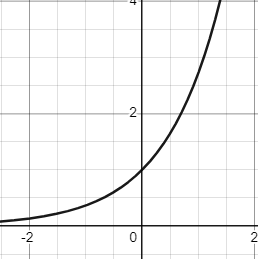
Equation: \(\displaystyle f(x) = ab^x \)
Parent Function: \( \displaystyle f(x)= b^x \)
Logarithmic
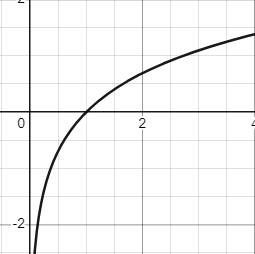
Equation: \(f(x)= \log_b(x+h)+k\)
Parent Function: \(\displaystyle f(x)= log_b x \)
Exponent Rules
Product: \( \displaystyle \left(x^{a}\right)\left(x^{b}\right)=x^{a+b} \)
Quotient: \(\displaystyle \frac{x^{a}}{x^{b}}=x^{a-b} \)
Power: \(\displaystyle \left(x^{a}\right)^{b}=x^{a b} \)
Negative Exponents: \(\displaystyle x^{-a}=\frac{1}{x^{a}} \)
Zero Exponents: \(\displaystyle x^{0}= 1 \text{ for } x \neq 0\)
One Exponents: \(\displaystyle x^{1}= x \)
Logarithmic Rules
Product: \(\displaystyle \ln (a b)=\ln (a)+\ln (b) \)
Quotient: \(\displaystyle \ln \left(\frac{a}{b}\right)=\ln (a)-\ln (b) \)
Log of Power: \(\displaystyle \ln \left(a^{b}\right)=b \ln (a) \)
Base Change: \( \displaystyle\frac{\ln (a)}{\ln (b)}=\log _{b}(a) \)
Natural Log of e: \(\displaystyle \ln (e)=1 \)
Log of 1: \(\displaystyle \log (1)=0 \)
Matrices and Systems of Equations
Row-Echelon Form Properties
1) Any rows consisting entirely of zeros occur at the bottom of the matrix.
2) For each row that does not consist entirely of zeros, the first nonzero entry is a 1 (called a leading 1).
3) The leading 1 in each row must lie farther to the right than the leading 1 in the row above it.
To be reduced row-echelon form the following must also be true:
4) Any column that contains a leading 1 has zeros everywhere else.
Row-Equivalent
If a given matrix can be obtained from another matrix by
performing elementary row operations then those matrices are said to be row-equivalent.
Elementary Row Operations:
1) Interchange any two rows.
2) Multiply a row by a real number.
3) Replace a row with a sum of two rows.

Special Thanks to Greg Wheeler, Ph. D., for his Math 1050 Note Resources.