
Introduction to Statistics • Stat 1040/1045
At Utah State University, Introduction to Statistics covers conceptual understanding and statistical thinking. This page is a summary of most topics covered in Intro Statistics.
Fun With Stats Calculator
Intro to Statistics Topics Playlist
Equations
Histograms
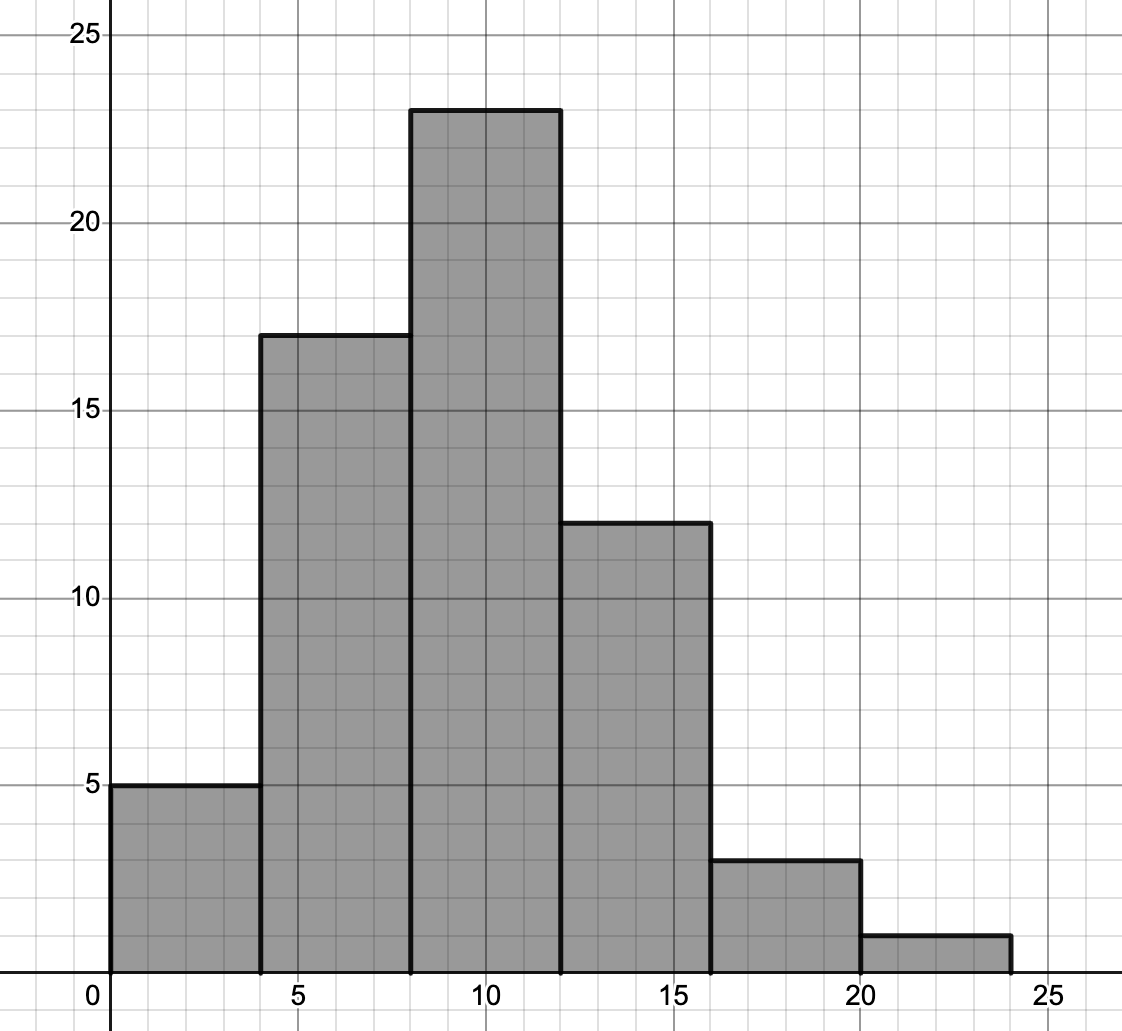
\(\displaystyle \text{height} = \frac{percentage}{width} \)
Area Under A Normal Curve

\( \displaystyle \text{Empirical Rule: } 68 - 95 - 99.7 \)
\(\displaystyle z = \frac{x- \text{average}}{SD}\)
\(\displaystyle x = \text{average} +z(SD)\)
Linear Regression
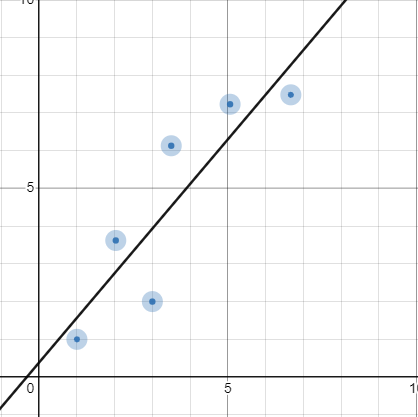
\(\displaystyle \text{rms error} =\left(\sqrt{1-r^{2}}\right)\) SD \(\displaystyle _{Y}\)
\(\displaystyle \text{slope} = \frac{r(SD_Y)}{SD_X}\)
\(\displaystyle \text{Intercept} =\text{average}_Y - \text{slope}(\text{average} _X) \)
Box Models
![Generic Box Model. 2 tickets [1] 3 tickets[0]](/math-stats/amlc/images/stat-1040/box-model.png)
\(\displaystyle \mathrm{SD}_{1-0 \text { box }}=\sqrt{(\text { proportion of } 1\mathrm{~s}) \times(\text { proportion of } 0\mathrm{~s})}\)
\(\displaystyle \mathrm{EV}_{\text {sum }}=\text{( number of draws)} \times \text{(average of the box)} \)
\(\displaystyle \mathrm{SE}_{\text {sum }}=\mathrm{SD}_{\text {box }} \times \sqrt{\text { number of draws }}\)
\(\displaystyle \mathrm{EV}_{\%}=\% \text{ of } 1\mathrm{~s}\text{ in the box} \)
\(\displaystyle \mathrm{SE}_{\%}=\frac{\sqrt{\text {number of draws}} \times \mathrm{SD}_{\text {box }}}{\text { number of draws }} \times 100 \%\) or \(\displaystyle \mathrm{SE}_{\%}=\frac{\mathrm{SD}}{\sqrt{\text { # of draws }}} \times 100 \%\)
\(\displaystyle SE_{\text {avg }}=\frac{\sqrt{\text { number of draws }} \times S_{\text {box }}}{\text { number of draws }}\) or \(\displaystyle S E_{\text {avg }}=\frac{\text { SD }}{\sqrt{\text { # of draws }}}\)
Hypothesis Tests
\(\displaystyle z=\frac{\text{observed}- \text{expected}}{SD}\)
\(\displaystyle \mathrm{SD}^{+}=\sqrt{\frac{\text { sample size }}{\text { sample size }-1}} \times \mathrm{SD}\)
\(\displaystyle \mathrm{SE}_{\text {diff }}=\sqrt{\left(\mathrm{SE}_{\mathrm{A}}\right)^{2}+\left(\mathrm{SE}_{\mathrm{B}}\right)^{2}}\)
\(\displaystyle \chi^{2}=\operatorname{sum} \text{ of }\frac{\text {(observed count - expected count)}^{2} }{\text { expected count }}\)
\(\displaystyle \text{Expected Count} =\frac{(\text { row total) }(\text { column total })}{(\text { table total })}\)