
Outcomes Data: Professional & Technical Writing
2024-25
Direct Measures
In October 2025, Drs. Chen Chen, Rebecca Walton, Ryan Moeller, and Heidi Willers of the Technical Communication and Rhetoric Assessment committee met to evaluate the work of graduating students in the Technical Communication and Rhetoric Major. We assessed 6 documents created by graduating students in TCR 4250 – Careers in Professional Communication, which asks students to answer typical interview questions. These questions correspond to the following learning objectives:
Learning New Technologies
Does the student convince you that they keep up with technology trends in the field and are able to learn new technologies quickly and effectively? Taught in the following courses:
- TCR 2110 – Digital Writing Technologies
- TCR 3210 – Usability and Games User Research
- TCR 4220 - Technology and Activism
- TCR 4240 – User Experience Design
Information Design
Does the student discuss the design philosophies, theories, and/or principles that guide their work? Can the student articulate key differences between effective and ineffective designs? Taught in the following courses:
- TCR 3110 – Accessibility and Disability Rhetorics
- TCR 4210 – Visual Communication
- TCR 4220 - Technology and Activism
- TCR 4250 – Careers in Professional Communication
Collaboration and Project Management
Does the student write convincingly of their experiences in a variety of roles on teams? Does the student value others’ diverse contributions to a common goal? Does the student talk engagingly about their challenges and successes with managing complex projects? This learning outcome is emphasized across TCR courses, but perhaps most specifically addressed in the following courses:
- TCR 2100 – Introduction to Technical Communication
- TCR 3100 – Workplace Research
- TCR 3220 – Technical Editing
- TCR 3230 – Community Grant Writing
- TCR 4220 - Technology and Activism
- TCR 4230 – Project Management
Faculty worked in groups of two to evaluate the final projects as Unacceptable, Marginal, Acceptable, Exceptional in their demonstration of three learning objectives.
|
Unacceptable: |
Marginal: |
Acceptable: Evidence shows that the student has developed an acceptable level of literacy |
Exceptional: Evidence shows that the student has developed a high level of literacy |
|
|---|---|---|---|---|
| Learning New Technologies | 0 | 1 | 2 | 3 |
| Information Design | 0 | 0 | 2 | 4 |
| Collaboration | 0 | 1 | 0 | 5 |
Indirect Measures
During AY 2024-2025, TCR majors participated in the following high impact practices:
- 4 USU Student Research Symposium presentations and research posters
- 3 presentations at the Utah Conference for Undergraduate Research
- 1 presentation at the National Conference for Undergraduate Research
- 3 students in TCR 4240 – User Experience Design presented their research with Google and the UXD Lab to propose new Chromebook Explore features for increasing user engagement at the international conference Association for Computing Machinery Special Interest Group on Design of Communication (SIGDOC). They won third place in the student research competition undergraduate division.
- Students also regularly worked on community-engaged projects in a variety of classes as well as participated in internships. For example, in the Community Grant Writing course, students worked on writing grant applications for a community group. Three students also participated in internships for the Sandbox program hosted in the Computer Science department where they worked with CS students on their tech startup companies.
2023-24
Direct Measures
In November 2024, Drs. Avery Edenfield, Chen Chen, Rebecca Walton, Ryan Moeller of the Technical Communication and Rhetoric Assessment committee met to evaluate the work of graduating students in the Technical Communication and Rhetoric Major. We assessed 6 documents created by graduating students in TCR 4250 – Careers in Professional Communication, which asks students to answer typical interview questions. These questions correspond to the following learning objectives:
Learning New Technologies
Does the student convince you that they keep up with technology trends in the field and are able to learn new technologies quickly and effectively? Taught in the following courses:
- TCR 2110 – Digital Writing Technologies
- TCR 3210 – Usability and Games User Research
- TCR 4220 - Technology and Activism
- TCR 4240 – User Experience Design
Information Design
Does the student discuss the design philosophies, theories, and/or principles that guide their work? Can the student articulate key differences between effective and ineffective designs? Taught in the following courses:
- TCR 3110 – Accessibility and Disability Rhetorics
- TCR 4210 – Visual Communication
- TCR 4250 – Careers in Professional Communication
Collaboration
Does the student write convincingly of their experiences in a variety of roles on teams? Does the student value others’ diverse contributions to a common goal? This learning outcome is emphasized across TCR courses, but perhaps most specifically addressed in the following courses:
- TCR 2100 – Introduction to Technical Communication
- TCR 3100 – Workplace Research
- TCR 3220 – Technical Editing
- TCR 4230 – Project Management
Faculty worked in groups of two to evaluate the final projects as Unacceptable, Marginal, Acceptable, Exceptional in their demonstration of three learning objectives.
Exceptional: Evidence shows that the student has developed a high level of literacy.
Acceptable: Evidence shows that the student has developed an acceptable level of literacy the objective.
Marginal: Evidence that the student has developed this literacy is provided, but it is weak or incomplete.
Unacceptable: Evidence that the student has developed this literacy is not provided, is unconvincing, or very incomplete.
| Common Learning Objectives | Exceptional | Acceptable | Marginal | Unacceptable |
|---|---|---|---|---|
| Demonstrates technological literacy | 1 | 2 | 3 | 0 |
| Demonstrates rhetorical literacy | 2 | 3 | 0 | 1 |
| Demonstrates ethical literacy | 3 | 2 | 0 | 1 |
Indirect Measures
During AY 2023-2024, TCR majors participated in the following high impact practices:
- 9 USU Student Research Symposium presentations and research posters
- 3 presentations at the Utah Conference for Undergraduate Research
- 3 presentations at the National Conference for Undergraduate Research
- 5 undergraduate students helped organize the Intersections Research Symposium
- 4 undergraduate students organized a Visiting Scholar event, including a writing workshop and a reading
- 3 undergraduate students used the UXD lab to conduct website research as part of a funded, interdepartmental partnership
- Students in TCR 4240 – User Experience Design partnered with Google and the UXD Lab to propose new Chromebook Explore features for increasing user engagement
2022-23 Outcomes Data
Direct Measures
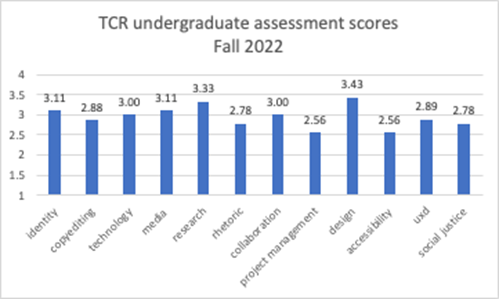
In fall of 2023, Drs. Avery Edenfield, Rebecca Walton, Chen Chen, Jared Colton, and Ryan Moeller of the Technical Communication and Rhetoric Assessment committee met to evaluate the work of graduating students in Technical Communication and Rhetoric. Six portfolios were evaluated. The portfolios are from 2022-2023. Faculty evaluated portfolios according to three literacies of the field.
Assessment Results
2020-21 Outcomes Data
Direct Measures
In fall of 2021, Drs. Avery Edenfield, Rebecca Walton, John McLaughlin, and postdoctoral fellow Dr. Calvin Pollak of the Technical Communication and Rhetoric Assessment committee met to evaluate the work of graduating students in the Professional and Technical Writing track. Six portfolios were evaluated. The portfolios are from 2020-2021. Faculty evaluated portfolios according to three literacies of the field.
This is the second year we worked with the new assessment form created by Dr. Ryan Moeller. For the second year, our assessment matched the assignments created. Rather than looking at portfolio projects as we have in the past, we used Dr. Moeller’s “Interview Preparedness Document” assignment, which asks students to answer typical interview questions. These questions correspond to our learning objectives (above).
Assessment Results
Exceptional: Evidence shows that the student has developed a high level of literacy.
Acceptable: Evidence shows that the student has developed an acceptable level of literacy the objective.
Marginal: Evidence that the student has developed this literacy is provided, but it is weak or incomplete.
Unacceptable: Evidence that the student has developed this literacy is not provided, is unconvincing, or very incomplete.
| Common Learning Objectives | Exceptional | Acceptable | Marginal | Unacceptable |
|---|---|---|---|---|
| Professional identity | 1 | 3 | 2 | 0 |
| Copyediting | 0 | 3 | 2 | 1 |
| Learning new technologies | 2 | 4 | 0 | 0 |
| Multiple media | 1 | 4 | 0 | 1 |
| Research | 3 | 2 | 1 | 0 |
| Rhetorical awareness | 0 | 2 | 3 | 1 |
| Collaboration | 0 | 3 | 2 | 1 |
| Project management | 1 | 1 | 4 | 0 |
| Information design | 1 | 2 | 2 | 1 (skipped) |
| Accessibility | 4 | 2 | 1 | 0 |
| User experience design | 2 | 1 | 3 | 0 |
| Social justice | 2 | 1 | 3 | 0 |
2019-20 Outcomes Data
Direct Measures
Having the flagship journal of the field of technical communication, Technical Communication Quarterly, under Dr. Walton’s leadership at USU has benefited students enormously. For example, students have access to a new student copy editing internship, which provides students practical copyediting experience and a byline credit in the journal.
Students continue to express appreciation for the project-based assignments, especially where they work with clients and/or produce work that impacts the broader community. Some highlights include document design projects with nonprofit organizations in Cache County, HTML coding projects for USU’s CIDI, and marketing projects for SAAVI/Title IX offices.
Preparedness Document” assignment, which asks students to answer typical interview questions. These questions correspond to our learning objectives (above).
Exceptional: Evidence shows that the student has developed a high level of literacy.
Acceptable: Evidence shows that the student has developed an acceptable level of literacy the objective.
Marginal: Evidence that the student has developed this literacy is provided, but it is weak or incomplete.
Unacceptable: Evidence that the student has developed this literacy is not provided, is unconvincing, or very incomplete.
| Common Learning Objectives | Exceptional | Acceptable | Marginal | Unacceptable |
|---|---|---|---|---|
| Demonstrates technological literacy | 5 | 4 | 2 | 1 |
| Demonstrates rhetorical literacy | 6 | 3 | 1 | 2 |
| Demonstrates ethical literacy | 6 | 2 | 4 | 0 |
Indirect Measures
Having the flagship journal of the field of technical communication, Technical Communication Quarterly, under Dr. Walton’s leadership at USU has benefited students enormously. For example, students have access to a new student copy editing internship, which provides students practical copyediting experience and a byline credit in the journal.
Students continue to express appreciation for the project-based assignments, especially where they work with clients and/or produce work that impacts the broader community. Some highlights include document design projects with nonprofit organizations in Cache County, HTML coding projects for USU’s CIDI, and marketing projects for SAAVI/Title IX offices.
2018-19 Outcomes Data
Direct Measures
In October 2019, Drs. Jared Colton, Avery Edenfield, Keith Grant-Davie, Rebecca Walton, John McLaughlin, and Ryan Moeller of the Technical Communication and Rhetoric Assessment committee met to evaluate the work of 12 graduating students in the Professional and Technical Writing track. The portfolios are from the Fall of 2018. Faculty worked in pairs to evaluate portfolios according to three literacies of the field.
Exceptional: Evidence shows that the student has developed a high level of literacy.
Acceptable: Evidence shows that the student has developed an acceptable level of literacy the objective.
Marginal: Evidence that the student has developed this literacy is provided, but it is weak or incomplete.
Unacceptable: Evidence that the student has developed this literacy is not provided, is unconvincing, or very incomplete.
| Common Learning Objectives | Exceptional | Acceptable | Marginal | Unacceptable |
|---|---|---|---|---|
| Demonstrates technological literacy | 6 | 2 | 3 | 1 |
| Demonstrates rhetorical literacy | 4 | 4 | 2 | 2 |
| Demonstrates ethical literacy | 1 | 2 | 5 | 4 |
Indirect Measures
Feedback from students about their experiences in the Technical Communication and Rhetoric emphasis continue to be very positive. Students appreciate that so many classes include project-based assignments in which they work with actual clients and/or produce work that affects the broader community beyond the classroom and often beyond the campus. In addition, students are proud of the intellectual work they do engaging with theory. Compared to years past, student feedback suggests that the curriculum is well balanced in addressing critical and applied work.
2017-18 Outcomes Data
Direct Measures
In January 2019, Jared Colton, Avery Edenfield, Zarah Moeggenberg, Rebecca Walton, John McLaughlin, and Ryan Moeller of the Technical Communication and Rhetoric Assessment committee met to evaluate the work of 12 graduating students in the Professional and Technical Writing track. The portfolios are from the Fall of 2017 and the Spring of 2018. Faculty worked in pairs to evaluate portfolios in light of three learning objects.
Exceptional: Evidence shows that the student has developed a high level of literacy.
Acceptable: Evidence shows that the student has developed an acceptable level of literacy the objective.
Marginal: Evidence that the student has developed this literacy is provided, but it is weak or incomplete.
Unacceptable: Evidence that the student has developed this literacy is not provided, is unconvincing, or very incomplete.
| Common Learning Objectives | Exceptional | Acceptable | Marginal | Unacceptable |
|---|---|---|---|---|
| Demonstrates technological literacy by ability to work with current technologies and to research and critique how users work with current technologies | 7 | 4 | 1 | 0 |
| Demonstrates rhetorical literacy by ability to select appropriate technologies for stakeholder and unique situations | 1 | 8 | 3 | 0 |
| Demonstrates ethical literacy, which is an awareness of the ethical dimensions of technical communication | 3 | 6 | 3 | 0 |
Indirect Measures
Feedback from students about their experiences in the Professional and Technical Writing emphasis continue to be very positive. However, like last year, we continue to receive some conflicting feedback from students re: opportunities to develop technology skills. On the one hand, students express concern that they need to develop additional experience with technology: for example, web design. However, in classes many students choose the least-technological assignment options and push back against assignments with required technological competencies.
2016-17 Outcomes Data
In November 2017, Jared Colton, Avery Edenfield, Keith Grant-Davie, John McLaughlin, and Ryan Moeller of the Technical Communication and Rhetoric Assessment committee met to evaluate the work of 12 graduating students in the Professional and Technical Writing track. The portfolios are from the Fall of 2016 and the Spring of 2017. Faculty worked in groups of two and three to evaluate portfolios in light of three learning objectives.
Exceptional: Evidence shows that the student has developed a high level of literacy.
Acceptable: Evidence shows that the student has developed an acceptable level of literacy the objective.
Marginal: Evidence that the student has developed this literacy is provided, but it is weak or incomplete.
Unacceptable: Evidence that the student has developed this literacy is not provided, is unconvincing, or very incomplete.
| Common Learning Objectives | Exceptional | Acceptable | Marginal | Unacceptable |
|---|---|---|---|---|
| Demonstrates technological literacy by ability to work with current technologies and to research and critique how users work with current technologies | 2 | 10 | 0 | 0 |
| Demonstrates rhetorical literacy by ability to select appropriate technologies for stakeholder and unique situations | 6 | 4 | 2 | 1 |
| Demonstrates ethical literacy, which is an awareness of the ethical dimensions of technical communication | 4 | 3 | 4 | 1 |
Indirect Measures
Feedback from students about their experiences in the Professional and Technical Writing emphasis continue to be very positive. However, because we were concerned at the lack of constructive criticism or suggestions for change in previous years, we intentionally solicited feedback in a planning meeting with students in the PTW capstone class. Students still appreciated the opportunity to shape their projects to their own professional interests, but many graduating students reported feeling unsure of their next professional goal, be it grad school or a career in industry. The majority of the respondents said they would feel more confident if they had more technology training.
2015-16 Outcomes Data
In November 2016, Jared Colton, Avery Edenfield, Keith Grant-Davie, John McLaughlin, Ryan Moeller, and Rebecca Walton of the Technical Communication and Rhetoric Assessment committee met to evaluate the work of 12 graduating students in the Professional and Technical Writing track. The portfolios are from the Fall of 2015 and the Spring of 2016. Faculty worked in pairs to evaluate portfolios in light of three learning objects.
Exceptional: Evidence demonstrates that the student has mastered this objective at a high level
Acceptable: Evidence shows that the student has generally attained the objective
Marginal: Evidence that the student has mastered this objective is provided, but it is weak or incomplete
Unacceptable: Evidence that the student has mastered this objective is not provided, is unconvincing, or very incomplete
| Common Learning Objectives | Exceptional | Acceptable | Marginal | Unacceptable |
|---|---|---|---|---|
| Demonstrates basic literacy in design, grammar and mechanical principles | 6 | 6 | 0 | 0 |
| Demonstrates rhetorical literacy by ability to select appropriate technologies for stakeholder and unique stiuations | 9 | 3 | 0 | 0 |
| Demonstrates ethical literacy, which is an awareness of the ethical dimensions of technical communication | 4 | 7 | 1 | 0 |
Indirect Measures
Feedback from students about their experiences in the Professional and Technical Writing track has been very positive, including praise for coursework that balances critical reflection and theoretical frameworks with hands-on application of skills. Students appreciate the opportunity to shape some of their projects to their own professional interests, and graduating students report feeling ready for their next professional goal, be it grad school or a career in industry. While we appreciate this positive feedback, the TCR faculty is a bit concerned at the lack of constructive criticism or suggestions for change garnered by our current approach.
2014-15 Outcomes Data
Direct Measures
Exceptional: Evidence demonstrates that the student has mastered this objective at a high level
Acceptable: Evidence shows that the student has generally attained the objective
Marginal: Evidence that the student has mastered this objective is provided, but it is weak or incomplete
Unacceptable: Evidence that the student has mastered this objective is not provided, is unconvincing, or very incomplete
| Common Learning Objectives | Exceptional | Acceptable | Marginal | Unacceptable |
|---|---|---|---|---|
| Demonstrates basic literacy in design, grammar and mechanical principles | 8 | 3 | 1 | 0 |
| Demonstrates rhetorical literacy by ability to select appropriate technologies for stakeholder and unique stiuations | 6 | 4 | 2 | 0 |
| Demonstrates ethical literacy, which is an awareness of the ethical dimensions of technical communication | 5 | 5 | 1 | 1 |
2013-14 Outcomes Data
Direct Measures
Exceptional: Evidence demonstrates that the student has mastered this objective at a high level
Acceptable: Evidence shows that the student has generally attained the objective
Marginal: Evidence that the student has mastered this objective is provided, but it is weak or incomplete
Unacceptable: Evidence that the student has mastered this objective is not provided, is unconvincing, or very incomplete
| Common Learning Objectives | Exceptional | Acceptable | Marginal | Unacceptable |
|---|---|---|---|---|
| Demonstrates basic literacy in design and grammar and mechanical principles | 6 | 5 | 1 | 0 |
| Demonstrates rhetorical literacy by ability to select appropriate technologies for stakeholder and unique stiuations | 3 | 7 | 2 | 0 |
| Demonstrates ethical literacy, which is an awareness of the ethical dimensions of technical communication | - | 6 | 3 | 3 |
2012-13 Outcomes Data
No data available for 2012-13.
2011-12 Outcomes Data
No data available for 2011-12.
2010-11 Outcomes Data
No data available for 2010-11.