
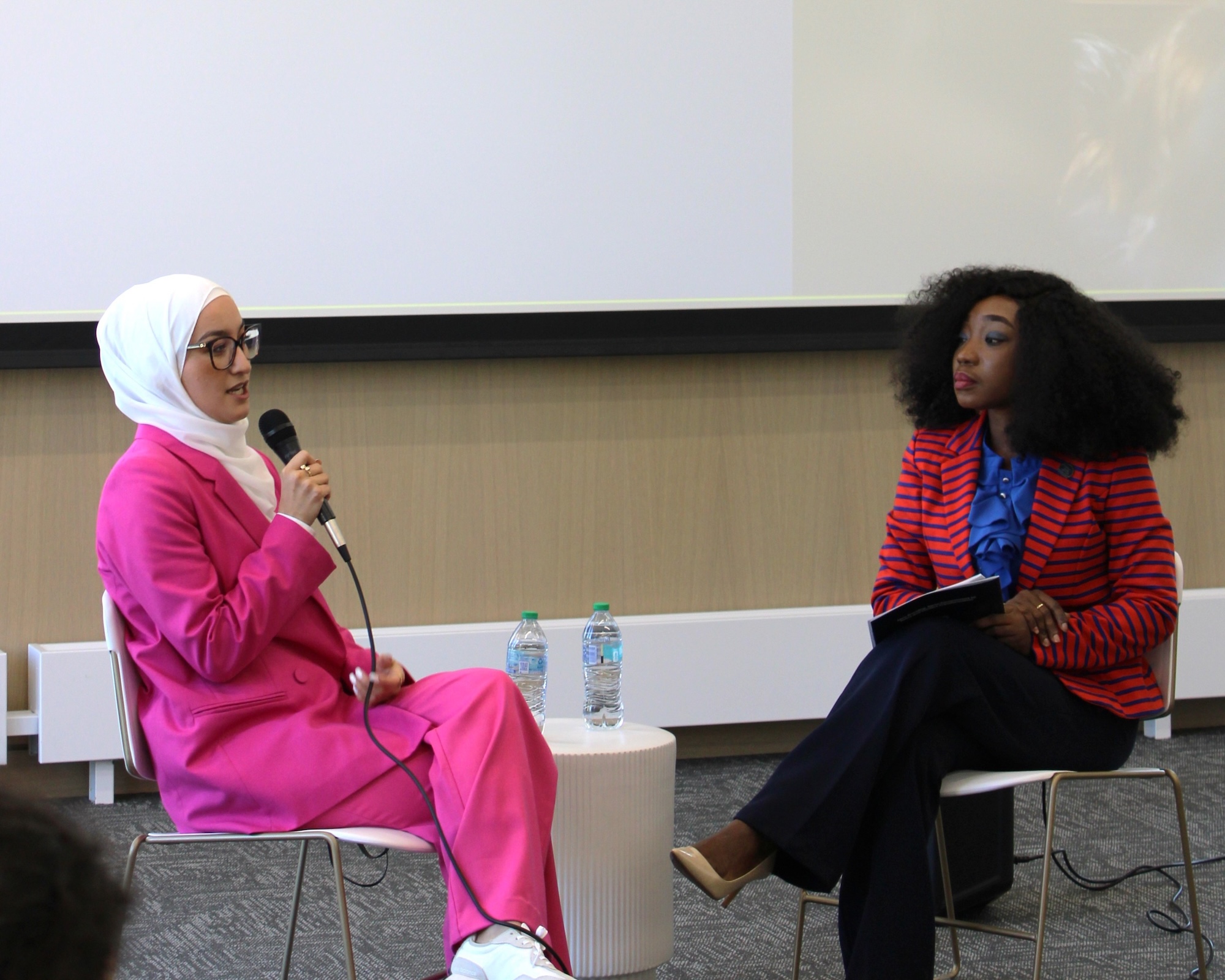
 Sveto Mohammad Ishoq and Prof. Lady Ajayi speaking at the Heravi Peace Institute Fall Tanner Talk
Change What You Can
Meeting Sveto Mohammad Ishoq at Utah State University
When I saw the flyers promoting the Heravi Peace Institute’s speaker event, “Afghan Women’s Voices in Exile,” I did not know what to expect. Arriving at the event, I happened to take a seat near the speaker, Sveto Mohammad Ishoq, a beautiful young woman in a strikingly cheerful pink pantsuit and white hijab. We struck up a conversation, and I was immediately put at ease by her friendly smile, easy laugh, and soft voice. You’d never guess that as a child, this girl had been forced to flee her home and live as a refugee in six different countries, or that she’d witnessed the deaths of her friends at the hands of the Taliban.
Sveto Muhammad Ishoq is an award-winning Afghan activist, women’s rights advocate, TEDx Speaker, and social entrepreneur who empowers women economically, amplifies their voices, and reshapes narratives about her country. Only 14 years old when she began her activism by authoring publications on women’s rights in Afghanistan, Sveto has since founded several organizations, including Ayat and Chadari, providing women with ways to make their own money in a system designed to keep them dependent.
Sveto had come to USU to present on a project she’d recently completed as a part of her fellowship with Kroc Institute for Peace and Justice at University of San Diego, in which she interviewed hundreds of Afghan women living in exile. She spoke passionately about their experiences, struggles, and strength, shedding light on a story that (I believe) few people in that room knew they needed to know. She inspired us. Better yet, she reminded me that a better world is possible, if we’re willing to work for it.
I don’t consider myself a pessimistic person. On the contrary, I’m forever looking on the bright side, reminding myself that “things will work out.” But the older I get, and the more I learn about the world we live in, the more difficulty I have had staying positive.
How can I possibly stay positive in a world where, in spite of an abundance of evidence and desperate calls to action, we continue to contribute to global climate change that could displace an estimated 300 million people due to rising ocean levels by 2050? We live in a world where one third of all food produced is thrown away, despite the 821 million people suffering from severe malnourishment. The top 1 percent owns more wealth than the bottom 95%, and nearly 50 million modern-day slaves produce everyday consumer goods in sweatshops, unseen and unheard by those who buy their products. The problems we face feel so big, so insurmountable, that it seems like all our efforts at fixing them are mere drops of water in a bucket full of mud. In such a world, it’s hard not to feel a little—well—hopeless.
But hopelessness leads to apathy, and apathy leads to inaction, and nothing is going to change if no one’s willing to act. Reading the news every morning, learning about the problems my generation will inherit, I desperately want to act. But how can I, an 18-year-old girl, hope to fix a world that’s so big, and so broken?
This was the question weighing on my mind the following morning, when I attended a follow-up meet and greet breakfast with Sveto. I had the opportunity to ask her a question that has been weighing on my mind,
“Sveto, what advice do you have for those of us who want to make a difference, but don’t know how?”
She didn’t hesitate for a moment before answering.
“When I was starting out,” she told us, “There wasn’t much I could do. I was just 14 years old, and I had no idea what I was doing. But I knew I wanted to make a difference. So, I started doing whatever I could. Volunteering, writing for local papers, things like that. As I went along, more opportunities emerged, and I was able to make more changes. If you want to make big changes in the world, start by changing what you can.”
I love this idea for its simplicity. It’s approachability. “Change what you can” is a much easier call to action than “change the world,” though, they’re the same call. All solutions must start somewhere. Why not here? Why not with you? With us?
I still get discouraged reading the news. But now, in the moments when real solutions feel so far away, I remind myself of the girl who started changing what she could, and by doing so made a lasting impact on a major scale, that might have felt impossible once. I think of the millions of people who get up every morning and spend their day making the world a better place by changing what they can. I remind myself that I, too, have the power to create change. We all do.
 Mohammad Ishoq presenting her research on Afghan Women Voices in Exile.

Meet Blithe!
Blithe Bigelow is an undergraduate student at Utah State University dual majoring in International Studies and Economics. She holds an associate’s degree in Spanish and is currently pursuing a certificate in Leadership and Diplomacy with the Heravi Peace Institute. Blithe is passionate about leading, learning, and connecting with people from all backgrounds. In her free time, she enjoys reading, backpacking, and composing music on the harp.