
Go to the Canvas course for this class to access Vocabulary and Grammar Drills, Vocabulary Quizzes, and Practicum and DIRT Quizzes.
Visitors from outside of USU, login using the USU Canvas portal to view these resources.
Rule 1: -bi- (seen sometimes as -bo- and -bu-) is the future tense sign.
Rule 2: -ba- is the imperfect tense sign.
I. Grammar
A. The Future Tense
In the present-tense system (present, imperfect, future), the Latin verb changes tense by the insertion of a tense sign between the base/thematic vowel and the personal ending. The future tense sign in Latin is -bi- (-bo 1s, -bunt 3pl), e.g.:
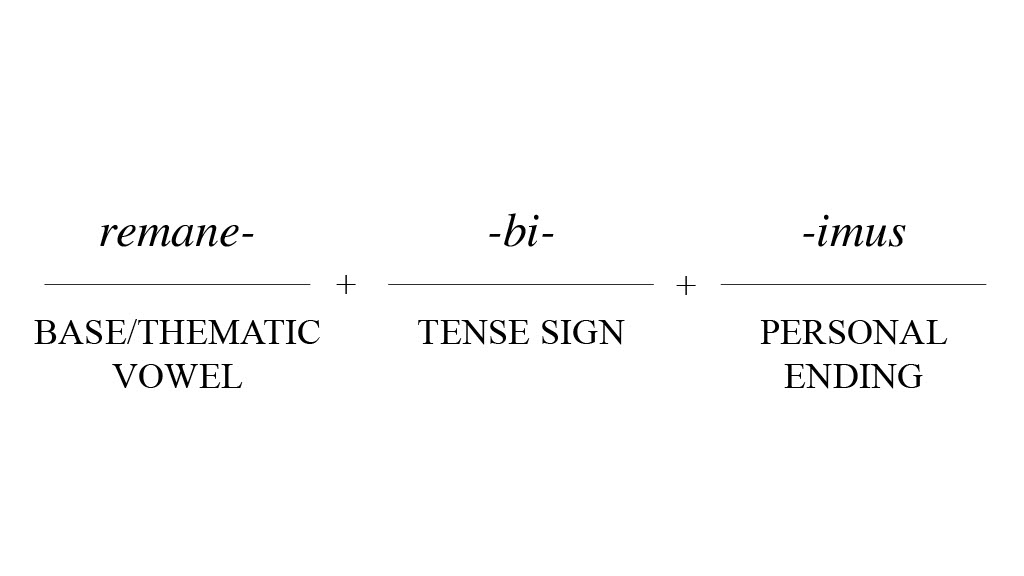
Note that Latin verbs reverse the order of components seen in English verbs.
- Latin: base/meaning + tense sign + person/number marker (e.g. serva+bi+t);
- English: pronoun (person/number marker) + tense modal + base/meaning (e.g. "he + will + save").
As with the present, there's more than one possible English translation for the Latin: "I will X, I will be X-ing."
B. The Imperfect Tense
The Latin future and imperfect tenses are formed in a similar fashion, except that the imperfect uses -ba- as a tense marker and is translated as "was/were X-ing, used to X, kept on X-ing, X-ed," e.g. remanebas ("you were remaining"), amabant ("they used to love"). The imperfect tense shows habitual, continuous or incomplete action in the past.
C. Handout
A practice handout for the future and imperfect tenses is available.
II. Adjectives ending in -er.
It's important to memorize whether or not an adjective which ends in -er in its nominative singular contracts, that is, whether it loses its -e- in its base, e.g. noster which contracts to a nostr- base. Each -er adjective must be memorized individually.
III. Vocabulary
animus: In the singular, animus means "spirit, soul," but in the plural it means "courage."
igitur: This conjunction is postpositive, meaning that the conjunction is "placed (-positive) after (post-)" the first word of a sentence. Note, however, that being postpositive does not always mean that the conjunction must be the second word of the sentence necessarily. It can be the second "word-thought," if the first word-thought is a group of closely connected words (e.g., noun + adjective, prepositional phrase, etc.). However and though function much the same way in English: "My sister, however, disagreed."
-ne: This particle is called an enclitic, literally a thing which "hangs on," a verbal particle attached to the back of a word. Latin -ne is attached to the first word of the sentence and signifies that the sentence will be a question. When -ne is attached to Non at the front of a sentence, the combination (Nonne . . .) serves the same function as English ". . ., isn't it?", expecting the answer "Yes". In contrast, Latin Num expects the answer "No" (see Wheelock, Supplementary Syntax, pp. 378-9).
propter: This preposition takes an accusative object.
satis: Satis ("enough") does not function as an adjective in Latin, but as a noun, and therefore, does not agree with a noun, as the English adjective enough does, e.g. enough money. Instead, Latin uses the genitive case after satis to complete its meaning, e.g. satis pecuniae, "enough (of) money." This type of genitive is called a partitive genitive, another important use of this case in Latin. Like nihil (Chapter 4), satis is indeclinable.
remaneo: The re- prefix is redundant, cf. English stay and stay behind.