
Celina Johnson - 2021
Artist's Statement
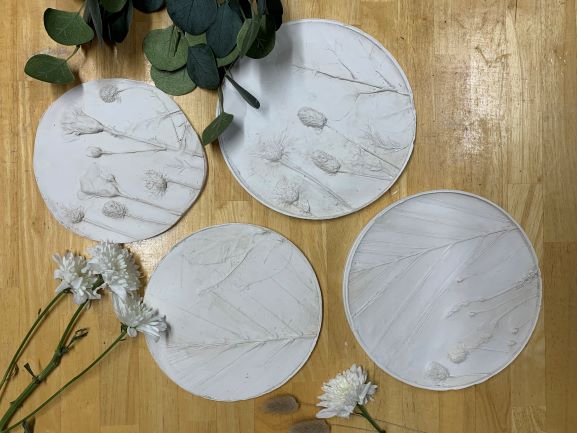
I chose to showcase Earth's natural beauty in a way that instills a sense of awareness into everyone who views the art. Many extinct species are discovered through fossils, and I relied on a similar medium to demonstrate the threat that our current pathway poses on the entire ecosystem and our human experience. I created these clay molds of herbs I grew at home as well as discarded flowers from the market to showcase the "Remains" of our planet as viewed from future generations. I first pressed the plants into clay to create the mold, and then I poured plaster into it to create the final products here. These pieces of art symbolize a memory of our healthy planet and represent the drastic extinction of species, down to even the weeds.
Along with these "fossils", I also wrote literary vignettes and poetry portraying both the beauty we know now and the future it faces. A literary vignette is a short, descriptive piece of writing that captures a brief period of time. These vignettes, although only depicting moments in time, tell the story of our environment as a whole. The first vignette illustrates the world as we could know it, if we were only willing to relinquish our stubborn habits. The white rose symbolizes purity, and the character leaves it to thrive, which represents the Earth/biodiversity remaining untainted by human hands. The other vignette and poems tell of the repercussions of our current customs. Because our society values beauty and material possessions above resolving societal crises and saving the beauty that suffers as a result of our impacts, I think it is powerful to appeal to those values by revealing the imposing threats on the beauty we pride ourselves in.
Poems & Literary Vignettes
Saving Grace
Take me to the days
where the fields were painted gold.
To the untouched plains
with natural grains
where the cows were left alone,
to graze on grass
among firm oak trees
in a place they call their home.
If only our tears could
replenish the sea
& each of our footprints
be poison free.
If our breath gave back
to the lives we took;
now let’s write a pure story
in the earth’s ending book.
How selfish to plead
for four more worlds
when we fail to take care of
this Earth undeserved.
The land is not ours—
we are simply guests here,
Stop giving Earth reasons
to make us
disappear.
Retribution
A planet born
only to die.
An endless greed
meets a fading supply.
One cannot blame
the world alone.
So plant a new seed
and set aside what you’ve known.
Speak for equality
the bees and the sea
which absorb corruption
between you and me.
Human nature refuses, denies,
and spreads hate.
But you can’t deny facts--
Human nature’s no match
for the nature
that cradles our fate.
If Humans Were Harmless
White roses emerge from cracks in the pebbled road, their buds lick the air like a child testing the waters with her big toe before plunging into the numbing depths. The roses, pleased with the worthy air, climb up their slender stems and out of the ground. Unparalleled in their beauty, I bend over to inhale the roses’ delicate scent and graze their velvet petals. My inhale becomes an exhale as I straighten my back to stand, releasing the resilient bloom. With one final glance, I leave the roses to waver in the breeze, bounding off one another in enchanting harmony.
On my left, blades of rich, green grass slice at the air, but not in the timid way they had before, instead with graceful force as if to remind us to tread mindfully across their home. The ripple of leaves in a forest of aspen trees reveals golden-tufted birds hovering above a morsel of honeycomb, aglow with droplets of fresh honey. I tilt my head back to glimpse the harmless culprits buzzing blissfully above me. My eyes wander to the now granite sky that traces the treetops; lush clouds threaten to release a rejuvenating rain and ample water for the verdant hills that shone like emeralds after even the slightest of rainfall. I near the end of the road where the pebbles meet a stream, billowing with ripples that resemble soft flower petals in the midst of a summer draft, just as the clouds shed their glassy raindrops. The land is rich with the aroma of
wild substance that hints towards prosperity.
Already damp, I wade through the stream, my pale linen dress trailing behind me beckons schools of fish to follow my bare toes through the transparent waters. Stepping out of the lukewarm water, I cross the threshold where countryside and city meet--but I’m not welcomed by heavy plumes of smoke or the drone of constant, industrious uproar; instead, I drift onto a path lined with monuments dedicated to flawed success, now engulfed in climbing moss and circled in thickets of abundant trees. Various species of bird nestle between the branches extending from forgotten windows, their light-hearted whistles echo through the silence creating the sense of an endless misty morning. Through a cascade of evolution forced by Mother Nature, the Earth reclaimed its diversity. The revival and newly refined environment sent emboldened insects, plants, and animals into swift recovery, and everything else fell into place. We escaped catastrophe to get here--Earth’s riches reached depletion and forced our habits into extinction in place of the natural world. Turning back to the haven we now nurture above all else, I inhale and think, how promising it is to live where roses grow aimlessly in the absence of fear.
Inevitable Downfall
I wept as I watched the sun go down behind the barren, god-forsaken mountains, afraid it would never rise again. My eyes refused to pull away in light of a greater fear: that I would take for granted the beauty that rested in this fleeting moment. I almost couldn’t see the sun’s descent through my cloud of tears, and the rays were no match for the hazy sky. I sit motionless on a wilted patch of grass among stumps of trees on the hillside until the moon rose to take the sun’s place. Darkness veils the desolate land and masks the filthy air, and I breathe a sigh of relief, disgusted to know that I’ve inhaled the now invisible gloom. The idiosyncrasy of this nation is growth and smoke. It rolls sullenly in slow folds from the great chimneys of the iron-foundries, and settles down in black, murky pools on the tainted streets. I finally pick up my heavy feet and rise from the patch of grass I labeled as my own to trod down the once-abundant hillside. One cricket performs a frail chirp, then dissolves into the dismal atmosphere with everything else we’ve released or destroyed. Does the human race feel accomplished at the notion? Satisfied at the idea that we’ve managed to eradicate even the sounds known to enhance the solace of summer nights?
Moonlight hovers over my shoulder, illuminating the realities I can no longer ignore. Near the dried up stream, a young mother rocks back and forth, grasping her bruised knees with one arm and her two fragile children with the other. Even their innocence fails to blind them from our doings. Tear stains line her cheeks and reveal sunken ivory skin beneath the dark grit that cakes her face. It would appear that poverty no longer discriminates. She appears to believe that the sun will remain below the horizon, a blessing in disguise that shields her children from glimpsing her hopeless eyes, empty of everything but tears. How does loneliness still plague us in such overpopulated areas? The constant natural disasters remind me that the Earth is still fighting a war we provoked. Stopping in my tracks, I drag my gaze across the cracked, degraded land between capitalist structures that forced us--paraded us--into this chaos, and I realize that an ecosystem kept us company for so long but went unappreciated by too many.
The next morning, I wake to silence and, somehow, the sunlight pours down relentlessly still, without mercy, no matter how many have perished beneath its rays. But we cannot blame the rays. Unlike us, the sun has remained steady in its path, giving no more and no less, fulfilling its natural obligation. I dream of the day we become as the sun, not in the suffocating way that we are now, but in fulfilling our own obligations. Otherwise, our pain and sorrows will only end with the Earth’s demise.