
Danelle Steele - 2022
Artist Statement
My motivation is mostly to explore what this art has to say about climate change and how it is effective. I wanted to see how climate change and all its results were portrayed and how this art affected how we see climate change.
Essay: An Exploration of Art on Climate Change
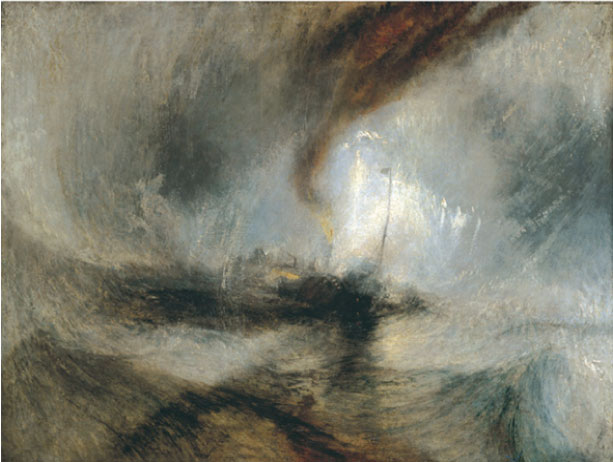
Climate change has become an exigent part of our daily lives. Our surroundings affect nearly every decision we make and our climate is in great need of saving. To someone who does not have a large platform or much scientific education, this can feel like a losing game. How can anyone help if they do not have the scientific skill to make real change to the circumstance? However, something that large necessitates action. Artists have been addressing climate in their work for years. In 1842, JMW Turner created Snow Storm — Steam-Boat off a Harbour’s Mouth, a painting that depicts a boat in a turbulent storm.
In 1939, John Steinbeck published The Grapes of Wrath, a novel about a family leaving their home to flee from drought and the dust bowl. Jan de Bont directed the 1996 film Twisters, which follows two storm chasers who must create a weather alert system. In 1723, Vivaldi presented The Four Seasons, a group of concertos about the seasons of the year. All this to say that art has been influenced and affected by weather and climate for as long as art has been created. Climate is a massive influence over our lives, so naturally, it plays a large part in the art we create. While not everyone can make scientific additions to conversations about climate change, it is much easier for some to put their thoughts into words, to music, or in a form of physical art. Throughout this paper, we will discuss recent media that addresses climate and its effect on both people and the planet.
Just as climate can have a large impact on art, art can have an impact on climate. In recent years, there has been a focus on art that discusses climate change. While this might not seem as productive as scientific additions to climate change discussions upon first glance, it does have merit and plays an important role in this situation. Art that focuses on climate change can bring awareness to people who may not know as much about the subject and all its accompanying issues. Art, perhaps something like a movie, is far more accessible than an academic article; not only is it more likely to appeal to more people, but the medium is much easier to understand for someone who might not feel comfortable reading a more advanced academic piece. This opens the discussion to more people and ultimately brings about more awareness. Asking an audience to grapple with the state of the world can be difficult, and though art is a medium much less trusted or accredited than something like an essay or a study, it is a great starting point. There have been many different movies, books, musical performances, and more inspired by climate change. In this essay, I would like to discuss a few examples of art based on climate change and highlight both their main points or themes and their importance in the climate discussion.
As one of the most popular art forms in our society, film is a great medium to both discuss climate change and garner a large audience. Naturally, people feel deep connections to movies because they are so personal and visual. A viewer may feel that they can relate to a character in a movie and watching them deal with detrimental effects of climate change makes it far more personal than reading about it. As such, there have been many movies that are about climate change or act as an allegory for climate change.
One recent and popular example is Don’t Look Up, directed by Adam McKay. The movie follows two astronomers who must go on a media tour to warn citizens of an impending comet. The 2021 film faced controversy after its release. While some viewers disliked the movie and found the message heavy-handed, others suggested that the movie is a perfect parallel to the current climate change situation. In Don’t Look Up, the protagonists struggle to share news of the comet almost entirely because people do not want to believe; although the science points to a comet, many claim that the astronomers behind the science are histrionic. Everyday people do what they can to help, but it is ultimately futile. The media, those who control the discussions and the information, actively push against this science, spreading misinformation to people who consume their content and turning their viewers against the science as well.
Many critics of this film claimed that not only was the metaphor overbearing, but the story itself was not realistic. Surely, they claimed, if such a fate lay ahead, everyone would do what they could to change it. However, when we contrast this movie to our current situation, the satire almost hits too close to home. Climate change, though the evidence has proven it time and time again, is still commonly denied by many. In fact, only 62% of people believe that climate change affects their communities (Funk, 2019). While it might be true that climate change affects some communities more than others, it is clear that it affects every part of the planet.
Interstellar is an example of humanity searching for a solution in the middle of a climate disaster. Christopher Nolan’s 2014 film follows Cooper, a father who leaves earth in search of a new planet for humanity to inhabit. Earth has become barren and though humans have survived, there is not much plant life and there is little oxygen available. The family farms, which is difficult in near-unlivable conditions and the constant dust storms. This film addresses a common—and highly unrealistic—climate justification. Many are convinced that despite our destruction of the earth, that humans will find a way to survive. Interstellar looks at these humans that survived and questions their quality of life. Was it worth it to survive only to be forced to live on a planet that cannot sustain you well, or almost at all? The characters must fight to survive and find a living, and while it is normal to them, the experience is shown to the audience as miserable. This film asks its audience whether or not an existence in which you are merely surviving is appealing, or worth it. Perhaps humans could survive a climate disaster, but this movie asks us whether or not that might be something we would even want. It invites its audience to engage in deeper thinking through the character’s plight; how did the planet get to be so unlivable? What are they to do about it? How might they affect the planet they inhabit next? It urges us to consider our own circumstances and how far we are away from a planet that looks something like the earth in the film.
There have been many fiction novels written about the climate crisis. The Sea and Summer was originally published by George Turner in 1987. The novel follows the Conway family as they lose their wealth and must survive rising sea levels, rising temperatures, and the failing agriculture of their climate. Turner published this book before climate discussion was as widespread as it is now, though it feels surprisingly contemporary and not all that unrealistic. In the postscript, Turned writes, “We talk of leaving a better world to our children but in fact do little more than rub along with day-to-day problems and hope that the longer-range catastrophes will never happen. Sooner or later some of them will… The Sea and Summer is about the possible cost of complacency.” The author’s commentary on the book is perhaps as important as the book itself. The condemnation of complacency is exactly the place climate activists come from; complacency and ignorance are some of the largest issues in climate acceptance in the general public. If they do not outright deny it, many assume that someone else will find a solution to the problem and continue their lives.
Six years later, Octavia Butler published The Parable of the Sower. Butler remains one of the most influential science and speculative fiction writers to date. Published in 1993, her novel is set in 2024 in a politically unstable United States. Climate change plays a large part in the societal unrest in the novel. Often, climate change is painted in a way that only highlights the physical effects on both the planet and its inhabitants. Butler, however, theorizes on the social and political effects of climate change. The poverty, wealth inequality, and the effect of corporations on the population. This is effective because it puts climate change in a new point of view that not many have considered through literature. It makes the book and, consequently, the crisis, seem so much more personal and realistic.
Another great fiction exploration of climate change is the 2014 novel Annihilation by Jeff VanderMeer. Annihilation follows four women, each with their own specialty, who set out on an expedition; the climate of the area in which they must explore is unlivable and in a complete state of ruin. Annihilation works as a parable of the unsustainable way we treat our planet and the inevitable effect of our carelessness. The near-unrecognizable environment of the novel is a very real possibility, including the mutated species and the harsh climate.
Diane Cook’s debut novel, The New Wilderness, was released in 2020. Perhaps the most scathing of any of the books discussed, the novel follows a mother’s attempt to save her daughter from the unsurvivable conditions of climate change. Bea’s daughter is affected by the smog and pollution of their city; they must travel to an untouched expanse of land in order to save her daughter’s life. This dystopian novel offers an unflinching look at the current realities of climate change. Flooding, wildfires, pollution, and more are serious threats to lung health and all are results of climate change. These are already real issues for people that can affect lung health. While the prospect of finding untouched land might not be as realistic, the set-up of the novel is a very real problem.
Finally, the newest of the novels offers a look at a near-future in which climate catastrophe has ravaged California. Alexandra Kleeman’s Something New Under the Sun is a story of a director who travels to California only to find it razed by wildfire and drought. Kleeman’s narrative condemns the phenomenon of ‘alternative facts’ and complacency of those in power. While each of them play with different elements, genres, characters, and more, each of these books serves the same purpose. The novels discussed force their audiences to sit with the discomfort of climate change and acknowledge the part humans play in it.
While film and fiction are much more digestible forms of art, especially about something as difficult as climate change, physical art can be much more difficult to understand. However, the visual aspect of art can be much more impactful. Climate change is an increasingly common subject in art, inspiring paintings, sculptures, performance, or entire exhibits.
One fascinating example is Unmoored by Mel Chin. In a New York Times article that features the app, Zoë Lescaze writes, “Those who download the app and look up through their phones in Times Square can experience an incoming flotilla of boats of all kinds make its way around existing buildings and create a nautical traffic jam above…Enlarged forms of plankton appear and seem to seek connection with the human audience. Because augmented and mixed reality formats use the real world as backdrops, inserting an apparition of the future on devices puts a phenomenological experience into the hands of the individual.” The nature of this app makes the inevitability of rising water levels a reality to its users, and offers users an opportunity to consider the consequences of such a possibility.
Another interesting piece is Olafur Eliasson’s 2014 Ice Watch. Eliasson has created many pieces with strong environmental undertones, and Ice Watch is perhaps one of the most moving. The Icelandic artist transferred 30 blocks of glacial ice from his home country to London in front of the Tate Modern. The public were urged to physically interact with the ice before it melted and was gone. The interaction with actual glacial ice and the ability to watch it disappear is moving and brings a very personal element into one’s thoughts on climate change. For many, melting glaciers can seem like a problem that is so far removed from their everyday lives and therefore, hardly their problem. Bringing it closer to home is an incredible way to ask people to think harder about what melting glaciers actually means and how it can affect them.
Last, photographer Edward Burtynksy focuses on the effect of humans and industry on the planet. Often, we discuss climate change in terms of how everyday people can help. However, the majority of damage to our planet comes from corporations and industrial work. Burtynsky uses his large-scale photographs of industrial landscapes to show the audience the massive scale in which these things take place; the sheer size of many of these sites forces the viewer to grapple with the possible consequences of such work.
To finish, I would like to discuss some pieces of music that have shed light on climate change. Perhaps one of the most notable examples of popular music that discusses climate change is Joni Mitchell’s “Big Yellow Taxi.” Originally recorded in 1970, the song was inspired by a vacation the singer took to Hawaii. The song, a gentle pop ballad, laments the commodification of land. In the chorus, Mitchell observes, “Don't it always seem to go / That you don't know what you got 'til it's gone / They paved paradise, and put up a parking lot.” Though the words were written nearly fifty years ago, they seem perfectly in place in our current world. Our world, overrun by cities, golf courses, and, of course, parking lots, seems increasingly disinterested in preserving the land as it is. When asked about the song, Mitchell told the story of her first trip to Hawaii; she describes looking out her window in the morning and seeing the lush green green hills and the wildlife and how it contrasted so starkly with the parking lots and tourism.
Only a year after Mitchell’s “Big Yellow Taxi” was recorded, Marvin Gaye released “Mercy Mercy Me (The Ecology).” Gaye’s soulful song ponders the change of the Earth and its inhabitants. He considers the recklessness with which we treat our planet, asking, “How much more abuse from man can she stand?” The upbeat R&B melody betrays the hopelessness of the lyrics; Gaye cites the polluted water, overpopulation, and pollution. The imagery in this song, if the listener is paying attention, paints a haunting picture of a planet only deteriorating. Instead of a call to action, the song only brings the listener’s attention to these problems.
Later on, Dead Kennedys made their own response to climate change and the complacency of those in power. The San Francisco based punk/rock band are known for their political and satirical commentary in their music, and “Moon Over Marin” is no exception. The 1982 song discusses the inevitable future of Marin County, an upper class neighborhood in California. The commentary of the deteriorating beach begins with, “Another tanker's hit the rocks / Abandoned to spill out its guts / The sand is laced with sticky glops.” The carelessness of humanity is very much to blame for the ruined beaches. “I squish dead fish between my toes / Try not to step on any bones.” The ecological collapse of the ocean is merely an inconvenience for someone so detached from the realities of climate change; this is viewed as normal to the subject of the song, offering the listener a grave look into the future.
Perhaps more than pop music, orchestral and choral music takes great inspiration from nature. Climate-themed concertos are incredibly popular. Much like Eliasson’s Ice Watch, Sean Shepherd’s Melt is largely inspired by glacial melting. With four smaller sections entitled “Frozen,” “Drowing,” “Liquid,” and “Final,” Shepherd moves his audience through a linear story of the melting glacier from a bystander’s point of view. On this piece, Shepherd comments, “the piece might be heard as program music – a musical melting, chaos, and reformation in an altered state – or, in purely emotional terms: an exploration of feelings about these lands I have known my whole life” (Shepherd).
Art about climate change is only growing in popularity as the issue becomes larger. The change in our climate is impossible to ignore, not just because it is expressed in art everywhere, but because it affects our daily lives and our futures. Art about climate is vital; it serves to educate the public about the real and terrifying future we face in an unsteady climate. While this education can be deeply uncomfortable, scary, or hard to believe, it is the first step in taking action. Watching characters in these movies or books, or listening to music about climate change can be a starting point for many to learn more. Not only that, many of these pieces work as a call to action against climate change. They urge their audience to be more mindful of how they treat their surroundings and how to be critical of those in power and how they handle these issues. Most importantly, these works make our situation personal. They bring the issue of climate change closer to home and ask the audience to imagine themselves in these situations. To the untrained eye, art may not seem as valuable an addition to the conversation as science, but art about climate change is as inextricably important as the science. Art on the climate crisis is for those who may still be dreaming up a solution.
Works Cited
Burtynsky, Edward. “Highland Valley #8.” The Guardian, 15 Sep 2016, www.theguardian.com/artanddesign/2016/sep/15/edward-burtynsky-photography-interview.
Dead Kennedys. “Moon Over Marin.” Plastic Surgery Disasters/In God We Trust, Inc. Decay Music, 1985, track 14.
Funk, Cary, and Meg Hefferon. “U.S. Public Views on Climate and Energy.” Pew Research Center Science & Society, Pew Research Center, 12 July 2021, https://www.pewresearch.org/science/2019/11/25/u-s-public-views-on-climate-and-energy/.
Gaye, Marvin. “Mercy Mercy Me (The Ecology).” What’s Going On. UMG Recordings, 1971, track 6.
Lescaze, Zoë. “12 Artists on: Climate Change.” The New York Times, The New York Times, 22 Aug. 2018, https://www.nytimes.com/2018/08/22/t-magazine/climate-change-art.html.
Mitchell, Joni. “Big Yellow Taxi.” Ladies of the Canyon. Reprise records, 1970, track 10.
Shepherd, Sean. “Melt.” Boosey & Hawkes, www.boosey.com/cr/music/Sean-Shepherd-Melt/103360.