
Lisa Gabbert Publishes The Medical Carnivalesque
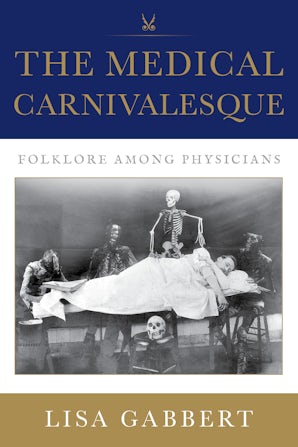
The Medical Carnivalesque
Lisa Gabbert, professor and Director of the Folklore Program at USU, recently published her book, The Medical Carnivalesque. Lisa describes her book as “a study of the occupational folk culture of physicians.” She focuses on how physicians speak to each other informally, and how this dialogue can be funny and subversive despite the serious nature of their work. The main argument of the book is that medical folklore and humor is similar to the term conceptualized by Mikhail Bakhtin: the carnivalesque.
Bakhtin defined the carnivalesque as a literary or cultural mode that subverts expectations of the style or atmosphere through humor and chaos. The Medical Carnivalesque explores the connection between the carnivalesque and the world of medicine, with each of the main chapters focusing on fundamental aspects of the carnivalesque. Lisa says: “There is a chapter on death, dying, and anatomization of the body in which I examine folklore that arises in gross anatomy classes. There is also a chapter on the patient body as expansive and transgressive, which resists physician attempts to control and medicalize it. The last chapter is about the stereotypes and wisecracks doctors make about other doctors, which I frame as being about the contingent nature of truth/knowledge. A good portion of the book also examines physician training and work, and I illustrate that this training and work contributes to a pervasive context of suffering within the institution of medicine. I think it ultimately underlies the carnivalesque nature of physician folklore. In short, it’s a book that touches on the relationship of laughter and suffering.”
The project has been almost 25 years in the making, beginning when Lisa’s husband started medical school at the same time she was starting her PhD. He started bringing home examples of the folklore from his time in school, and the project eventually grew. Lisa thought about the project for a while but fully immersed herself in it in 2019 after receiving a fellowship with the American Folklife Center. She comments, “I became much more interested in it when I started to realize that the practice of medicine was quite fraught and that doctors themselves were fundamentally affected by their training and practice. Plus, the examples are quite intriguing!”