
Shane Graham Gives Lecture Tour of South Africa
Shane Graham Gives Lecture Tour of South Africa
Shane Graham, professor of English literature, recently delivered a lecture at five major universities in South Africa. His talk focused on the ongoing legacy of African American writer Langston Hughes in South Africa, as seen in two recent South African texts that feature Hughes as a fictionalized character.
Shane did his doctoral research on and in South Africa, and then spent a year in Johannesburg in 2004-2005 on a postdoctoral research fellowship, during which time he wrote his first book, South African Literature after the Truth Commission: Mapping Loss (2009). With his second book, Cultural Entanglements: Langston Hughes and the Rise of African and Caribbean Literature (2020), Shane expanded the scope of his research to include African American and Caribbean literature, particularly Langston Hughes’s connections to and influence on writers throughout Africa and the diaspora. Hughes’s close connections to a number of South African writers in the 1950s and 1960s were central to this project.
Shane’s new paper builds on his work in Cultural Entanglements and brings it into the twenty-first century with a focus on two very recent texts. The play Bloke and His American Bantu by Siphiwo Mahala was first produced in 2022, and will soon be published by Wits University Press, with a foreword written by Shane. It dramatizes the real-world friendship between Hughes and Bloke Modisane, who first exchanged letters in 1960 and met in London shortly thereafter. Shane argues that the play shows how much the relationship meant to both men, and how they established bonds of solidarity across the boundaries erected by apartheid and Jim Crow.
The novel How to Be a Revolutionary by C.A. Davids, published in 2021, likewise features Langston Hughes as a character. Several of its chapters consist of fictionalized letters inspired by the real correspondence exchanged between Hughes and Richard Rive beginning in 1954. Shane argues that, like Mahala’s play, How to Be a Revolutionary reveals the political and cultural significance of these transnational entanglements. But it also shows the challenges of maintaining Black internationalism against the backdrop of segregation, redbaiting, and the Cold War. Shane concludes that ultimately, complicity in those systems is the other side of the coin of transnational solidarity.
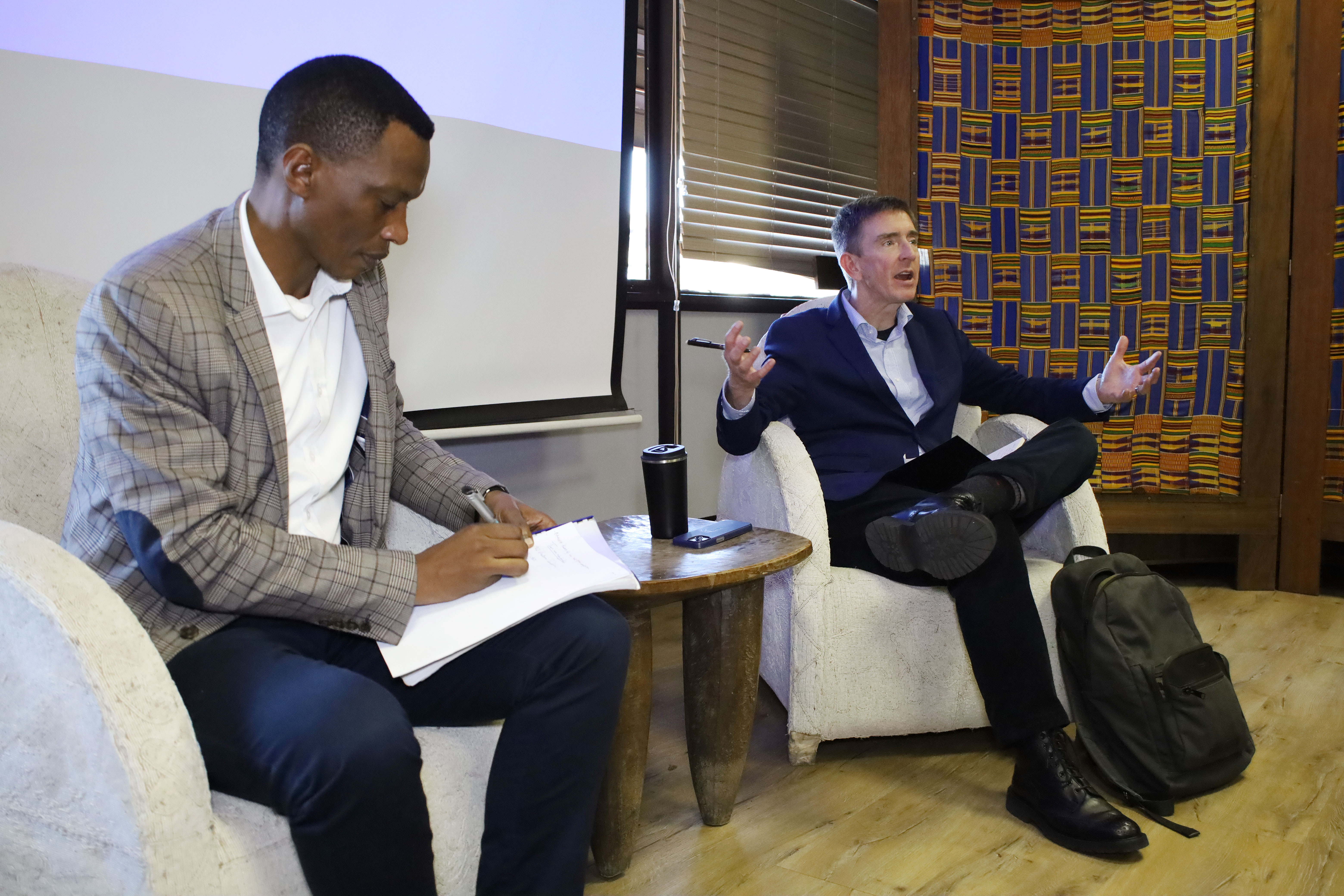
Shane delivered his talk in seminars at the University of Pretoria (April 30), the University of Johannesburg (May 2), the University of the Witwatersrand (known as Wits; May 3), the University of Cape Town (May 7), and Stellenbosch University (May 9). At the University of Johannesburg, his discussant was none other than Siphiwo Mahala, who, besides authoring Bloke and His American Bantu, is one of South Africa’s foremost playwrights, novelists, short story writers, critical biographers, and literary scholars. Shane says, “In twenty-five years as a scholar, I’ve never given a paper on a text while the author sat ten feet away! It would have been intimidating except that Siphiwo was so hospitable and welcoming. We’d been emailing back and forth for over a year, and we’d met for tea the day before, so it felt like having an old friend attend my seminar.”
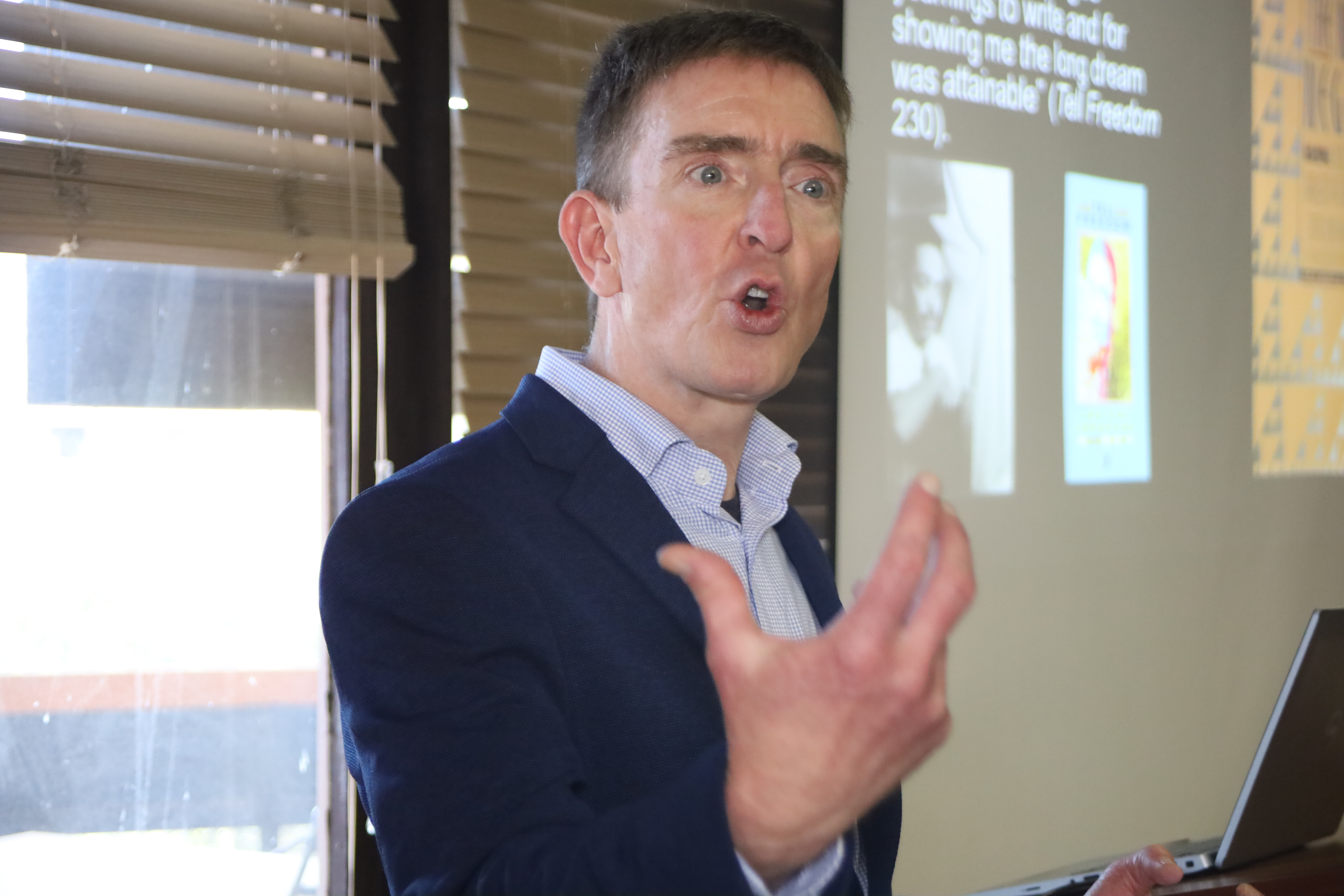
At Stellenbosch University, Shane’s discussant was Professor Uhuru Phalafala. Shane remarks, “Uhuru is one of the world’s leading scholars on connections between Africa and the United States, so she was the perfect person to act as respondent. I was honored to have her serve in that role, and grateful for her feedback on my work-in-progress.” And while he was in Cape Town, Shane met the novelist C.A. Davids, whom he describes as “incredibly gracious and just as delightful a conversationalist as everyone told me she would be.”
Shane considers the lecture tour to have been a great success, and calls the whole trip a kind of homecoming. “Between 1999 and 2008, I visited South Africa a half dozen times, and those visits added up to almost two years. It was my second home.” Then, as his research moved on to Langston Hughes and Caribbean literature, he had fewer opportunities to visit South Africa, and “somehow thirteen years went by since my last visit in 2011. So, this trip was long overdue. And it was overwhelming in the best ways: seeing old friends and making new ones, having stimulating conversations with world-famous experts and promising graduate students, seeing how the country has changed.” He also notes that he and his wife Christie climbed Table Mountain, canoed the Sundays River, and saw some amazing birds and a whole lot of elephants. “I fell in love with South Africa all over again,” says Shane.
Shane thanks USU’s English Department and the Center for Intersectional Gender Studies and Research for underwriting some of his travel expenses.