
Alum AJ Romriell Book Launch and Reading

English Department alum, AJ Romriell, is visiting USU on Thursday, March 6, 2025 at 12 p.m. to read from his forthcoming memoir, which will be published February 18, 2025, Wolf Act, a series of linked personal essays that explores his journey through reconciling religion and sexuality while weaving in wolfish fairy tales and mythology.
AJ started writing the memoir nearly ten years ago as an undergraduate at USU. The oldest essay in the memoir, “Gracious Ruin,” was written in Jennifer Sinor’s advanced creative nonfiction course. “When I first started writing Wolf Act, I didn’t know it was a book I was writing. I was just writing essays about my experiences, harnessing creativity in a way of processing trauma,” AJ reflects. “But over the years, the essays piled up, and when I was finishing up my master’s at USU in 2021, I decided to throw all them together and see if there was a book lying somewhere in the chaos. To my honest surprise, I immediately saw patterns in my work — religious trauma, struggles with understanding sexuality, a history of hiding and lying, and, of course, the image that bound it all together: wolves.”
After compiling the essays, fitting them together, and filling in gaps, AJ sent the manuscript to the Utah Original Writing Competition and won the full-length nonfiction book category. “While it still took many more years of revision and reshaping before it was contracted for publication at that point, I finally accepted that I had something I needed to see through, a book that needed to be written, and I wouldn’t stop until it was,” AJ says.
AJ’s gravitation toward fairy tales and mythology stemmed from the idea that they teach us about good and evil, much like religion does. “In these stories, roles tend to be fairly straightforward — a childlike look at the world. But reality is much more complicated. We all do good and bad. We all hurt and heal,” AJ comments. “As I thought through these stories in adulthood, I started to question things (and write about them): What if the wolf wasn’t the villain?”
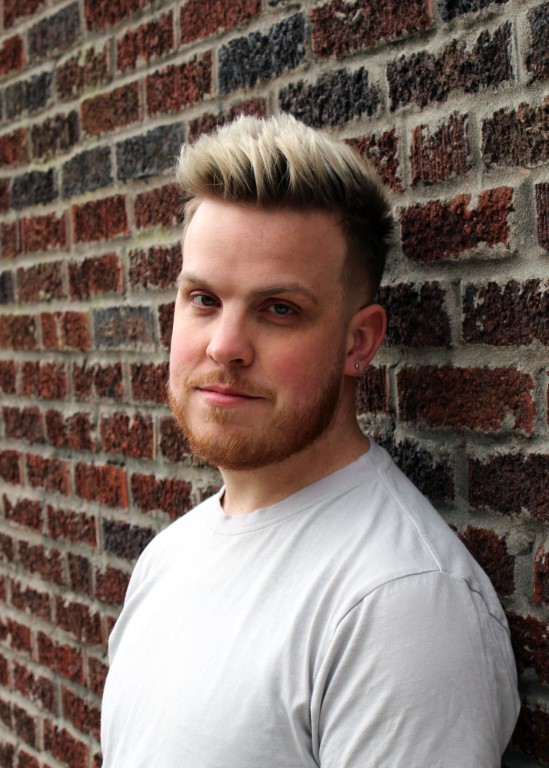
Wolf Act explores AJ’s religious mission, from which he came home early because of depression resulting from his lack of acceptance about his own sexuality. After coming back, he saw a video as part of the Trevor Project called “It Gets Better at BYU,” where queer and allied BYU students shared their stories of being closeted and coming out. AJ says, “It was only through hearing their stories —and realizing how alike they were to my own — that I finally began the journey to accept myself. Their stories saved my life, and Wolf Act has become my way of paying that forward.”
For future writers, AJ shared the wisdom his dad told him whenever he felt defeated: “You are going to make it because you are not going to stop until you do.” AJ implores future writers to take chances and keep submitting work, even if they don’t think it will get published. “It’s okay to be afraid,” he says. “It’s going to feel impossible at times. That’s what art is, but you can’t let that stop you from trying. Put in the work. Be humble. Be proud. Be vulnerable. Listen to the critiques of others. Learn from them, take what makes sense, and let the rest be. Stay true to yourself. Celebrate the success of others. Shun envy. Keep your hands open to every opportunity. Dream big. Take risks. Let yourself feel afraid, and then do it anyway. And please, never stop trying. Never stop writing. I promise you, great things will come.”
AJ’s reading of Wolf Act at USU marks a return to the place where the whole journey started. “To be coming back, to read that very work, and to read it alongside Jennifer, feels full-circle. I’m excited to see familiar faces, and I’m excited to see the new generation of students coming through the program that made me so much of the writer I am today. It’s a return to home for me, and I couldn’t be more ecstatic,” he reflects.
For future readers or reading attendees, AJ acknowledges there might be different perspectives. “What I share is what I have experienced, both good and bad, and sometimes this means the reader might feel a bit of discomfort. That’s okay; I wasn’t comfortable either. What I wrote is simply my perspective on events and ideas. When it comes to realms of memory and experience, that’s all we can do,” he says. He also acknowledges the writing not moving chronologically, which might leave readers feeling a little wobbly in terms of time. “That’s how my mind works. One thing makes me think of another that makes me think of another — and on and on. Our lives are a big amalgamation of moments that alchemize into who we are.” His last word to readers or attendees is this: “Lastly, and most importantly, thank you for reading!”
The English Department is excited to welcome AJ back to USU for his reading and to congratulate him on his publication!