
Farm Literature Celebrates Ten Years on UPR
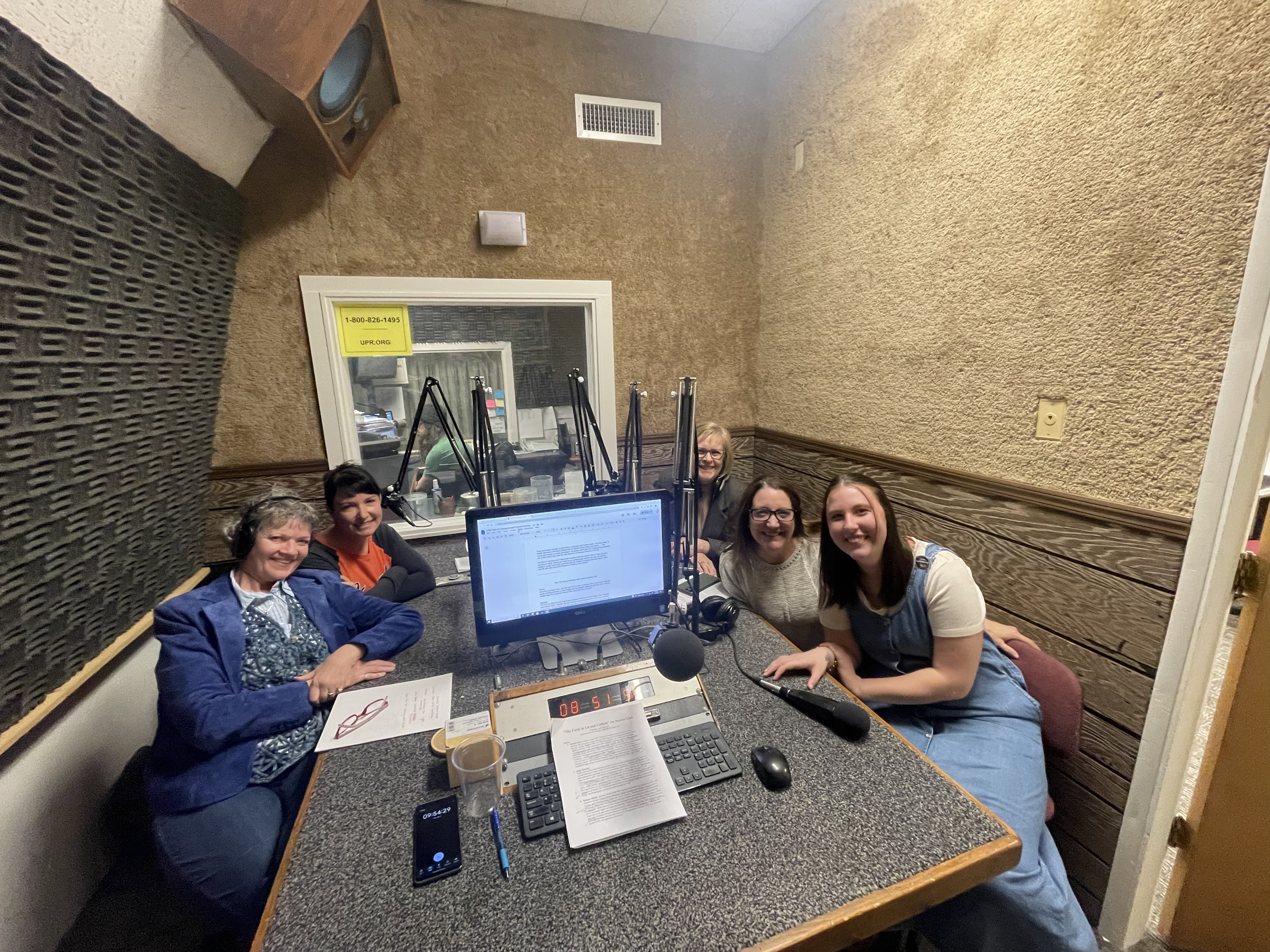
On April 3, 2025, ENGL 3630: The Farm in Literature and Culture was featured on Utah Public Radio’s show, Access Utah. English Department instructors Bonnie Moore, Rosa Thornley, Deanna Allred, and Lynne McNeill were joined by undergraduate EmmaLee Folsom to discuss the decade of the course and the impact it’s had at USU.
ENGL 3630 was started by Professors Emeritus Joyce Kinkead and Evelyn Funda. They taught sections of the course and, with Lynne, created the book FARM: A Multimodal Reader. Now, the course is taught by Bonnie, Rosa, and Deanna with the intention of examining how the farm is culturally represented and portrayed in media and literature.
“It’s interesting that we teach 4-5 sections of this course each year and we never have difficulty filling the courses; students engage with the ideas of the farm and farming and the cultural capital that goes along with those ideas,” Bonnie comments. “We have students from every major across campus—engineering, accounting, business, geology, music, journalism, English, and of course, many Ag-related majors—who enjoy the course.”
In the interview, Lynne recognized the course as a “living entity” that has the “capacity to be responsive to the students who take it.” She noted that “students have changed it and shaped it” and that “that is the hallmark of a class that can connect with students.”
EmmaLee took Farm Lit last summer and instantly connected to the material, noting she previously suppressed her rural lived experiences as a student. In the interview, she discussed how reading Evelyn Funda’s Weeds in Farm Lit helped her process the loss of her own family farm. “I discussed my research on rural students and their high school and post-high school experiences,” EmmaLee comments. “My research was really an extension of my connection to the Farm Lit course, and I think what I most enjoyed was getting to share and connect my experiences with the Farm Lit team.”
Deanna has mentored EmmaLee for six months, the two working together to elevate rural student voices in the classroom. Deanna notes, “After taking Farm Lit and working together during her student teaching, EmmaLee was able to use texts and writing prompts to help rural students feel more comfortable about their place in the classroom and in their opportunities in a university environment.”
Deanna and Bonnie have also worked with Concurrent Enrollment teachers who teach students from rural backgrounds across the state, extending the course’s connection statewide. “Our work as Farm Lit instructors, CE teachers, and undergraduate mentors have shown us that when we make rurality visible in the classroom, even an online classroom, those rural students see their lived experience as valuable,” Deanna says.
To EmmaLee, the course celebrating ten years shows how impactful the course is to students. “The course really does open your eyes to the possibility of the farm as more than just a sedentary being. For me, it was a chance to see that, much like the Farm Lit course, our lives are in some interdisciplinary way connected back to agriculture. It allowed me to really tell my story better,” she reflects. “This class is getting students civically and personally engaged at levels that can only be done in a way the Farm Lit class can. The world is always shifting, but the one thing we can always go back to amidst this change is the land. The Farm Lit course embodies change and shows us how to embrace it too.”
Students in Rosa’s class this semester and in the courses over the summer have and will curate an exhibit that will be displayed in the Merrill-Cazier Library and across statewide campuses. The exhibit will go up in the fall and will feature USU as the state’s land-grant institution with didactics written by the students.
Rosa said she asked her class before going on UPR what they wanted people listening to hear. Students responded that they wanted listeners to think about the impact of land-grant institutions and how students can shift higher education from something they participate in to something they actively work to improve. Rosa reflects, “Studying the agricultural roots of the U.S. helps students understand what it means to be civic minded.”
Bonnie added the course lasting ten years with growing demand shows the importance of the humanities at the university level: “At a time when the value of humanities classes is being questioned, the fact that students are drawn to this interdisciplinary course that also connects closely with our land-grant mission and with students from all over the state shows that the humanities do have something important to add the discussion about agriculture and the ways we engage with and think about it.”