
The Brewer Festival of Writing Featuring Nicole Walker
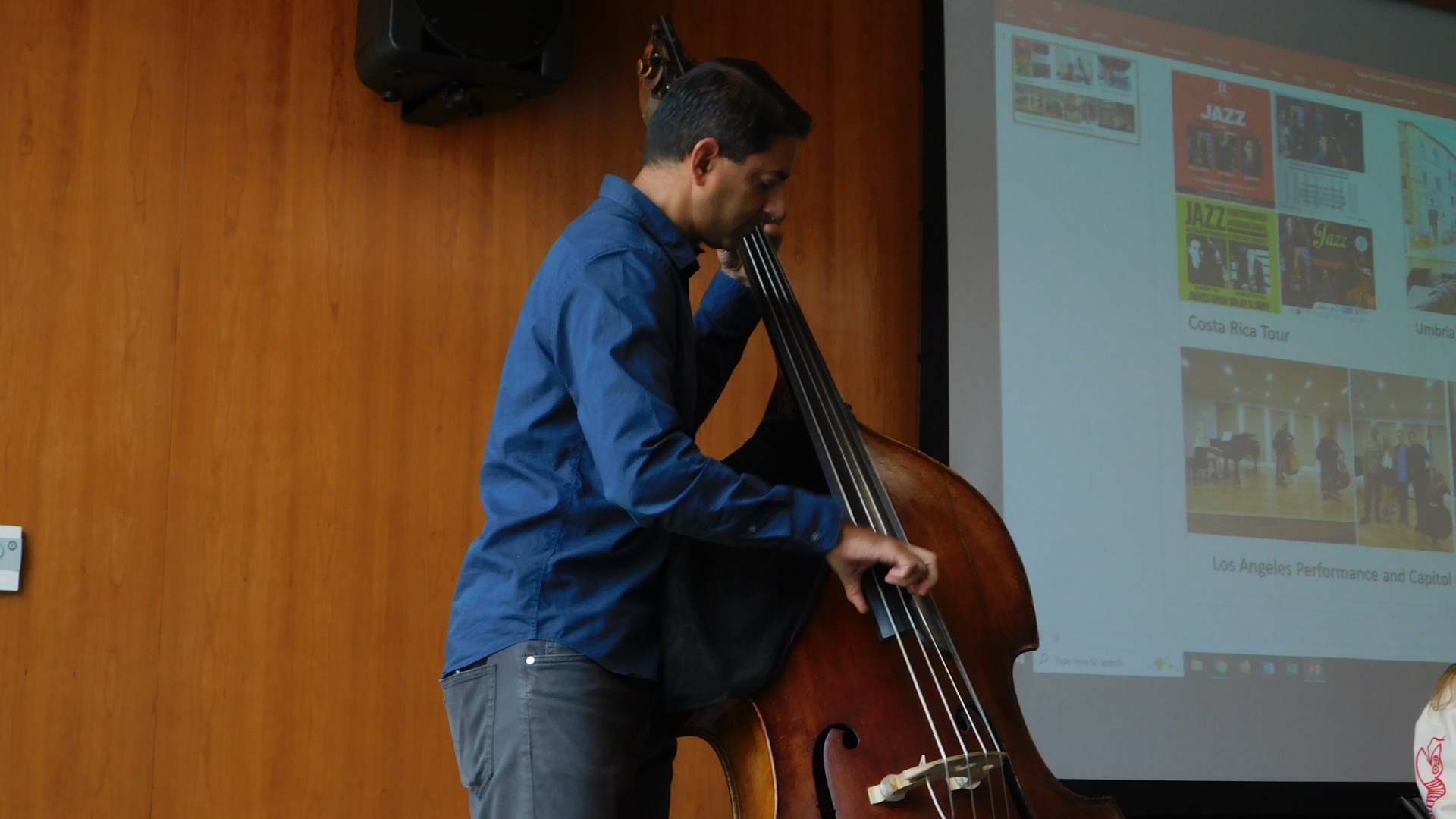
As part of the Brewer Festival of Writing, a two-part event named after USU Professor Emeritus and Utah Poet Laureate Ken Brewer, students heard from author Nicole Walker, musician Braun Khan, and interdisciplinary artist Tamryn McDermott at an artist panel and reading.
Nicole Walker read from her book How to Plant a Billion Trees: A Memoir of Childhood Trauma and the Healing Power of Nature, and an essay about the Great Salt Lake found in The Once and Future Lake.
Nicole’s work combines personal narrative with principles from the natural world — seamlessly blending together bodily violation and ecological collapse, brine shrimp and fertility, and contrasting mycorrhizal fungi and human communities.
“I’ve been working very hard to become a better speaker and performer, since one of the ways I think we may shift from AI is to be more embodied, to take our bodies places and speak our stories aloud,” Nicole says.
After the reading, students and members of the community were able to ask Nicole about the research process and her practice as a writer.
Clark Cundick, a student in the English Department who attended the reading says, “Walker's intricate analogies inspired a new method for grounding my work. While much of my work derives from personal experience, I've rarely thought to look for inspiration in sources like brine shrimp. These types of examples serve as a way to find unique inspiration.”
Nicole explained a practice she uses to encourage students to blend personal narrative and inspiration. “I ask people to write for two minutes about a personal topic then for two minutes about something they’re curious about. You can pick whatever — General Hospital, anything,” she explains.
The students alternate between the two seemingly unrelated topics until a pattern begins to emerge. “It doesn’t work right off the bat, so what I have them do is read their essays together — underline images that reoccur, metaphors, verbs, anything,” she continues.
The practice helps writers bridge the gap between their stories and their research. “There are resonances between the pieces, and you start to see why you chose that bit of research with that personal story. It’s a surprise to yourself,” Nicole notes.
At the Work of Art panel discussion, Nicole, Braun, and Tamryn each shared insights into the creative life. They discussed their work, mentorship, collaboration, and the many hats that artists wear before answering audience questions.
Braun brought his bass and played for the audience. He discussed his most recent projects which include teaching in Costa Rica, recording original bass-centered compositions with Capital Records, and taking lessons from modern-day bass legend John Clayton.
He says that early in his career, he was shameless in reaching out to potential mentors. He would go to his local jazz club and if he liked the visiting bassist, he would ask for a lesson the next day.
“It’s really easy to misinterpret the path and misunderstand what it looks like,” Braun says.
He compared a career as an artist to a hike. “You think it's a three- or four-hour hike, but really, it's a twelve-hour hike. When you’re on that path, the path does not always go up. Sometimes, it goes down. That’s why you need mentors. You need other people who’ve been along the path. You need somebody to say don’t panic. That’s what it looks like. Stay on the path,” Braun reflects.
Mentors can also help you when you get off track. "The skill of getting back on track is, in a sense, way more important than the skill of staying on track,” Braun reflects.
Tamryn also emphasized the importance of mentorship and collaboration. She brought sketchbooks bursting with found poems, notes, and collages. As part of a five-year collaborative exhibition, she stitched together data analysis into long hanging columns — a sort of sculptural spreadsheet — which she later repurposed by weaving the literature into baskets that she brought for audience members to see.
She also talks about an art education teacher that was influential in her early career. The teacher introduced her to visual journaling and took her to seven Smithsonian museums. “I could learn and do something with her one day. The next day I would try it in my classroom,” Tamryn remembers. Being able to immediately apply information shared by her mentor kept her students engaged and helped her stay more engaged in the teaching process.
Nicole, Braun, and Tamryn each encourage young artists to reach out and find mentors, follow their creativity, and establish a regular routine.
“Don’t try to circumvent the process of understanding and developing the fundamentals of whatever your craft is,” Braun says. “Pay attention to the things that really catch your interest. Those aren’t accidents. Craft your specific path around those things.”