
USU Faculty and Students Gather for Weaving Our Stories Conference
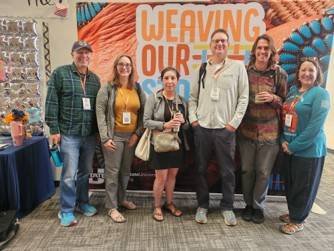
USU students and faculty from across the state recently gathered at the Blanding campus for the Weaving Our Stories Conference. The conference works to support indigenous students by bringing together community members to explore how stories, culture, relationships, and shared experiences strengthen communities and help shape the future. Among the attendees and presenters were members of the USU English Department.
Senior Lecturer Deanna Allred and Lecturer Jeremy Ricketts presented together with USU CE instructor Shanda Winget from San Juan High School and Jeff Winget from San Juan School District in the panel “Reframing the Rural: Critical Rural Pedagogy and the Communities We All Carry.” The panel focused on the ways in which rural identities shape students' experiences in educational spaces. They explained that often, rural voices are stereotyped or overlooked in educational settings, and students are frequently told to leave behind the knowledge that shaped them. Therefore, it is up to educators to elevate these voices however they can.
For Deanna, this conference creates a space where these conversations are central rather than peripheral. “Weaving Our Stories is an especially meaningful conference to attend and present at because the audience is already deeply engaged with the importance of rural and Indigenous voices,” she describes. “Presenting to an audience that understands the value of rural experience made the panel discussion particularly productive because participants were able to connect our ideas to their own experiences as students, teachers, and community members.”
Jeremy notes that one of the most striking parts of this presentation was the inviting atmosphere that the Blanding community created. He recalls that, “The Blanding community is so welcoming and kind, and USU Blanding is a wonderful Statewide campus. The entire conference experience is centered on community and connection, and the presentations were all excellent.” Both he and Deanna noted the hospitability given to them by the campus, and the communal environment it created.
Later in the day, Senior Lecturer Rosa Thornley presented on the panel, “Expanding Local Campuses to the World: Unlocking Study Abroad Opportunities for USU Statewide Students.” Working with two other faculty and two students, they discussed the importance of short-term study abroad programs. Study abroad opportunities can allow rural students to connect their academics, career goals, and community concerns to global experiences. By presenting, they hoped to help students and faculty see the value of participating in these experiences.
Rosa believes this topic was important for conference attendees to hear. She details that studying abroad “can create pathways for Statewide students to expand their community of learners to find a sense of belonging. Helping students understand the feasibility of participating in a Study Abroad program is positively affected by faculty members who can mentor them through the funding and application process.”
On top of presenting, though, this conference allowed for attendees and presenters to learn from one another. The conference was both educational and engaging and left Jeremy with many ideas of how to apply the information presenters shared.
Deanna recalls how going through the conference, one of the most valuable things she learned was how she could include more Indigenous voices in her classroom.
“The conference introduced me to additional Indigenous writers and perspectives that could broaden the course and help students encounter a wider range of relationships to land and place. I was especially interested in considering how Indigenous perspectives can deepen conversations about agriculture, rural communities, environmental stewardship, cultural memory, and the different ways people understand their responsibilities to the places they inhabit,” she explains. Because she teaches a Farm Literature and Culture course, this information is incredibly valuable to the topics of the class.
Ultimately, this conference was integral to the USU community. Rosa describes it as an opportunity to create community across the state. “Since we are a land-grant university, we have many Statewide campuses with students studying in a variety of delivery methods. This conference brings people together to create more connections between faculty and students from a variety of locations.”
Deanna agrees, saying that it helps “strengthen relationships among educators working throughout Utah.” On top of this, it is also a chance to support students whose identities are not always represented in academic spaces.
“The conversations about Indigenous students were especially valuable because they encouraged participants to think beyond inclusion as simply adding texts or perspectives to a syllabus. Instead, the conference emphasized the importance of creating classrooms in which students’ communities, histories, knowledge, and lived experiences are treated as meaningful intellectual resources,” she states.
There is not one feature of this conference that makes it important, but rather the combination of them all that makes this conference necessary for USU. Jeremy explains, “A conference like this underscores the importance of our Statewide mission. It brings people from across USU together in a place and community that many of us do not get to experience often enough. It also creates space for Indigenous voices, histories, and perspectives and asks us to think more deeply about USU’s relationship with the communities it serves. That combination of learning, storytelling, and community is what makes Weaving Our Stories so valuable.”