
The Pan Lab studies how light interacts with materials at the nanoscale. By learning how to probe and control these interactions, we aim to develop new technologies that could make communication more secure, computing faster, and networking more efficient. We are especially interested in creating bright, controllable sources of quantum light from materials and using quantum light to study quantum materials. To do this, we build instruments, design and fabricate nanoscale photonic devices, and explore exciting new phenomena at the intersection of materials, light, and devices.
Research
We explore the quantum frontier of light–matter interactions in nanophotonic devices and low-dimensional quantum materials. Our mission is to understand, control, and harness light-matter interactions at length scales far below the wavelength of light. We develop nanophotonic platforms that enhance and manipulate light–matter interactions through tailored symmetries, geometries, and optical resonances. These efforts enable the creation of scalable quantum light sources, photonic quantum computing platforms, and energy-efficient optical information systems. At the same time, we pursue fundamental discoveries in condensed matter physics by using quantum states of light to probe many-body phenomena in quantum materials. By using nonclassical light spectroscopy, we seek to reveal hidden excitonic, spin, and correlated quantum states that are inaccessible to conventional optical measurements.
Photonic Quantum Systems for Communication, Computing, and Networking
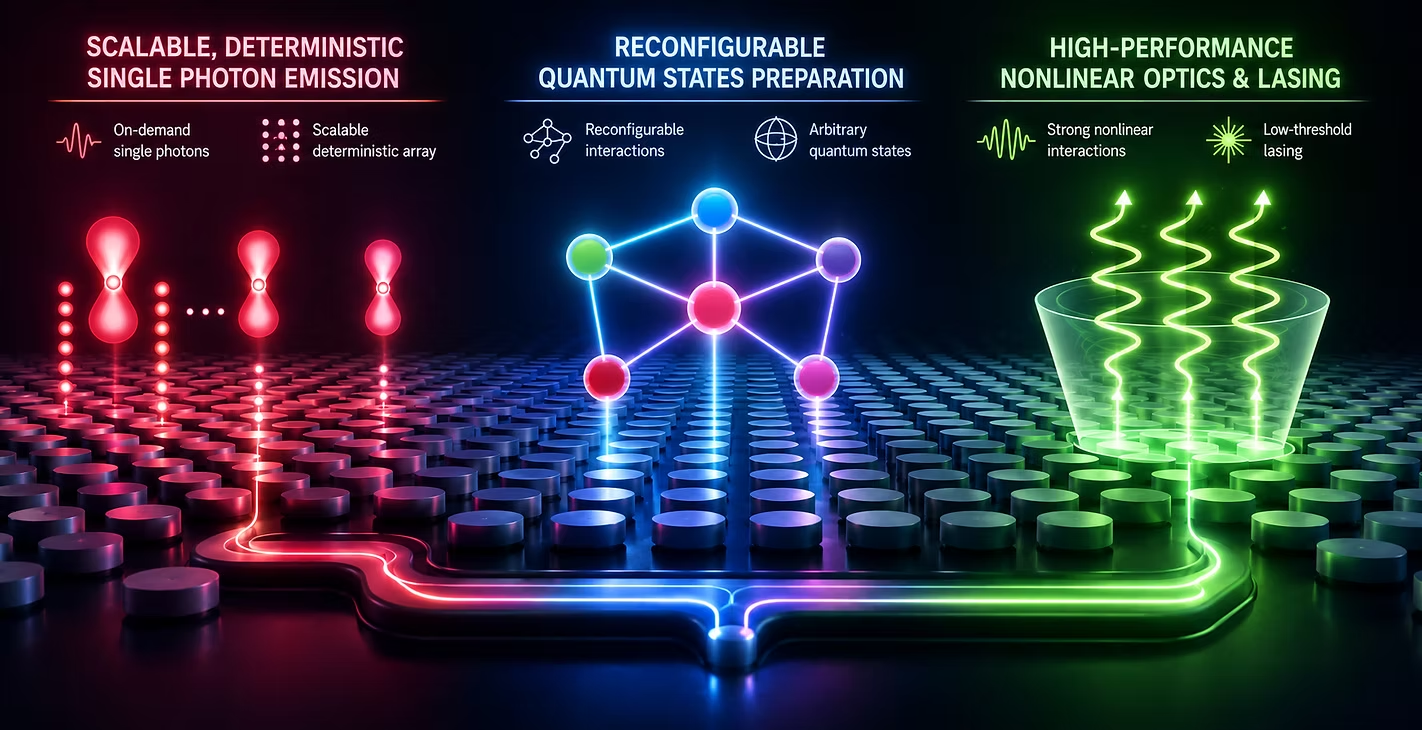 Quantum technologies promise transformative advances in secure communication, distributed computing, and information processing. Realizing this vision requires scalable sources of quantum light, precise control over quantum states, and energy-efficient interfaces between photons and electrons. Our research focuses on engineering light–matter interactions at the nanoscale to create next-generation photonic quantum systems.
We develop nanophotonic platforms that enable deterministic single-photon emission, reconfigurable quantum state generation, and energy-efficient nonlinear and chiral photonic devices. By integrating advances in materials science, nanophotonics, and quantum optics, we seek to establish the foundational technologies for scalable quantum networks, fault-tolerant photonic quantum computing, and high-performance optical connectivity.
References
- Nature Communications, 2025
- Nanophotonics, 2025
- Nanophotonics, 2023
- Annual Review of Physical Chemistry, 2024
- Nature Materials, 2024
Nonclassical Light Spectroscopy of Low-Dimensional Quantum Materials
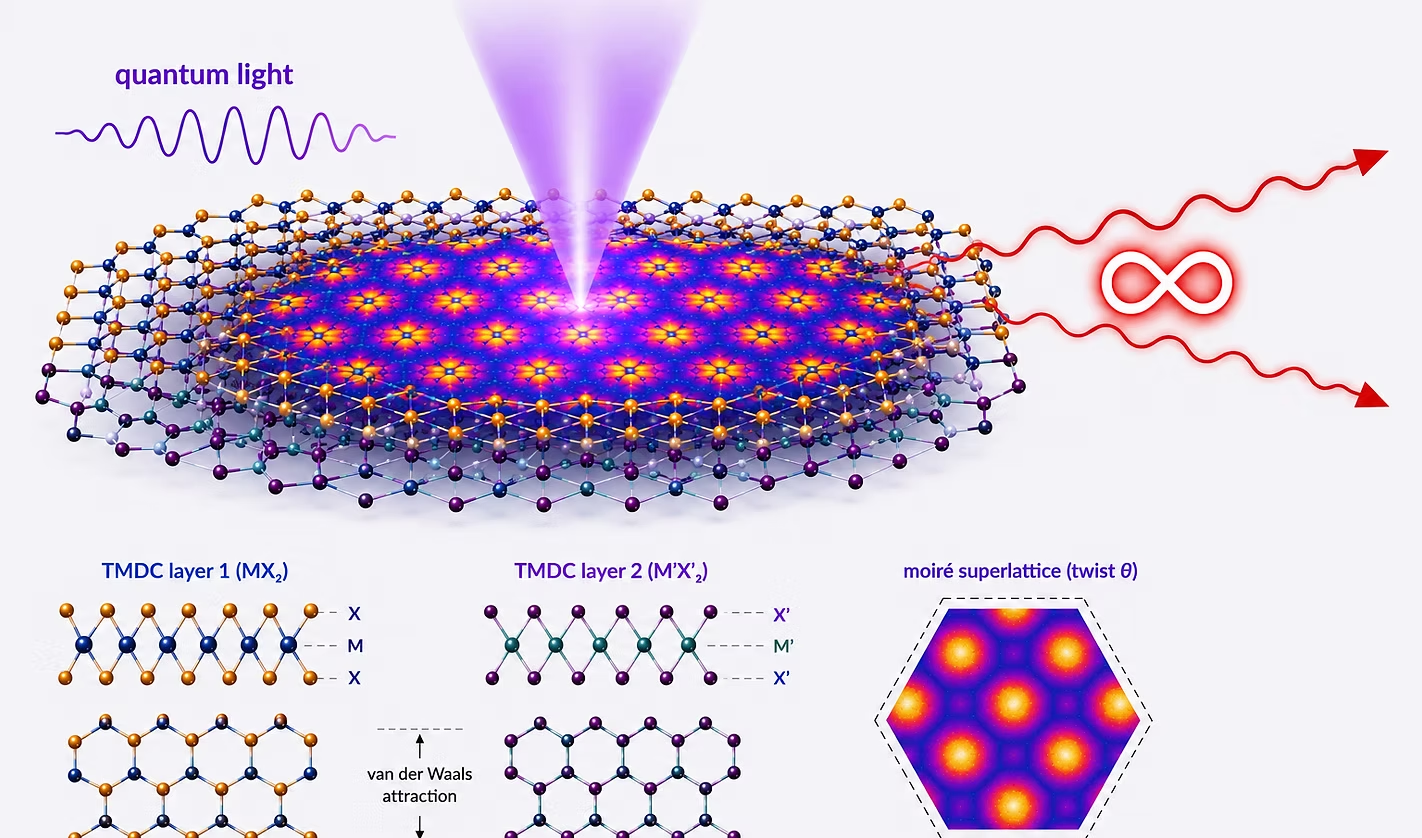 Low-dimensional quantum materials exhibit a rich landscape of many-body phenomena arising from strong Coulomb interactions, reduced dielectric screening, and quantum confinement. These systems host a variety of emergent excitations and correlated states—including dark excitons, interlayer excitons, exciton blockade, charge-density waves, spin waves, and collective quantum phases—that play central roles in their optical and electronic properties. However, many of these states remain hidden or difficult to access using conventional spectroscopy because classical light primarily probes single-particle excitations and linear optical responses.
Our research seeks to establish nonclassical light spectroscopy as a new frontier for exploring quantum matter. By leveraging entangled photons, correlated photon pairs, squeezed light, and other engineered quantum states of light, we aim to selectively excite, probe, and control many-body interactions in two-dimensional van der Waals materials and their heterostructures. These quantum optical probes provide access to higher-order correlations, collective excitations, and quantum pathways that are inaccessible to classical measurements, enabling new insights into excitonic correlations, moiré quantum phases, quantum magnetism, superconductivity, and nonequilibrium quantum dynamics.
References
The Pan Lab Team
Principal Investigator
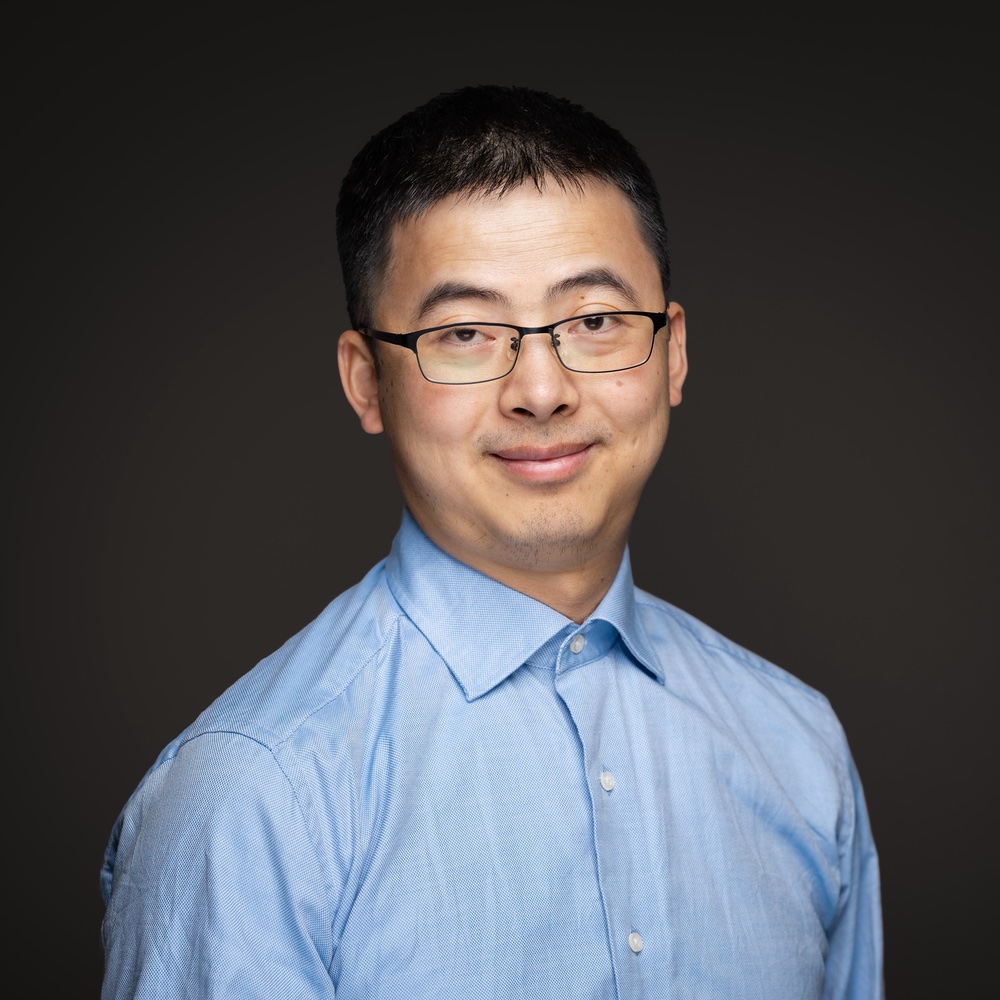
Feng Pan
Principal Investigator & Assistant Professor | feng.pan@usu.edu
Although he knew little about photonics before graduate school, he was drawn to optics, lasers, and spectroscopy from the beginning. He first caught a glimpse of what photonics could enable while working in Prof. Randall Goldsmith’s lab, where he became captivated by the idea that light could be guided, confined, and manipulated in unexpected ways. He later ventured deeper into the nanoscale world in Prof. Jen Dionne's lab at Stanford, where he became fascinated by how carefully designed structures can “trick” light and shape light–matter interactions in powerful ways. Outside the lab, Feng enjoys hiking, running, century-mile cycling, and doing fun chemistry experiments at home with his two boys.
Graduate Researchers
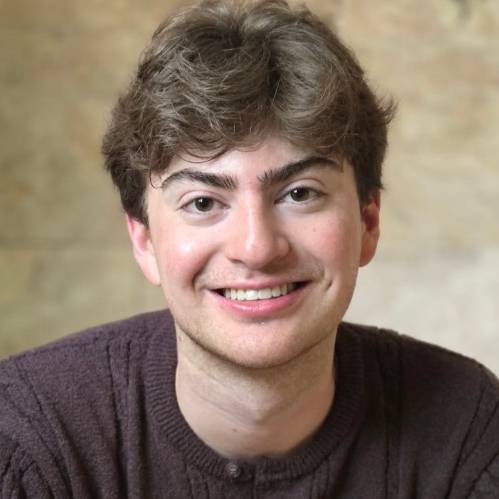
Alejandro Patch
Graduate Researcher
Alejandro Patch is a master's student at USU working under Dr. Feng Pan with light matter interactions and nanophotonics. He graduated from USU with a degree in Physics and a minor in mathematics with specialization in photonic studies. He previously did research on atmospheric gravity waves under the guidance of Dr. Yucheng Zhao and with support from NASA, analyzing data from cameras around the world to better understand high-altitude weather phenomena. Outside of physics, he enjoys sports such as volleyball and snowboarding, as well as documenting his travels through his photography.
Undergraduate Researchers
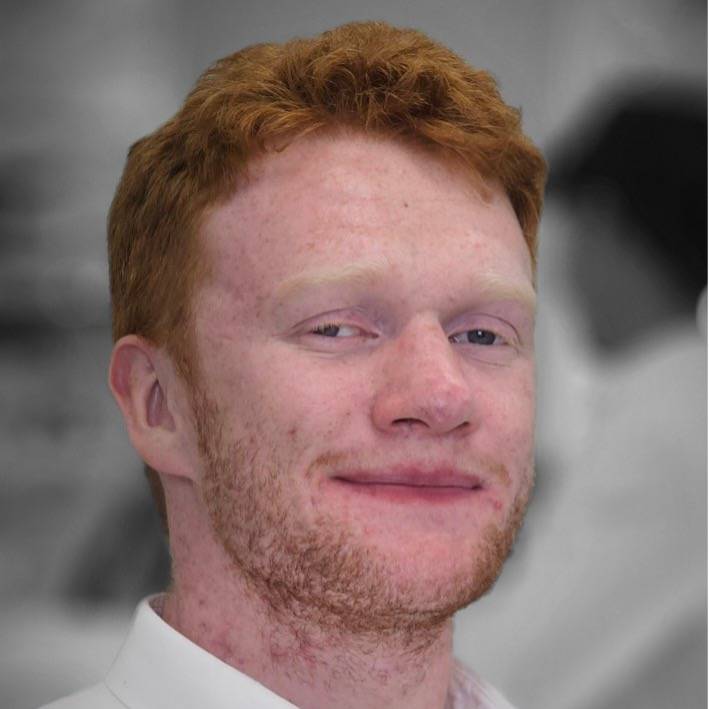
Jed Evans
Undergraduate Researcher
Jed Evans is majoring in electrical engineering with a minor in physics and with an emphasis in photonics. He is interested in the application of nanophotonics to quantum computing. Outside of the lab, he enjoys music and being in the outdoors.
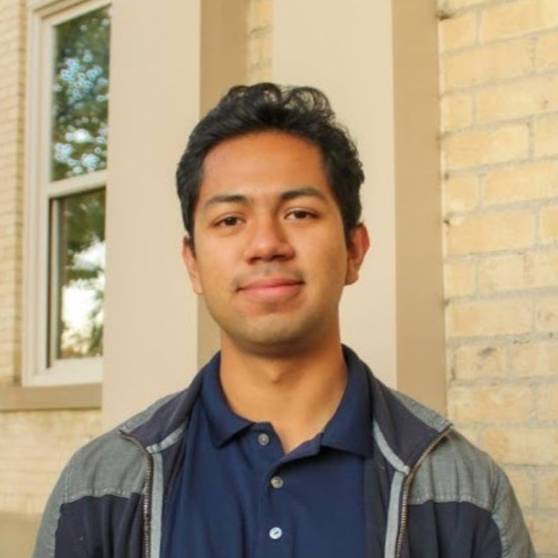
Ismael Santos
Undergraduate Researcher
Ismael Santos is a Physics major with a minor in Mathematics and a concentration in Photonics. His research interests focus on light–matter interactions at the nanoscale and their applications in photonics and related technologies. Outside of his academic work, he enjoys staying active through various activities, though he enjoys running the most.
Recruiting Graduate & Undergraduate Students
We are hiring! The Pan lab is actively recruiting motivated graduate students and undergraduate researchers interested in nanophotonics, optics, quantum materials, and quantum devices. Students will work on nanoscale light–matter interactions, optical cavities, quantum optics, nonlinear spectroscopy, and low-dimensional quantum materials. We welcome students from physics, engineering, materials science, chemistry, and related fields. Prior research experience is a plus, but enthusiasm, creativity, and curiosity are most important. Interested students should email Dr. Feng Pan with a CV/resume and a brief description of their research interests.
Publications
Preprints
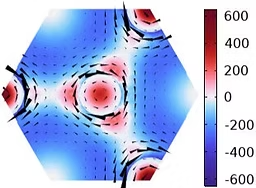
Spin dissymmetry in optical cavities. Priyanuj Bordoloi, Jefferson Dixon, Zachary N. Mauri, Christopher J. Ciccarino, Feng Pan, Tony Low, Felipe H. da Jornada, Jennifer A. Dionne
2026
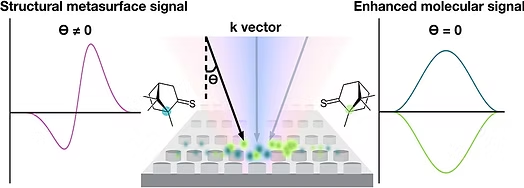
Metasurface-enhanced momentum-resolved circular dichroism spectroscopy. Remi S. Dado, Priyanuj Bordoloi, Yanyu Xiong, Chi-Ching Liu, Lucille J. Brinkman, Parivash Moradifar, Feng Pan, Ming Lee Tang, Mark Brongersma, Jennifer A. Dionne, Nano Lett., (2026).
2025
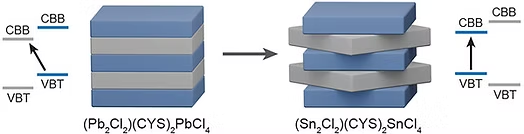
Twisted tin-chloride perovskite single- crystal heterostructures. Jamie L. Cleron, Chih-Yi Chen, Feng Pan, Santanu Saha, Frederick P. Marlton, Robert M. Stolz, Jiayi Li, Jennifer A. Dionne, Fang Liu, Marina R. Filip, Hemamala I. Karunadasa, Angew. Chem. Int. Ed., (2025).
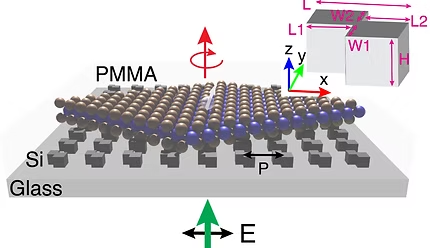
Room-temperature valley-selective emission in Si-MoSe2 heterostructures enabled by high-quality-factor chiroptical cavities. Feng Pan*, Xin Li*, Amalya C. Johnson, Scott Dhuey, Ashley Saunders, Meng-Xia Hu, Jefferson P. Dixon, Sahil Dagli, Sze-Cheung Lau, Tingting Weng, Chih-Yi Chen, Jun-Hao Zeng, Rajas Apte, Tony F. Heinz, Fang Liu, Zi-Lan Deng, and Jennifer A. Dionne, Nat. Commun., (2025). *equally contributed.
Intriguing innovation of 2025 at Stanford University. News release: Phys.org, Stanford Report, Interesting Engineering, Today Headline, Photonics Online
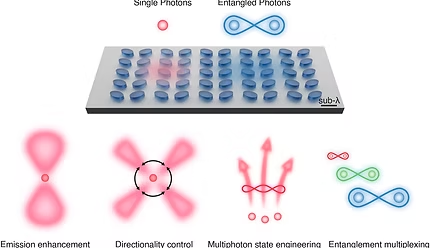
Resonant metasurface-enabled quantum light sources for single-photon emission and entangled photon-pair generation. Feng Pan, Priyanuj Bordoloi, Chih-Yi Chen, Jennifer A Dionne, Nanophotonics 14, 3861 (2025)
2024
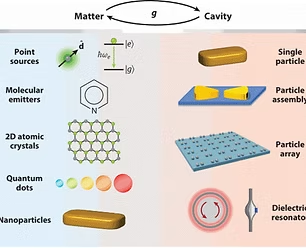
Spectroscopy in nanoscopic cavities: models and recent experiments. Marc R. Bourgeois, Feng Pan, C. Praise Anyanwu, Austin G. Nixon, Elliot K. Beutler, Jennifer A. Dionne, Randall H. Goldsmith, and David J. Masiello, Annu. Rev. Phys. Chem., 75, 509 (2024)
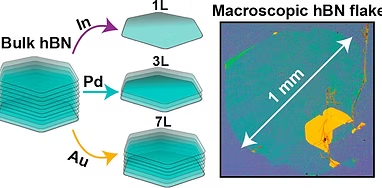
Millimeter-scale exfoliation of hBN with tunable flake thickness for scalable encapsulation. Amy S. McKeown-Green, Helen J. Zeng, Ashley P. Saunders, Jiayi Li, Jiaojian Shi, Yuejun Shen, Feng Pan, Jenny Hu, Jennifer A. Dionne, Tony F. Heinz, Stephen M. Wu, Fan Zheng, Fang Liu, ACS Appl. Nano Mater., 7, 6, 6574 (2024)
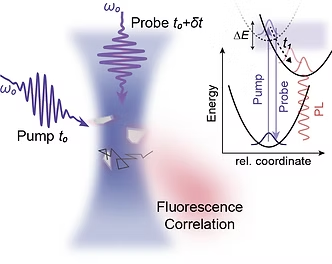
Solution-phase sample-averaged single-particle spectroscopy of quantum emitters with femtosecond resolution. Jiaojian Shi*, Yuejun Shen*, Feng Pan*, Weiwei Sun, Anudeep Mangu, Cindy Shi, Amy McKeown-Green, Parivash Moradifar, Moungi G. Bawendi, William E. Moerner, Jennifer A. Dionne, Fang Liu, Aaron M. Lindenberg, Nat. Mater., 23, 1063 (2024). *equally contributed.
2023
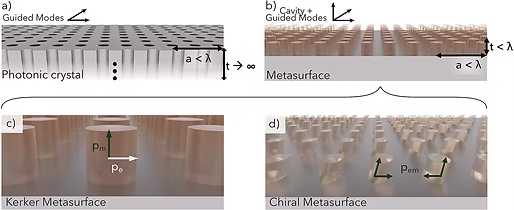
Through thick and thin: how optical cavities control spin. Jefferson P. Dixon, Feng Pan, Parivash Moradifar, Priyanuj Bordoloi, Sahil Dagli, Jennifer A. Dionne, Nanophotonics, 12, 14, 2779 (2023).
2022-2018
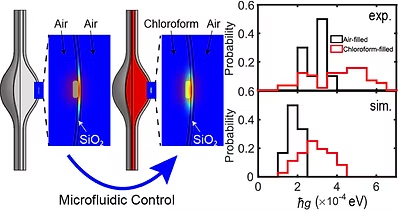
Active control of plasmonic-photonic interactions in a microbubble cavity. Feng Pan, Kristoffer Karlsson, Austin G. Nixon, Levi T. Hogan, Jonathan M. Ward, Kevin C. Smith, David J. Masiello, Sile Nic Chormaic, Randall H. Gold-smith, J. Phys. Chem. C, 126, 48, 20470 (2022).
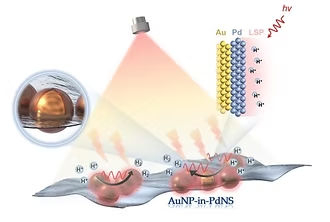
Two-dimensional palladium nanosheet intercalated with gold nanoparticles for plasmon-enhanced electrocatalysis. Jiangwei Ding*, Fengmei Wang*, Feng Pan*, Peng Yu, Ning Gao, Randall H. Goldsmith, Shuangfei Cai, Rong Yang, Jun He, ACS Catal., 11, 21, 13721 (2021). *equally contributed.
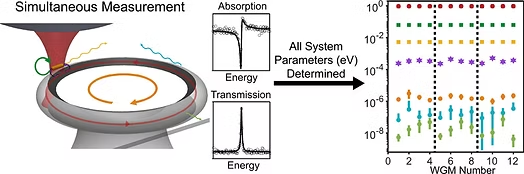
Elucidating energy pathways through simultaneous measurement of absorption and trans-mission in a coupled plasmonic-photonic cavity. Feng Pan*, Kevin C. Smith*, Hoang L. Nguyen, Kassandra A. Knapper, David J. Masiello, Randall H. Goldsmith, Nano Lett., 20, 1, 50 (2020). *equally contributed.

Investigating the mechanism of post-treatment on PEDOT:PSS via single-particle absorption spectroscopy. Morgan T. Rea, Feng Pan, Erik H. Horak, Kassandra A. Knapper, Hoang H. Nguyen, Cecilia H. Vollbrecht, Randall H. Goldsmith, J. Phys. Chem. C, 123, 51, 30781 (2019).

Applicability of the invisible ink vibrationally excited nitric oxide monitoring technique to various flow conditions: a temperature perturbation simulation study. Joshua D. Winner, Feng Pan, Madison H. McIlvoy, Rodney D. W. Bowersox, Simon W. North, Appl. Opt., 58, 10, 2702 (2019).

Single-particle photothermal imaging via inverted excitation through high-Q all-glass toroidal microresonators. Kassandra A. Knapper*, Feng Pan*, Morgan T. Rea, Erik H. Horak, Jeremy D. Rogers, Randall H. Goldsmith, Opt. Expr., 26, 19, 25020 (2018). *equally contributed.
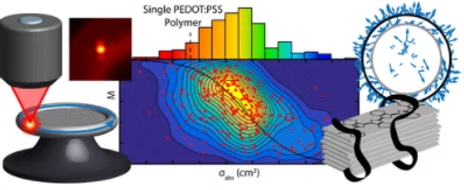
Exploring electronic structure and order in polymers via single-particle microresonator spectroscopy. Erik H. Horak, Morgan T. Rea, Kevin D. Heylman, David Gelbwaser-Klimovsky, Semion K. Saikin, Blaise J. Thompson, Daniel D. Kohler, Kassandra A. Knapper, Wei Wei, Feng Pan, Padma Gopalan, John C. Wright, Alan Aspuru-Guzik, Randall H. Goldsmith, Nano Lett., 18, 3, 1600 (2018).
2016-2011
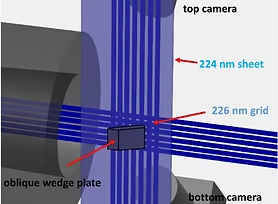
Simultaneous three-dimensional velocimetry and thermometry in gaseous flows using the stereoscopic vibrationally excited nitric oxide monitoring technique. Feng Pan, Rodrigo Sanchez-Gonzalez, Madison H. McIlvoy, Rodney D. W. Bowersox, Simon W. North, Opt. Lett., 41, 7, 1376 (2016).

Targeted synthesis of a large triazine-based [4+6] organic molecular cage: structure, porosity and gas separation. Huimin Ding, Yihui Yang, Bijian Li, Feng Pan, Guozhu Zhu, Matthias Zeller, Daqiang Yuan, Cheng Wang, Chem. Commun., 51, 10, 1976 (2015).

Synthesis of 6-(het) ary Xylocydine analogues and evaluating their inhibitory activities of CDK1 and CDK2 in vitro. Chuan Xiao, Chao Sun, Weiwei Han, Feng Pan, Zhu Dan, Yu Li, Zhi-Guang Song, Ying-Hua Jin, Bioorg. Med. Chem., 19, 23, 7100 (2011).
News
Feng was featured in Utah State Today. He spoke to undergraduate researchers at the Undergraduate Research Fair. He’s actively recruiting highly motivated and talented undergraduate researchers. Alex Patch joined the lab as the first graduate student, and Jed Evans joined as the first undergraduate researcher. Welcome, Alex and Jed! We are excited to have both of you as our founding members.
Resources
Graduate Fellowships
- USU Presidential Doctoral Research Fellowship
- NSF Graduate Research Fellowship Program (GRFP)
- DoD National Defense Science and Engineering Graduate Fellowship Program
- Hertz Fellowship
- DoE Computational Science Graduate Fellowship
- Future Investigators in NASA Earth and Space Science and Technology (FINESTT) Fellowship
- NASA Space Technology Graduate Research Opportunities
Textbooks
- Nonlinear Optics (R. W. Boyd)
- Classical Electrodynamics (J. Jackson)
- Principles of Nano-Optics (Novotny and Hecht)
- Photonic Crystals: Molding the Flow of Light (J. Joannopoulos)
- Quantum Optics (M. Fox)