
Program Overview
The Bachelor of Arts in Theatre Studies is designed for students who prefer a more comprehensive liberal arts background in theatre. Students receive a broad based knowledge of history, literature, and aesthetics, as well as a basic knowledge of performance, design and technical theatre. This degree is intended to give a broad background in preparation for specialization in a graduate program. The credits required for this degree make it possible to pursue an additional degree if desired.
Learning Objectives / Assessment Plan
Students must demonstrate competency in three broad areas of theatre arts practice.
Competency I: Theatre History and Literature
Students must be able to:
- Define and recognize traditional dramaturgical principles in various historical and contemporary performance scripts
- Interpret a script to the challenges of producing it in a performance space as a member of a collaborative team
- Recognize common structural forms of plays related to periods and genres (tragedy, comedy, farce, melodrama, realism, expressionist forms of theatre, and so forth)
- Demonstrate knowledge of historical and contemporary theatre production practices appropriate as background to an understanding of the themes in dramatic works from those periods; familiarity with the social, political, religious, and related cultural circumstances which produced or were reflected by, the theatre of these periods
Competency II: Script Analysis & Performance
Students must be able to:
- Score a script for objectives, obstacles, tactics, and beats.
- Create convincing characters from scripted texts and improvisation.
Competency III: Technical Theatre & Design
Students must be able to:
- Manipulate basic practices in stagecraft (e.g., set construction, rigging, prop construction)
- Perform basic practices in costume crafts (e.g. sewing, pattern drafting, fabric manipulation).
- Implement fundamental design skills in at least one domain of design.
Outcomes Data
Summative assessment of student progress is based on final grades in the courses indicated below. Students must earn a grade of B- or higher in each of these courses. Each course involves a number of formative and summative assessments appropriate to nature of the course and briefly summarized below.
Courses Assessing Competence in Theatre History & Literature
THEA 3710 (Theatre History I), THEA 3720 (Theatre History II), ENGL 2300 (Intro to Shakespeare), ENGL 4300 (Shakespeare), HIST 3160 (Classical Drama & Society), THEA 4710 (Contemporary Theatre), THEA 4720: Musical Theatre History & Literature I, THEA 4730: Musical Theatre History & Literature II
Examples of Summative Assessments in Theatre History & Literature
Analytic essays, research papers, presentations on historical periods, written examinations.
Courses Assessing Competence in Script Analysis & Performance
THEA 1033 (Beginning Acting), THEA 1713 (Playscript Analysis), THEA 2000 (Scene Study), THEA 3610 (Directing), THEA 4760 (Playwriting), THEA 5610 (Directing II)
Examples of Summative Assessments in Script Analysis & Performance
Group and solo performances of scripted texts and improvised scenes, script scoring, examinations.
Courses Assessing Competence in Technical Theatre & Design
THEA 1513 (Stagecraft), THEA 2203 (Costume Construction), THEA 2555 (Production Practicum), THEA 3510 (Scene Design I), THEA 3520 (Costume Design I), THEA 3540 (Lighting Design I), THEA 3550 (Stage Management), THEA 3560 (Period Styles/Historic Interiors), THEA 3570 (Historic Clothing), THEA 1223 (Stage Makeup)
Examples of Summative Assessments in Technical Theatre & Design
Construction projects (scenic and costume), design renderings, examinations
Outcomes Data
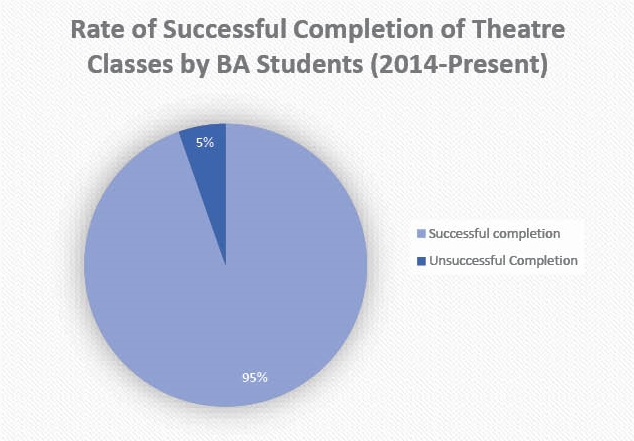
The chart below represents the percentage of students earning the requisite grades in courses taken to date each year from 2014 to the present.
Data-Based Decisions
Based on the data presently available, the theatre studies faculty believe that student progress in the program does not meet expectations. We will be evaluating individual courses, methods of evaluation and the program of study as a whole with a view to making programmatic changes.