
Program Overview
2017 BFA Design & Technology Assessment
Design & Technology students receive training in the actual operation and physical aspects of production. This degree prepares students for further graduate studies or professional work. Students study lighting, sound, scene & costume design, construction, production skills, history, and basic makeup. Students choose a concentration track in consultation with the Academic Advisor: Costume Design, Scenic Design, Lighting Design, or Production Technology. Acceptance into the Design & Technology program is by application, portfolio & interview process. Retention is through personal growth, commitment and a yearly portfolio review, evaluation, and interview.
Technical Production Track 4 Year Degree Map
Scene Design Track 4 Year Degree Map
Lighting Design Track 4 Year Degree Map
Costume Design Track 4 Year Degree Map
Learning Objectives
There are four clearly defined emphasis areas in the BFA Theatre Design and Technology program: Scenic Design, Costume Design, Lighting Design, and Production Technology. The type of activities in which they engage measures the success of our BFA graduates. All emphases require paper projects, design presentations, hands-on practicum in the Scenic, Costume, and Lighting Design studios, and annual portfolio reviews culminating in a fully realized stage design, short film or technology project within the Utah State Theatre production season. Students are then chosen through the jury system to compete in the Kennedy Center American College Theatre Festival (KCACTF) national competition, film festival or the United States Theatre and Technology (USITT) convention. The Department of Theatre Arts offers six full-scale productions a year in three different venues, including an experimental black box theatre, a small proscenium and large thrust venues, allowing for seven student design positions per production (42 per year). Prior to graduating from the program, students must demonstrate competency in one of these distinct emphases that is directly related to successful professional practice in the field.
Competency 1: Literature and History Analysis
Students must be able to:
- Demonstrate the ability to analyze plays perceptively and to evaluate them critically.
- Script Analysis introduces students to methods of analyzing written play scripts from various genres and styles, encouraging better understanding of the importance of background, plot, structure, character, dialogue and all the elements that collectively determine the play’s meaning.
- Demonstrate the ability to understand and discuss dramatic literature drawn from different genres and styles.
- The Theatre History series introduces students to cultural theatre activity of European and American literature from ancient to 1840, then from approximately 1840 through the cultural revolution (60’s to 90’s) of the last decade of the 20th century.
- The Period Styles and Historic Clothing components require complete design research dossiers in regards to design projects, paper or realized. (e.g. a costume bible, French scenes, character evaluations, script analysis for actors/directors).
(This competency is measured through the History and Literature components of the program)
Competency 2: Artistry and Skills
Students must be able to:
- Regularly envision, create, or significantly contribute to the creation of high-quality artistic projects (as assessed by university faculty, professional community partners, and peers).
- Understand the specific requirements of a production, including style, period, mood, location, and special needs.
- Demonstrate an innovative and creative approach to the process of theatre design, problem solving, and/or management.
- Demonstrate quality of product through well-planned, meticulously executed and skillfully presented artistic or technical projects: renderings, draftings, video, photo, or other multimedia documentation that clearly demonstrates the quality of a particular aspect of a creative project
- Demonstrate a broad general knowledge of the technical aspects of theatre, as well as expertise in technology specific to one or more areas of specialization.
(This competency is measured through BFA Continuance Evaluation given at the annual portfolio review.)
Competency 3: Academics/Scholarship
Students must be able to:
- Meet or exceed departmental academic requirements.
- Make meaningful contributions to high-quality research/design and technology projects.
- Demonstrate the ability to communicate artistic, technical and/or organizational ideas through appropriate means, including written or visual.
(This competency is measured by the departmental standard of an overall 2.75 GPA and nothing lower than a B- in a program course.)
Competency 4: Leadership/Service
Students must be able to:
- Frequently lead in informal settings, such as: organizing theatre design/technology student activities or projects; coordinating communication among students; modeling leadership in classroom & laboratory.
- Utilize effective planning, time management, organization and leadership.
- Utilize effective collaboration, team-member and leadership skills while contributing to the "many artists/one work of art" concept that is at the core of theatre production.
- Regularly engage in service to the program, university, and/or community.
(This competency is measured through BFA Continuance Evaluation given at the annual portfolio review.)
Competency 5: Portfolio
Students must be able to:
- Demonstrate comprehension of the basic business procedures of the theatre profession including portfolio, resume and self-promotion.
- Prepare and display all design and technology work at the annual portfolio review each spring semester.
(This competency is measured through BFA Continuance Evaluation given at the annual portfolio review. See Assessment Plan: Assessment Part II below)
Competency 6: Professionalism
Students must be able to:
- Consistently exhibit respect for others as well as context-appropriate attitudes, enthusiasm, and engagement.
- Frequently offer helpful / competent feedback & receive criticism with grace.
- Consistently arrive on time, fully prepared, and dressed appropriately for courses, meetings, rehearsals, and other events.
- The outcomes for this program have been developed to align with the guidelines from the National Association of Schools of Theatre (NAST), as well as with the mandates for teacher preparation programs in theatre arts education set forth by the Utah State Office of Education (USOE).
(This competency is measured through BFA Continuance Evaluation given at the annual portfolio review.)
Design & Tech Rubric
The learning objectives are assessed using coursework grades and annual review of portfolios. The rubric is provided below for the portfolio evaluation process. The level of mastery for competency is a 2.75 GPA and B- or above which equates to demonstrating no less than an intermediate proficiency in all areas. Evaluation utilizes a combination of qualitative and quantitative data to assess and improve student learning outcomes. Contextualizing both classroom score assessments and contextual assessments of individual student projects drives the core of evaluating student success. It is through evaluating both the individual experience as well as the classroom model that USU Faculty can more easily address the needs of the students and program.
| Category | Professional | Advanced | Intermediate | Basic | Needs Improvement |
|---|---|---|---|---|---|
| Literature & Historical Analysis | Consistently demonstrate the ability to analyze plays perceptively & to evaluate them critically & discuss discuss with a dramaturgical emphasis highlighting historical, social, and political influencers when appropriate. | Consistently demonstrate the ability to analyze plays perceptively & to evaluate them critically using the analytical framework. | Exhibits strong intellectual curiosity to analyze plays perceptively & evaluate them critically, drawing from different genres & styles. | Does not currently demonstrate the ability to analyze plays perceptively & evaluate them critically. | Does not currently demonstrate one or more of the requirements & does not express sincere desire to address deficiencies. |
| Artistry | Envisions, creates, or contributes significantly to the creation of truly Exceptional artistic projects at least 3x/per school year. | Envisions, creates, or contributes significantly to the creation of high-quality artistic projects at least 2x/school year. | Makes meaningful contributions to the creation of high- quality artistic projects at least 2x/school year. | Makes meaningful contributions to the creation of high- quality artistic projects at least 1x/school year. | Rarely or never makes meaningful contributions to the creation of high-quality artistic projects. |
| Academics & Scholarship | Meets departmental academic requirements & designs/conducts original, high-quality research/scholarly projects OR GPA of 3.5 & grade A in all required theatre courses thereby exceeding the 2.75 GPA minimum for mastery and competency. |
Meets departmental academic requirements & makes meaningful contributions to high-quality research/scholarly projects OR GPA of 3.5 & grade A- or bove in all required theatre courses thereby exceeding the 2.75 GPA minimum for mastery and competency. |
GPA of 2.75+ & grade of B- or above in all required theatre courses. (This is the minimum departmental requirement for all theatre majors). |
Fails to meet departmental academic requirements, but is actively working with faculty & advisors to rectify the situation. | Fails to meet departmental academic requirements, and is not actively working with faculty & advisors to rectify the situation. |
| Leadership & Service | Frequently assumes & excels in formal leadership roles. Utilize effective planning, time management & organization. Utilize effective collaboration, team-member skills while contributing to the "many artists/one work of art" concept. | Sometimes assumes formal leadership roles. Utilize effective planning, time management & organization. Utilize effective collaboration, team-member skills while contributing to the "many artists/one work of art" concept. | Actively seeks formal leadership roles. Utilize effective planning, time management & organization. Utilize effective collaboration, team-member skills while contributing to the "many artists/one work of art" concept. | Infrequently seeks leadership roles. In effective planning, time management & organization. Ineffective collaboration, team-member skills while contributing to the "many artists/one work of art" concept. | Rarely/never seeks learship roles. Poor planning, time management & organization. Poor collaboration, team-member skills while contributing to the "many artists/one work of art" concept. |
| Portfolio | Consistently demonstrate comprehension of basic business procedures of the theatre profession including portfolio, resume & self- promotion. Prepare & display all design & technology work demonstrating a trajectory of success through written and demonstrated skill comprehension in the annual portfolio review each spring semester. | Consistently demonstrate comprehension of basic business procedures of the theatre profession including portfolio, resume & self- promotion. Prepare & display all design & technology work demonstrating a trajectory of success through written and demonstrated skill comprehension in the annual portfolio review each spring semester. | Actively demonstrates comprehension of the basic business procedures of the theatre profession including portfolio, resume & self- promotion. Prepare and display design & technology work at the annual portfolio review each spring semester. | Infrequently demonstrates comprehension of basic business procedures of the theatre profession including portfolio, resume & self- promotion. Partial display of design and technology work at the annual portfolio review each spring semester. | Rarely/ never demonstrates comprehension of basic business procedures of the theatre profession including portfolio, resume & self-promotion. Does not display design & technology work at the annual portfolio review. |
| Professionalism | Consistently exhibits extraordinary respect for others & context- appropriate attitudes, enthusiasm & engagement. Consistently offers helpful/ competent feedback & receives criticism with grace. Consistently on time, fully prepared & dressed appropriately for courses, meetings, rehearsals, etc. | Consistently exhibits extraordinary respect for others & context- appropriate attitudes, enthusiasm & engagement. Consistently offers helpful/ competent feedback & receives criticism with grace. Consistently on time, fully prepared & dressed appropriately for courses, meetings, rehearsals, etc. | Usually exhibits respect for others & context- appropriate attitudes, enthusiasm, & engagement. Generally offers helpful/ competent feedback & receives criticism with grace. Usually on time, ful prepared, & dressed appropriately for courses, meetings, rehearsals, etc. | Sometimes disrespectful to others or fails to exhibits context-appropriate behavior. Sometimes fails to offer helpful/ competent feedback or receive criticism with grace. Infrequently on time, fully prepared, &/or dressed appropriately for courses, meetings, rehearsals, etc. | Often disrespectful to others &/or fails to exhibit context-appropriate behavior. Rarely or never offers helpful/ competent feedback to others while receiving criticism with grace. Rarely on time, fully prepared, &/or dressed appropriately for courses, meetings, rehearsals, etc. |
Assessment Plan
Student progress on the competencies above is assessed formatively through ongoing mentoring, advising, and feedback throughout the year from faculty in the Department of Theatre Arts, as well as through feedback from guest artists and educators.
Formal, summative assessment takes place regularly through two independent means:
- Completion of courses related directly to the competencies with minimum grades of B- in all theatre related courses.
- Compilation of extensive portfolios documenting students' achievement in each of the six competencies, which are reviewed by a minimum of three design faculty annually during the portfolio review and continuance evaluations.
- Outcomes of student assessments will be compiled over the course of four-year degree plans to assist in determining growth of demonstrated skills in artistic and academic pursuits of the students. This will serve to both justify student success as well as inform faculty each time further development of classroom pedagogy is required.
Assessment Part I: Course Completion with Satisfactory Grades
Students complete a comprehensive training program that includes a core of 27 credits of theatre core courses designed to ensure a rigorous background in acting, technical theatre, directing, and theatre history and literature. Students must pass all of these courses with a minimum grade of B-.
Students take an additional 38 credits of coursework directly related to the area of emphasis, including a realized capstone project.
Assessment Part II: Annual Portfolio Review
Each year in the Spring Semeste, students prepare portfolios comprised of artifacts that demonstrate their evolving skills in each emphasis area, compose letters of intent, and provide a current resume. USU Design and Technology Faculty will coordinate in the first three weeks of the Spring Semester to provide notice to Theatre Department Majors informing them of the review. The review will be held after the Spring Semester Midterms have concluded, pending review of the department production calendar. USU design faculty review students’ portfolios based on the BFA Continence Evaluation rubric based on the learning objectives, calculate a score then diagnose the student’s progress.
Portfolios are comprised of the following documents, in this order:
- Letter of intent, according to their prospective emphasis, explaining there career objective.
- Current professional resume or curriculum
- Supporting documentation, divided into the sections
- Examples of artifacts that might be included are provided for each area. Students should include a wide variety of artifacts throughout the portfolio, and should be especially careful not to rely exclusively on peer assessment. As appropriate, students are welcome to include additional documentation not listed.
- Literature and History Analysis
- Complete historical dossier on historical costumes and architectural periods and styles.
- Complete design research dossiers in regards to design projects, paper or realized. (e.g. a costume bible, French scenes, character evaluation’s, script analysis for actors/directors).
- Artistry
- Reviews of productions or other artistic projects by faculty, media and/or peer, as Renderings, drafting’s, video, photo, or other multimedia documentation that clearly demonstrates the quality of a particular aspect of a creative
- Other documentation appropriate to the specific artist performed (e.g. a prompt book for stage managers, light plots, sound plots, scene break downs, costume plots).
- Academics / Scholarship
- A current academic transcript (required; unofficial transcripts are acceptable).
- Documentation of extenuating circumstances that may have resulted in poor performance in a particular course, if this area is measured by the departmental standard of a overall 2.75 GPA and nothing lower than a B- in a program course.
- Scholarly writing samples or academic
- Other written or multimedia documentation of research
- Leadership & Service
- While documentation of leadership and service may be included in the preceding sections, students may opt to include an additional section to document accomplishments not addressed elsewhere.
- Portfolio
- Prepare and present at the annual portfolio review in the spring semester.
- Professionalism
- Because professionalism is expected in all contexts, it should be documented in each of the previous areas, as opposed to a separate section.
- Literature and History Analysis
Following the conclusion of the Annual Portfolio Review, the USU Design and Technology Faculty Area Head will collect evaluation documentation from the Design and Technology faculty, and compile results for aggregation. Results will then be shared with USU Design and Technology Faculty in the subsequent area meetings for the purpose of learning improvement.
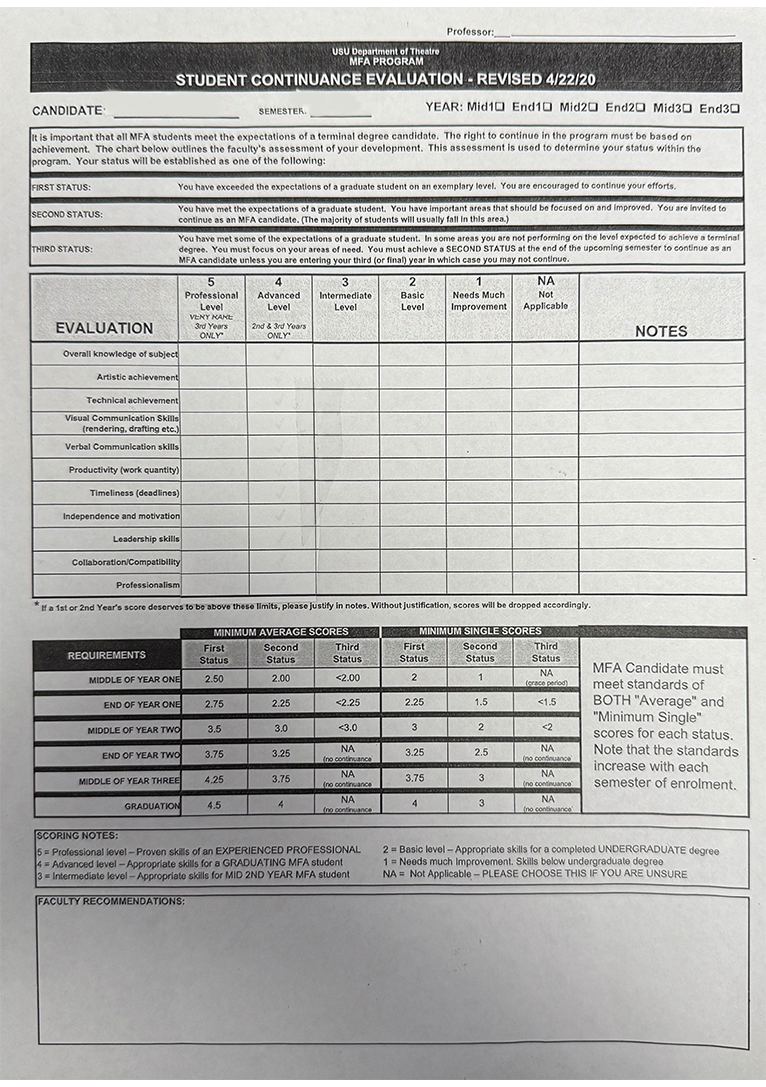
An example of the Student Continuance Evaluation has been provided below.
Criteria for BFA Assessment
BFA Student Portfolios are assessed annually by USU Design faculty using the criteria of the rubric on the Criteria for BFA Assessment page and evaluated using the Student Continuance Evaluation form.
Based on faculty assessment of each students' portfolio using the rubric above, students' progress toward meeting each competency. Their progress is assessed holistically and rated as exemplary, strong, acceptable, marginal, or poor. Students are required to meet the following benchmarks each year:
- Freshman Year Review: Acceptable or above in each of the 6 areas.
- Sophmore Year Review: Acceptable or above in all areas; Strong or above in at least 3 areas.
- Junior Year Review (and beyond): Strong or above in all areas; Exemplary in at least 1 area.
Based on this portfolio review, the faculty will then determine if students should:
- Continue in the emphasis
- To continue, students must have met the appropriate benchmarks described below, and must not be on academic, departmental, or any other form of probation.
- Be placed on programmatic probation
- If a student fails to meet all benchmarks, but in the opinion of the faculty has the potential to recover and meet the benchmarks within one semester’s time, the student may be placed on programmatic probation.
- Be discontinued from the emphasis
- If a student currently on probation fails to meet benchmarks within the time specified when he/she was placed on probation, or if his or her conduct is such that the faculty do not have confidence that he/she will be able to meet the benchmarks even during a probationary period, the student may be discontinued from the program. Students discontinued from the program may apply for re-admission only with permission of the faculty after demonstrating significant improvement from the time of their dismissal.
- If a student currently on probation fails to meet benchmarks within the time specified when he/she was placed on probation, or if his or her conduct is such that the faculty do not have confidence that he/she will be able to meet the benchmarks even during a probationary period, the student may be discontinued from the program. Students discontinued from the program may apply for re-admission only with permission of the faculty after demonstrating significant improvement from the time of their dismissal.
Outcomes Data
Enrollment & Graduates
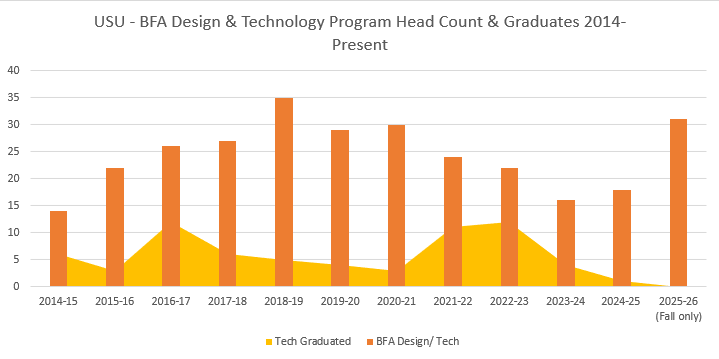
Enrollment Data is taken from USU Registered Students lists in Fall Semester of each year. Graduation Data is taken from Fall, Spring, & Summer Semester USU Graduation lists for each academic year.
| Dates | BFA Design/Tech | Tech Graduated |
|---|---|---|
| 2014-15 | 14 | 6 |
| 2015-16 | 22 | 3 |
| 2016-17 | 26 | 12 |
| 2017-18 | 27 | 6 |
| 2018-19 | 35 | 5 |
| 2019-20 | 29 | 4 |
| 2020-21 | 30 | 3 |
| 2021-22 | 24 | 11 |
| 2022-23 | 22 | 12 |
| 2023-24 | 16 | 4 |
| 2024-25 | 18 | 1 |
| 2025-26 (Fall Only) | 31 | N/A |
USU BFA Theatre Design and Technology Undergraduate Winners
American College Theatre Festival
1996-97
- Cameron Roberts was invited to the Kennedy Center two consecutive years (‘96, ‘97) after winning regional awards for her costume designs compete regionally in Cedar City in 1997. Cameron's designs were one of 14 costume exhibits from the USA featured in the USITT-sponsored (The World of Design) in Prague during the summer of 1999; she is now a graduate of Yale University and Designing in New York City.
1999
- Patrick Larsen placed second in the nation at the Kennedy Center ACTF competition in the spring of 1999 for his design for Holiday Memories, MFA, Scene Design, and University of California-San Diego.
- Brandon Moss won the Western Region ACTF competition in Eureka, CA, in February 1999 with his lighting designs for Holiday Memories, graduated MFA Lighting Design, San Diego State University
2000
- Greg Brenchley, won the Barbizon Award in lighting for KCACTF Region VIII and attended workshops at the Kennedy Center in Washington DC. MFA at Indiana University in Lighting Design, Architecture Lighting Designer, SLC
2002
- Jon Savage Regional winner Scene Design Lion in Winter 2002
2003
- Preston Horman won the Barbizon award, Kennedy Center American College Theater Festival (KCACTF) competition in Logan, Utah, in February 2003 with his lighting design for To Kill A Mocking Bird. MFA from California State University at Irvine.
- Brian Richards received a fellowship to study sound design at the North Carolina School for the Arts, 2003 KCACTF Regional Design Winner, To Kill A Mocking Bird 2003
- Rachael Wendal KCACTF Regional costume Design The Boy Who Drew Cats
2025
- Carter Lee was a finalist for the Excellence in Lighting Design award, Kennedy Center American College Theatre Festival (KCACTF) competition in Mesa, Arizona, in March 2025 for his design of The Ballad of Floyd Collins at Utah State University. Anticipated BFA from Utah State University, Spring 2026.
2026
- Samantha Clinger - Regional Honorable Mention in Lighting Design for "The Wickhams: Christmas at Pemberley"
- Chloe Satern - National Finalist in Costume Design for "Dracula, A Feminist Revenge Fantasy, Really"
- Brighton DeWitt McDonald - Regional Runner Up in Stage Management for "The Curious Incident of the Dog in the Night-Time"
- Audrey Allen - National Finalist in Projection Design for "The Wickhams: Christmas at Pemberley"
- Carter Lee - Regional Winner in Lighting Design for "Dracula, A Feminist Revenge Fantasy, Really"
Evaluation Data
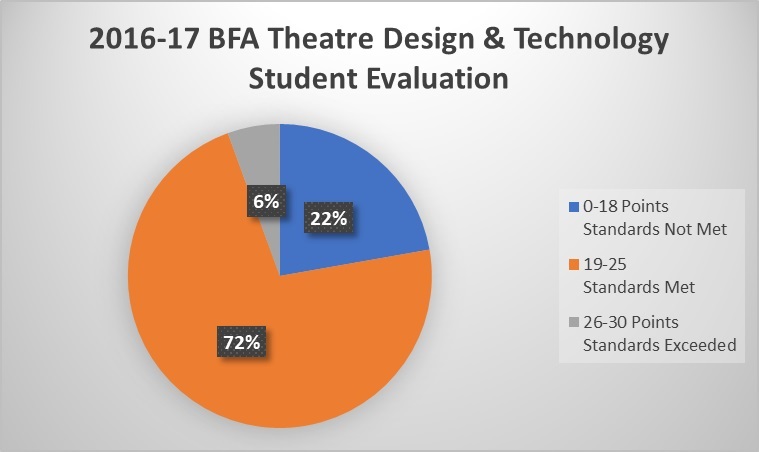
Students evaluated on their demonstration (through annual production assignments & portfolio review) of 5 areas: Literature & History Analysis, Artistry, Acadmics & Scholarship, Leadership & Service, Portfolio, Professionalism.
5 points available per area for a total possible score of 30.
2016-17
| Student | 0-18 Points Standards Not Met |
19-25 Points Standards Met |
26-30 Points Standards Exceeded |
|---|---|---|---|
| 1 | 1 | ||
| 2 | 1 | ||
| 3 | 1 | ||
| 4 | 1 | ||
| 5 | 1 | ||
| 6 | 1 | ||
| 7 | 1 | ||
| 8 | 1 | ||
| 9 | 1 | ||
| 10 | 1 | ||
| 11 | 1 | ||
| 12 | 1 | ||
| 13 | 1 | ||
| 14 | 1 | ||
| 15 | 1 | ||
| 16 | 1 | ||
| 17 | 1 | ||
| 18 | 1 | ||
| Total: | 4 | 13 | 1 |
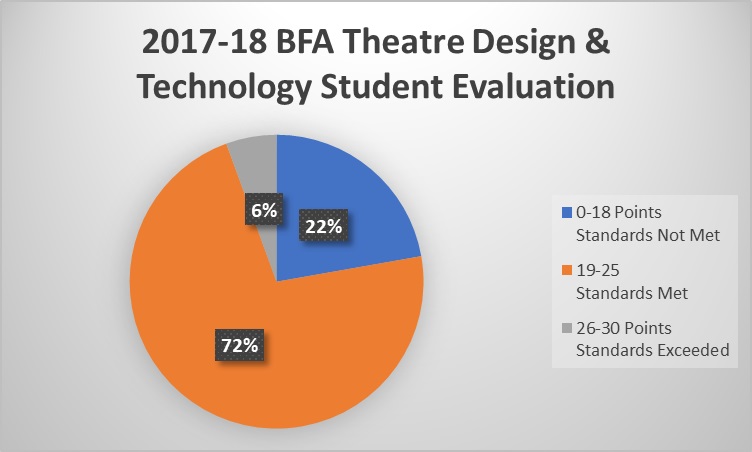
2017-18
| Student | 0-18 Points Standards Not Met |
19-25 Points Standards Met |
26-30 Points Standards Exceeded |
|---|---|---|---|
| 1 | 1 | ||
| 2 | 1 | ||
| 3 | 1 | ||
| 4 | 1 | ||
| 5 | 1 | ||
| 6 | 1 | ||
| 7 | 1 | ||
| 8 | 1 | ||
| 9 | 1 | ||
| 10 | 1 | ||
| 11 | 1 | ||
| 12 | 1 | ||
| 13 | 1 | ||
| 14 | 1 | ||
| 15 | 1 | ||
| 16 | 1 | ||
| 17 | 1 | ||
| 18 | 1 | ||
| Total: | 4 | 13 | 1 |
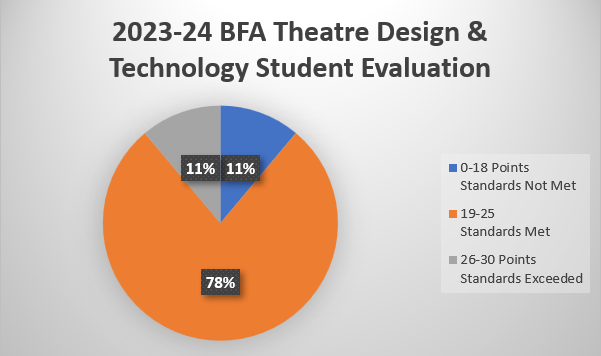
2023-24
| Student | 0-18 Points Standards Not Met |
19-25 Points Standards Met |
26-30 Points Standards Exceeded |
|---|---|---|---|
| 1 | 1 | ||
| 2 | 1 | ||
| 3 | 1 | ||
| 4 | 1 | ||
| 5 | 1 | ||
| 6 | 1 | ||
| 7 | 1 | ||
| 8 | 1 | ||
| 9 | 1 | ||
| 10 | 1 | ||
| 11 | 1 | ||
| 12 | 1 | ||
| 13 | 1 | ||
| 14 | 1 | ||
| 15 | 1 | ||
| 16 | 1 | ||
| 17 | 1 | ||
| 18 | 1 | ||
| Total: | 2 | 14 | 2 |
2024-25
| Student | 0-18 Points Standards Not Met |
19-25 Points Standards Met |
26-30 Points Standards Exceeded |
|---|---|---|---|
| 1 | 1 | ||
| 2 | 1 | ||
| 3 | 1 | ||
| 4 | 1 | ||
| 5 | 1 | ||
| 6 | 1 | ||
| 7 | 1 | ||
| 8 | 1 | ||
| 9 | 1 | ||
| 10 | 1 | ||
| 11 | 1 | ||
| 12 | 1 | ||
| 13 | 1 | ||
| 14 | 1 | ||
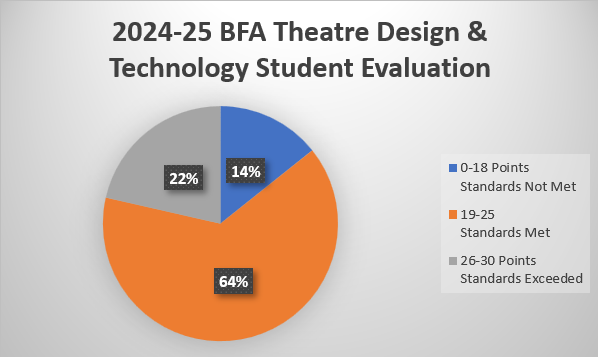
| Total: | 2 | 9 | 3 |
Data-Based Decisions
Based on the data presently available, the theatre design faculty believes that student progress in the program meets or exceeds expectations and that the best course of action at present is to expand documentation of current practices and methods of evaluations. In future years, data will be reassessed to determine if there are particular areas that warrant further investigation or possible programmatic changes.
Current program data indicates that student assessment is successful in meeting expectations yet also requires further development. While faculty and staff participate in extensive direct assessment with students, several years of written data is currently missing and our program will require multiple years to expand the documented numerical assessment in order to develop the full picture.
As our program is a constant and ever evolving field, our data must also grow and develop for accurate reflection. The quantitative data of classroom grading rubrics and enrollment to graduation rates do not provide an accurate scope for the reality of our programs’ success rate. More thorough documentation of individual student continuance evaluations, documented portfolio assessments between students and faculty, and student statements on major projects would provide a great deal of insight into a more complete assessment.
As indicated by our outcomes, our program is strong, and greater documentation of the qualitative data is required to show it. The Department of Theatre Arts Design and Technology Area is committed to developing and implement assessment protocols that align with institutional and industry standards for success and excellence.