
Program Overview
2017 MFA Theatre Arts Assessment
The USU Master of Fine Arts Program in Theatre Design and Technology is a professional training program intended to teach the crafts, motivate the creativity, and inspire the artistic vision necessary for our graduates to begin successful and livable careers in the theatre arts. Furthermore, this program emphasizes the commercial theatre model including industry standards, current artistic and technical practices, quality and diversity of portfolio, visual and oral communication skills, and professional integration. For students who, upon graduation, choose careers in academic theatre, this professional model will afford them the abilities to succeed in the dual commercial/academic profession that is the standard for theatre faculty. Most important is our commitment to guiding each individual towards their unique personal approach to theatre, based on original thought, creative vision and effective expression. As a result, students should leave Utah State University as leaders, prepared to enter the professional world with skill, confidence and a clear understanding of the path ahead.
USU Theatre Graduate Student Code
Learning Objectives
There are four areas of emphasis within the MFA Theatre design and technology program: Scenic Design, Costume Design, Lighting Design, and Technical Production. Each student also selects one area of secondary emphasis from the above list or Sound Design, Projection Design, Properties Design, Hair & Makeup Design, and Scenic Art.
At the completion of the MFA program, graduates will be prepared to demonstrate the following competencies:
- Demonstrate an overall knowledge and understanding the art and technology of theatre design.
- Present wide-ranging, innovative, and original artistic achievement through the execution of the art form.
- Demonstrate professional-level technical achievement and execute theatre designs through the process of technical practice.
- Demonstrate visual communication skills that clearly express all aspects of theatre design and technology through various mediums, including both traditional and digital methods.
- Communicate design concepts and visionary goals through verbal communication.
- Conceive, communicate, and execute designs at professional levels of productivity.
- Conceive, communicate, and execute designs at a pace that is conducive to successful theatre production and complete such activities with professional timeliness.
- Demonstrate independence and motivation by operating as self-driven, independent artist-technicians.
- Understand and demonstrate professional-level leadership skills and attitudes that facilitate successful project management.
- Function with highly effective levels of collaboration with other artists, technicians, managers, and administrators.
- Enter the commercial or educational theatre community with a commitment to professionalism and integrity.
- Enter the professional field with a highly-marketable portfolio that demonstrates a successful mastery of the above.
MFA Competencies and Course Associations
Competency 1: Overall knowledge of subject
- Students must be able to demonstrate a wide knowledge of the art form.
- Includes high expertise in the student’s area of emphasis.
- Includes advanced knowledge of the student’s secondary area of emphasis.
- Includes strong understanding of related areas including performance, management, directing, and technology.
- Developed and measured through courses that require high levels of collaboration with other artists as well as all specialized courses within the student’s area of emphasis. Courses may include Contemporary Theatre, Playwriting, Theatre Internship, Graduate Projects in Theatre, Design Studies, Advanced Design, Research Studies, Graduate Studies, and various others based on student needs.
Competency 2: Artistic Achievement
- Students must be able to demonstrate creativity, originality, and artistic mastery.
- Includes exceptional achievement in the student’s area of emphasis.
- Includes advanced achievement of the student’s secondary area of emphasis.
- Developed through design and production courses including Advanced Design, Design Studies, and Graduate Projects.
- Measured through an annual Portfolio Exhibition and Review as well as the classes listed above.
Competency 3: Technical Achievement
- Students must be able to demonstrate a mastery of the technical crafts, skills, standards, and procedures associated with the art form and profession of theatre design and technology.
- Includes mastery of the skills required to successfully execute designs within the student’s primary area of emphasis.
- Includes strong understanding and proficiency in the skills required to successfully execute designs within the student’s secondary area of emphasis.
- Developed through technical courses including Specialized Theatre Props and Craft, Advanced Lighting for Theatre, Scene Painting, Graduate Studies in Theatre, Special Topics in Theatre Production, Theatre Internship, Graduate Projects in Theatre, and various cognate classes.
- Measured through an annual Portfolio Exhibition and Review as well as the classes listed above.
Competency 4: Visual Communication Skills
- Students must be able to demonstrate a mastery of appropriate methods of visual communication as dictated by their area of primary emphasis.
- Set design – Sketching, painting, rendering, perspective drawing, hand drafting, computer drafting, computer-aided-design, and visual research.
- Costume design – Sketching, painting, rendering, pattern drafting, computer-aided-design, and visual research.
- Lighting design – Sketching, painting, rendering, perspective drawing, hand drafting, computer drafting, computer-aided-design, and visual research.
- Technical Production –Hand drafting, computer drafting, and computer-aided-design.
- Developed through technical courses including Drafting for Theatre, Design Studies, Advanced Design, Rendering in Theatre Design, Computer Aided Design for Theatre, Theatre Internship, Graduate Projects in Theatre, Special Topics in Theatre Production, and various cognate classes.
- Measured through an annual Portfolio Exhibition and Review as well as the classes listed above.
Competency 5: Verbal Communication Skills
- Students must be able to communicate complex concepts, visionary endeavors, perceived problems/solutions, and production needs through verbal means.
- Developed through courses that require high levels of collaboration with other artists as well as all specialized courses within the student’s area of emphasis. Courses may include Theatre Internship, Graduate Projects in Theatre, Design Studies, Advanced Design, Research Studies, Graduate Studies, and various others based on student needs.
- Measured through an annual Portfolio Exhibition and Review, Student Continuance Evaluations, MFA Plan-B Defense meeting as well as the courses listed above.
Competency 6: Productivity
- Students must be able to produce professional-level quantities of creative and technical output.
- Developed through courses that require high quantities of creative and technical output. Courses may include Theatre Internship, Graduate Projects in Theatre, Design Studies, Advanced Design, Research Studies, Graduate Studies, and various others based on student needs.
- Measured through an annual Portfolio Exhibition and Review as well as the courses listed above.
Competency 7: Timeliness
- Students must be able to produce creative and technical work at a pace output on par with that of early-career professionals.
- Developed through courses that require high quantities of creative and technical output. Courses may include Theatre Internship, Graduate Projects in Theatre, Design Studies, Advanced Design, Research Studies, Graduate Studies, and various others based on student needs.
- Measured through an annual Portfolio Exhibition and Review as well as the courses listed above.
Competency 8: Independence and Motivation
- Students must be self-driven leaders who recognize the needs of the production and execute them based on a self-driven approach.
- Must demonstrate the initiative and ability to recognize and diagnose problems.
- Must seek solutions either through experience-based problem solving or seeking and finding answers from the appropriate sources or individuals.
- Must maintain a rigorous process of time-management that facilitates the ability to execute responsibilities without intervention from outside sources.
- Developed through courses that require high quantities of creative and technical output, especially those requiring large-scale project management. Courses may include Theatre Internship, Graduate Projects in Theatre, Design Studies, Advanced Design, Research Studies, Graduate Studies, and various others based on student needs. Also developed through the Graduate Assistantship program.
- Measured through, fully-produced stage productions, an annual Portfolio Review as well as the courses listed above.
Competency 9: Leadership Skills
- Students must be highly-effective leaders who can run a complex operation including team-management, peer collaboration, undergraduate student mentoring, and project management.
- Developed through courses that require high levels of collaboration, especially those requiring large-scale project management and staff supervision. Courses may include Theatre Internship, Graduate Projects in Theatre, Design Studies, Advanced Design, Research Studies, Graduate Studies, and various others based on student needs. Also developed through the Graduate Assistantship program.
- Measured through stage productions, an annual Portfolio Review as well as the courses listed above.
Competency 10: Collaboration
- Students must be able to successfully execute complex artistic and technical projects as part of a diverse team creating a singular work of art.
- Developed through courses that require high levels of collaboration, especially those requiring large numbers of personnel and complex designs. Courses may include Theatre Internship, Graduate Projects in Theatre, Design Studies, Advanced Design, Research Studies, Graduate Studies, and various others based on student needs. Also developed through the Graduate Assistantship program.
- Measured through fully produced stage productions, an annual Portfolio Review as well as the courses listed above.
Competency 11: Professionalism
- Students must meet or exceed all standards of industry professionalism including:
- Stage protocols
- Standards of participation/attendance
- Healthy communication and conflict management
- Consistency in quality and reliability
- Developed through courses that result in fully-produced designs, especially those requiring large numbers of personnel and complex project management. Courses may include Theatre Internship, Graduate Projects in Theatre, and various others based on student needs. Also developed through the Graduate Assistantship program.
- Measured through fully produced stage productions, an annual Portfolio Review as well as the courses listed above.
Competency 12: Portfolio
- Although many aspects of the portfolio are covered by previous competencies, the professional standards of branding, self-promotion, presentation methods, and interview preparation are key to a graduate’s success.
- Developed through the Theatre Production Portfolio course.
- Measured through an annual Portfolio Exhibition and Review, Student Continuance Evaluations, MFA Plan-B Defense meeting, and the Theatre Production Portfolio course.
Assessment Plan
Student progress on the competencies above is assessed formatively through ongoing mentoring, advising, and feedback throughout the year from the MFA faculty in the Department of Theatre Arts, as well as through feedback from guest artists and educators.
MFA Continuance Evaluation Standards
Student Continuance Evaluation
Formal, summative assessment takes place regularly through three means.
- Completion of courses related directly to the competencies with minimum grades of B- for all MFA students.
- Compilation of extensive portfolios documenting students' achievement in each of the twelve competencies, which are reviewed by a minimum of three-design faculty during the annual Portfolio Review
- Biannual Continuance Evaluations conducted by MFA faculty.
Assessment Part I: Course Completion with Satisfactory Grades
Students complete a comprehensive training program that includes 60 credits of advanced professional training in the appropriate areas of emphasis. Students must pass all of these courses with a minimum grade of B-. Courses are generally categorized as follows:
- Introductory courses (5 credits)
- Advanced Literature courses (5-6 credits)
- Advanced Design courses (16-17 credits)
- Cognate Skill courses (6 credits)
- Design Studies course (studio lab, 12 credits)
- Graduate Projects (9-10 credits)
- Theatre Internship (6 credits)
- Culminating courses (4 credits)
Assessment Part II: Annual Portfolio Review
At the end of each academic year, students prepare portfolios comprised of artifacts that demonstrate their evolving skills in each emphasis area, compose letters of intent, and provide a current resume. USU MFA faculty review students’ portfolios, conduct public interviews at which students explain and defend their work, and provide detailed feedback regarding progress and achievements.
The Portfolio Review process is comprised of the following presentation items and activities:
- Current professional resume or curriculum vitae
- Samples of work from all years of participation at USU. These vary by area of emphasis but may include:
- Visual research and supporting documentation
- Drawing, sketches, renderings, paint elevations, swatches
- Models, mock-ups, miniature examples
- Management literature, schedules, costume bibles, lighting paperwork, props plots etc.
- Drafting, painting samples, and other technical drawings
- Fully executed samples of props, costumes, wigs, and scenic items.
- Verbal presentation of all work including:
- Concept statements
- Project justifications
- Chronological descriptions of various design projects
- Descriptions of challenges, solutions, and outcomes for various projects
- Specific and general self-assessments
- Requests for future foci within the program
Assessment Part III: Continuance Evaluations
At the end of each semester, the MFA faculty assesses the performance of each MFA student. The assessment criteria is described in detail via the Continuance Evaluation Form shown below. Once these assessments are made, the MFA faculty meets with each individual student to present and justify the assessment numerical scores while also providing detailed feedback regarding past performance and future goals and recommendations. The students also have the opportunity to express needs and concerns regarding their studies at USU.
Based on this portfolio review and coursework, the MFA faculty will assign a “status” to each student as follows:
First Status – They have met the expectations of an MFA student on an exemplary level. Their work is above that which is expected of a student at their current semester of training (semesters 1-6). They are invited to continue in the program and are encouraged to maintain their current level of effort.
Second Status – They have met the expectations of an MFA student. They have demonstrated consistent success but may have areas that require increased focus and effort. They are invited to continue in the program.
Third Status - They have met some of the expectations of a graduate student. In some areas they are not performing on the level or pace expected to achieve a terminal degree. They are expected to focus on specific areas of need as outlined on the evaluation form. They are placed on probation and are required to achieve a Second Status by the end of the upcoming semester if they wish to continue as an MFA candidate. If they are entering the third (or final) year of the program, they are released from the program.
Outcomes Data
The USU MFA Program in Theatre Design and Technology is one based on personal one-on-one attention and support, both during the academic process and in the years to follow.
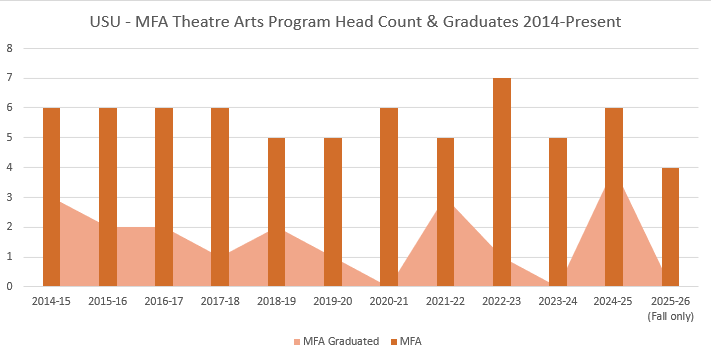
Enrollment & Graduates
| Dates | MFA | MFA Graduated |
|---|---|---|
| 2014-15 | 6 | 3 |
| 2015-16 | 6 | 2 |
| 2016-17 | 6 | 2 |
| 2017-18 | 6 | 1 |
| 2018-19 | 5 | 2 |
| 2019-20 | 5 | 1 |
| 2020-21 | 6 | 0 |
| 2021-22 | 5 | 3 |
| 2022-23 | 7 | 1 |
| 2023-24 | 5 | 0 |
| 2024-25 | 6 | 4 |
| 2025-26 (Fall only) | 4 | n/a |
USU MFA Theatre Arts Winners
American College Theatre Festival
1996-97
- Craig Brashears Faculty Scenic Designer/Technical Director at Del Mar College in Corpus Christi, Texas, in the summer of 1999; he was a finalist at the Kennedy Center in 1996 in the ACTF competition with his designs for the new play by Jack Gilhooley, The Machine.
1998
- Craig Brashears ACTF regional winner, lighting design for Into the Woods 1998
1999
- Nina-Nikolic McMillan was a finalist at the ACTF competition at the Kennedy Center in 1999 with her costume designs for The Royal Family.
2003
- Philp Lowe ACTF Nationals Costume Design 2003,
2004
- Amanda Profaizer, KCACTF Regional winner, The Beaux Stratagem, 2004
2005
- Macy Perone, KCACTF Regional winner Costume Design, The Hollow 2005, Freelance designer in Texas
- Darrin Brooks, Faculty, USU Interior Design, KCACTF Regional winner Scenery Design, Hayfever 2005
2006
- Kay Townsen, KCACTF Regional Make-up Design winner, Macbeth, 2006
- Caress Bergato, KCACTF Regional winner Scene Design, Sleepy Hollow, 2006
- Macy Perone, KCACTF Regional winner Costume Design, Comedy of Errors, 2006, Freelance designer in Texas
- Amanda Profaizer, KCACTF Regional winner, Sleepy Hollow, 2006
2007
- Kay Townsen, KCACTF Regional Sound Design winner, Anna in the Tropics, 2007
2008
- Kay Townsen, KCACTF Regional Lighting Design winner, Urinetown, 2008
2010
- Anthony Johnson, Faculty University Montana, KCACTF Regional Lighting Design winner, Issun Bossi, 2010
2011
- Melinda Week, KCACTF Regional Lighting Design winner, Seussical, 2010
- Brandi Jenks, KCACTF Regional winner Set Design, Golf Balls, 2010, 2013
2014
- Steven Piechocki, Barbizon award, Kennedy Center American College Theater Festival (KCACTF), Utah, in February 2013 with his lighting design for A Catered Affair, National award for the same production in April 2013, including and internship at the Eugene O’Neill Theatre
- Chelsea Richardson, KCACTF Honorable Mention, Set Design, Still Life with Iris
- Katy Parks, KCACTF Honorable Mention Costume Design, Still Life with Iris
- Hongji Zue, KCACTF 1st Place Costume Design Paper Project, A Winter's Tale
2015
- Katy Parks, KCACTF National Winner for Theatrical Design excellence in Costume Design Bus Stop
- Hongji Zue, KCACTF Honorable Mention Costume Design A Game of Love and Chance
- Jenny Cawley, KCACTF 1st Place Costume Design Paper Project Gappers of Frip
2026
- Mac McDermott - Heart of the Art Award for Scenic Design
Evaluation Data
2022-23 MFA Theatre Arts Annual Evaluation
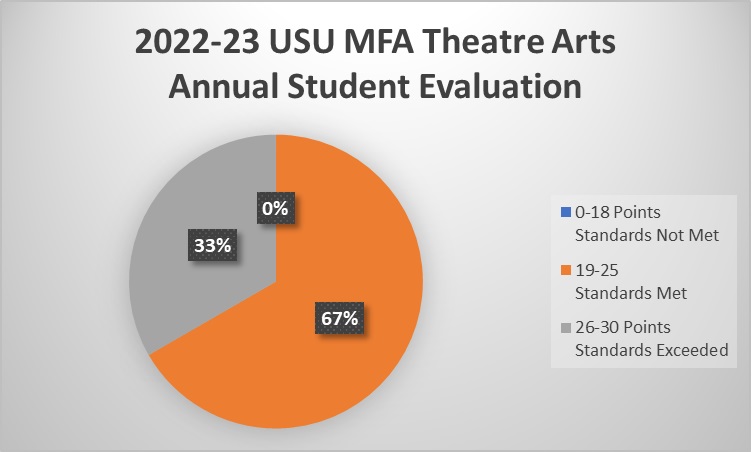
Students evaluated on their demonstration (through annual production assignments & portfolio review) of 5 areas: Literature & History Analysis, Artistry, Acadmics & Scholarship, Leadership & Service, Portfolio, Professionalism. 5 points available per area for a total possible score of 30.
| Student | 0-18 Points Standards Not Met |
19-25 Points Standards Met |
26-30 Points Standards Exceeded |
|---|---|---|---|
| 1 | 1 | ||
| 2 | 1 | ||
| 3 | 1 | ||
| 4 | 1 | ||
| 5 | 1 | ||
| 6 | 1 | ||
| 7 | |||
| 8 | |||
| 9 | |||
| 10 | |||
| 11 | |||
| 12 | |||
| 13 | |||
| 14 | |||
| 15 | |||
| 16 | |||
| 17 | |||
| 18 | |||
| Total: | 0 | 4 | 2 |
Data-Based Decisions
Based on the data presently available, the theatre design faculty believes that student progress in the program meets or exceeds expectations, and that the best course of action at present is to continue with current practices and methods of evaluations. In future years, data will be re-assessed to determine if there are particular areas that warrant further investigation or possible programmatic changes.