
Program Overview
2023 BA Theatre Arts Assessment
Students pursuing the BA receive a degree in general theatre arts. This is a four-year program designed for students who want a more comprehensive liberal arts background in theatre. This emphasis prepares students for graduate study and is also appropriate for those entering the field of stage directing. This program provides students with the flexibility to pursue an additional major. The BA degree requires foreign language training and the completion of additional related study courses.
Assessment
Assessment of BA Theatre Arts students is based upon five areas of study. Upon successful completion of the BA Theatre Arts program, students will be able to:
- Performance and Technical Skills
- Apply fundamental acting techniques including action, concentration, observation, and imagination in performance
- Demonstrate proficiency in basic stagecraft, including set construction, rigging, welding, and props management
- Execute essential costume construction techniques, including sewing, pattern drafting, and costume crafts
- Operate standard stage equipment and implement various staging methods safely and effectively
- Analytical and Directorial Competencies
- Analyze theatrical texts for plot structure, character development, language, and thematic elements
- Apply directorial principles in play selection, blocking, rehearsal management, and production organization
- Evaluate historical and contemporary staging practices in relation to dramatic texts
- Demonstrate leadership and effective communication skills in theatrical production settings
- Historical and Literary Knowledge
- Trace the evolution of global performance traditions from theatrical origins through the eighteenth century
- Examine the development of dramatic literature and performance practices from the nineteenth century to present day
- Apply knowledge of Shakespearean dramatic conventions and literary techniques to textual analysis and performance
- Connect historical theatrical movements to contemporary practice
- Practical Production Experience
- Collaborate effectively within production teams across various technical areas (costume, scenic, props, run crew)
- Apply theoretical knowledge to hands-on production work through practicum experiences
- Demonstrate professional conduct and organizational skills in theatrical production environments
- Execute specialized crew work under the guidance of technical direction
- Professional Development
- Develop a professional approach to theatrical production applicable in professional, civic, and educational settings
- Demonstrate safe working practices in all areas of theatrical production
- Exercise effective time management and personal organization skills
- Show proficiency in theatrical terminology and production protocols
Students’ progress on the BA Theatre Arts is assessed though successful completion of the core courses over the program of study and a yearly annual review where students submit their CV, a self-reflection letter, and their portfolio. The content of the core courses aligns with the learning objectives outlined above. Minimum GPA for continuance in the program and for graduation is 2.75. This is monitored by the head of program and the academic advisor. Many students on the BA course also opt for another major so pathways are specifically tailored for each student. At incremental points throughout the semester, students are required to complete ‘check-ins’ with the head of the BA program to reflect on progress and goal set for future attainment.
Outcomes Data
Enrollment Data taken from USU Registered Students lists in Fall Semester of each year. Graduation Data taken from Fall, Spring, & Summer Semester USU Graduation lists for each academic year.
BA Theatre Arts Student Data
| Dates | BA | BA Graduated |
|---|---|---|
| 2014 - 15 | 9 | 2 |
| 2015 - 16 | 8 | 2 |
| 2016 - 17 | 7 | 0 |
| 2017 - 18 | 7 | 1 |
| 2018 - 19 | 5 | 1 |
| 2019 - 20 | 6 | 1 |
| 2020 - 21 | 9 | 0 |
| 2021 - 22 | 12 | 1 |
| 2022 - 23 | 8 | 1 |
| 2023 - 24 | 9 | 4 |
| 2024 - 25 | 4 | 2 |
| 2025 - 26 (Fall only) | 26 | n/a |
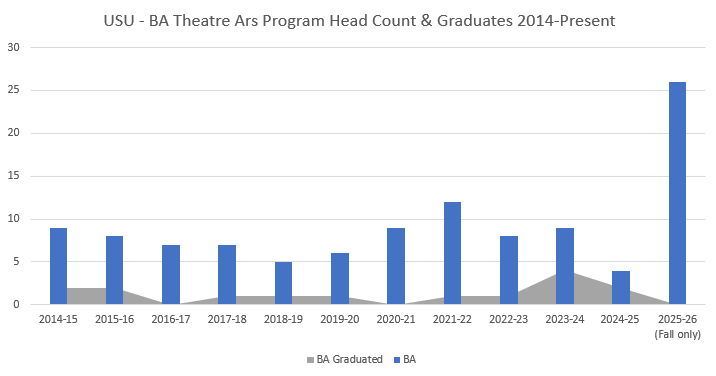
Aside from successful completion of the core courses, previously there was no formal yearly review cycle for BA students. New for 2025/6, students in the BA Program will undergo an annual review. The annual review will comprise of the following:
- Self-assessment letter
- Artistic resume
- Website portfolio
- GPA (minimum of 2.75)
Benchmarks
Students must meet progressively rigorous benchmarks each year, as detailed below. This schedule applies to students who enter the program as first-year university students (i.e. directly from high school). Transfer students may be required to meet benchmarks on a revised timetable.
| Year | Minimum Benchmark |
|---|---|
| Year 1 | Pass in all areas |
| Year 2 | Pass in all areas and demonstrate some emerging practice in the effective category. |
| Year 3 | Effective in at least one area, pass in other two areas |
| Year 4 (+) | Effective in all areas |
Assessment Rubric
The following rubric provides general frameworks the faculty will consider when assessing students' progress. The rubric offers only a starting point, however. Every student is unique and possesses different extant skills, aptitudes, and experiences. Given students' diverse backgrounds and short-term and long-term professional goals, faculty work with students on individual bases to determine the most appropriate criteria for assessing each their performance. While the rubric provides a general sense of the goals students should strive to achieve, faculty will use their discretion when assessing student achievement.
| Assessment Category | Exceptional | Effective | Pass | Fail |
|---|---|---|---|---|
| Artistry | Envisions, creates, or significantly contributes to the creation of exceptional artistic projects. | Envisions, creates, or significantly contributes to the creation of high-quality artistic projects. | Makes meaningful contributions to the creation of high-quality artistic projects. | Fails to make meaningful contributions to artistic projects. Work is of poor quality or incomplete. |
| Professionalism |
Consistently exhibits extraordinary respect for others and context-appropriate attitudes, enthusiasm & engagement. Consistently offers helpful / competent feedback & receives criticism with grace. Consistently on time and fully prepared for courses, meetings, rehearsals, etc. |
Frequently exhibits respect for others and context-appropriate attitudes, enthusiasm, and engagement. Frequently offers helpful / competent feedback & receives criticism with grace. Frequently on time and fully prepared for courses, meetings, rehearsals, etc. |
Usually exhibits respect for others and context-appropriate attitudes, enthusiasm, and engagement. Generally offers helpful / competent feedback & receives criticism with grace. Usually on time and fully prepared for courses, meetings, rehearsals, etc. |
Frequently disrespectful or inappropriate in attitude or behavior. Unable to give or receive feedback constructively. Frequently late or unprepared for courses, meetings, or rehearsals. |
| Portfolio |
Provides comprehensive, accurate, and current information. Demonstrates deep understanding and insight into theatre and teaching techniques and practices. Reflects advanced critical thinking and artistic interpretation. Easily to read and navigate (links and files work corrected, free from typos, etc.). |
Presents thorough and accurate information. Shows solid understanding of theatre and teaching techniques and practices. Reflects good critical thinking and artistic interpretation. Easily to read and navigate (links and files work corrected, free from typos, etc.). |
Provides adequate and generally accurate information. Demonstrates basic understanding of theatre and teaching techniques and practices. Reflects basic critical thinking and artistic interpretation. Minimal typos and grammar errors and/or broken links. |
Information is or may be incomplete or inaccurate. Shows developing or limited understanding of theatre and teaching techniques and practices. Various typos and grammar errors and/or missing information and/or broken links. |
| Self-Assessment Letter |
Demonstrates profound and insightful reflection on personal experiences and learning. Explores deep connections between experiences and personal or professional growth. Provides detailed and specific examples to support reflections. Meets the minimum word count required. |
Provides thoughtful reflection on personal experiences and learning. Makes clear connections between experiences and growth. Provides specific examples to support reflections. Meets the minimum word count required. |
Offers basic reflection on personal experiences and learning. Makes some connections between experiences and growth. Provides some specific examples, but they may be general or limited in detail. Meets the minimum word count required. |
Reflection is limited or surface-level. Makes few (or no) connections between experiences and growth. Lacks evidence to support reflections. Does not meet the minimum word count required. |
| Artistic Resume |
Exceptionally well-organized and professional. Highlights key achievements and relevant skills. Free of errors and tailored to the field. |
Well-organized and professional. Clearly presents relevant experience and skills. |
Adequately organized. Includes relevant information but may lack some detail or polish. |
Poorly organized or unprofessional. Lacks relevant information or contains significant errors. |
First set of data for this annual review will be collected in Spring 2026.