
Program Overview
2025 BFA Theatre Education K-12 Assessment
The B.F.A. in Theatre Education prepares students to pursue careers as professional theatre educators. Alumni work with high schools, middle schools, elementary schools, and professional arts organizations throughout the country. Students who successfully complete the program are eligible to receive licensure from the Utah State Board of Education in secondary education with an endorsement in theatre (grades K-12). The theatre education program emphasizes practical experience working with young people from the beginning of students’ studies and offers a small, supportive learning community and individual mentorship. Students receive thorough training in all aspects of theatre pedagogy, theatre for young audiences, and applied theatre.
Students in the theatre education program study all aspects of theatre as they prepare to teach theatre in schools at all levels or to work in educational roles with professional theatres. Coursework covers theatre/drama pedagogy (K-12), theatre for young audiences, applied theatre, performance, directing, technical theatre, and theatre history/literature.
Learning Objectives
Prior to graduating from the program, students must demonstrate competency in three distinct areas directly related to successful professional practice in the field.
Competency I: Pedagogy (K-12 Teacher Certification Students)
- The method and practice of teaching.
- Leadership and service as related to teaching.
- Scholarship and research as related to teaching. Specifically: Knowledge of pedagogical theories and practices
Students must be able to:
- Consistently designs exceptionally strong theatre/drama-based lessons.
- Shows an excellent ability to facilitate sessions with K-12 students.
- Demonstrates strong commitment to reflexive praxis.
- Actively promotes and implements inclusive practices, showing advanced skills in engaging with diverse groups and adapting teaching methods to meet varied needs.
Competency II: Artistry
- Creative skill or ability; the practice of making art.
- Leadership and service as related to artistry.
- Scholarship and creative research as related to artistry.
Students must be able to:
- Regularly envision, create, or significantly contribute to the creation of high-quality artistic projects (as assessed by university faculty, professional community partners, and peers).
Competency III: Professionalism
- Professional behavior (communication, participation, collaboration, and reflection) in pedagogy, artistry, leadership, service, scholarship and research.
- Following guidelines set out in USU Student Conduct and the Department of Theatre Arts Student Handbook.
- Additional student academics – enrollment, GPA, etc. – will be considered.
Students must be able to:
- Consistently exhibits extraordinary respect for others and context-appropriate attitudes, enthusiasm & engagement.
- Consistently offers helpful / competent feedback & receives criticism with grace.
- Consistently on time and fully prepared for courses, meetings, rehearsals, etc.
NOTE: The outcomes for this program have been developed to align with the guidelines from the National Association of Schools of Theatre (NAST), as well as with the mandates for teacher-preparation programs in theatre arts education set forth by the Utah State Office of Education (USOE).
Assessment Plan
Each spring, students in the BFA Theatre Education program will participate in an annual review. The annual review will comprise of the following:
- Self-assessment letter
- Artistic or teaching resume
- Academic Curriculum Vitae (CV)
- Website portfolio
- GPA (see “Academic and Disciplinary Probation” below)
The faculty will notify students in writing of the result of their annual review as soon as possible, usually one month after the end of the semester in which the review takes place.
Benchmarks
Students must meet progressively rigorous benchmarks each year, as detailed below. This schedule applies to students who enter the program as first-year university students (i.e. directly from high school). Transfer students may be required to meet benchmarks on a revised timetable.
Year 1: Pass in all areas.
Year 2: Pass in all areas and demonstrate some emerging practice in the effective category.
Year 3: Effective in at least one area, pass in other two areas.
Year 4+: Effective in all areas.
Self-Assessment Letter
The purpose of reflective self-assessment letters is to engage students in critical reflection on their developing practice as theatre arts educators. The letters also serve as an introduction and guide to the rest of students' portfolios. In their self-assessment letters, students should highlight their work, which demonstrates what benchmark they have achieved including growth from previous reviews. Letters should include:
- A 200 word (minimum) reflection on pedagogy
- A 200 word (minimum) reflection on artistry
- A 200 word (minimum) reflection on professionalism
- A 100 word (minimum) reflection on academics (GPA, areas of growth, etc.)
- A 100 word (minimum) articulation of goals and hopes for the next academic year
Students should assess their performance in each area by indicating which benchmark they believe they have achieved based on the criteria described in the rubric. Students must make specific references to the criteria in the rubric to justify their ratings. For example, “I achieved ‘satisfactory’ in artistry because XYZ.” No other criteria, such as students' own perceptions what constitutes high-quality work, may be applied. Students should support all claims with direct evidence from the artifacts.
Resume
Students will develop and maintain an artistic and/or teaching resume throughout their time in the program. A resume is a formal, concise document that demonstrates an individual’s education, experience, skills, and qualifications for a specific position. Resumes are typically used for non-academic positions. Resumes are typically 1-2 pages. Students will submit an updated resume to be considered with their annual review.
Curriculum Vitae (CV)
Students will develop and maintain an academic CV. A CV presents a full history of an individual’s academic credentials, education, experience, and more. This document is more detailed than a resume and may include research, grants, in additional the materials listed on a resume. CVs are typically used for academic positions. CVs can be any length. Students will submit an updated CV to be considered with their annual review.
Portfolio
Students will develop and maintain a website portfolio that highlights their progress in the areas of pedagogy, artistry, and professionalism.
Students should collect and retain evidence of their accomplishments in each area continuously throughout their enrollment in order to ensure they have a variety of artifacts to include in their portfolios. Evidence may include the following:
- Pedagogy
- Formal assessments of teaching, such as Clinical Experience Mentor Teacher Evaluations, Professional Review Evaluations, and/or Student Evaluations of Teaching.
- Completed session designs that demonstrate students' ability to articulate clear, relevant learning objectives; appropriate, effective assessment methods; and comprehensive, engaging learning plans.
- Video, photo, or other multimedia documentation that clearly demonstrates the quality of session facilitation and other teaching activities.
- Letters of support from students and/or students' parents/guardians; supervisors; and/or peers.
- Research products including journal articles, conference paper/poster sessions, and other public presentations related to teaching.
- Or other appropriate materials.
- Artistry
- Reviews of productions or other artistic projects by faculty, media and/or peers, as appropriate.
- Video, photo, or other multimedia documentation that clearly demonstrates the quality of a particular aspect of a creative project.
- Other documentation appropriate to the specific artist performed (i.e. a promptbook for stage managers, program notes for a dramaturg, script analysis for actors/directors).
- Research products including journal articles, conference paper/poster sessions, and other public presentations related to artistry.
- Or other appropriate materials.
- Professionalism
- Professional and peer evaluations from pedagogical and/or artistic opportunities.
- Thank you notes about your contributions to teaching, artistry, research, and more.
- While documentation of leadership and service may be included in the pedagogy and artistry, students should include this section to document accomplishments not addressed elsewhere, or to elaborate on earlier examples.
- Or other appropriate materials.
All students may include artifacts in their portfolio dating to the time they enrolled as regular undergraduate students at an institution of higher education (including but not limited to USU, not including time as a concurrent enrollment student while in high school). First and second year students may include artifacts from high school; however, they must replace these artifacts with more contemporary artifacts beginning in their third year.
Assessment Rubric
The rubric provides general frameworks the faculty will consider when assessing students' progress in each area (pedagogy, artistry, professionalism as well as the components of the annual review).
The rubric offers only a starting point, however. Every student is unique and possesses different extant skills, aptitudes, and experiences. Given students' diverse backgrounds and short-term and long-term professional goals, faculty work with students on individual bases to determine the most appropriate criteria for assessing each their performance. While the rubric provides a general sense of the goals students should strive to achieve, faculty will use their discretion when assessing student achievement.
| Category | Exceptional | Effective | Pass | Fail |
|---|---|---|---|---|
| Pedagogy |
Consistently designs exceptionally strong theatre/drama-based lessons. Shows an excellent ability to facilitate sessions with K-12 students. Demonstrates strong commitment to reflexive praxis. Actively promotes and implements inclusive practices, showing advanced skills in engaging with diverse groups and adapting teaching methods to meet varied needs. |
Designs effective theatre/drama-based lessons. Effectively facilitates sessions with K-12 students. Demonstrates commitment to reflexive praxis. Shows competence in working with diverse groups, consistently applying inclusive practices and adapting approaches to different cultural contexts. |
Designs basic theatre/drama-based lessons with guidance. Shows potential in facilitating sessions with K-12 students. Demonstrates awareness of reflexive praxis and attempts to apply it. Shows genuine interest in theatre education and willingness to work with diverse groups. |
Fails to demonstrate adequate pedagogical skills or knowledge. Unable to design or facilitate effective theatre/drama-based lessons. Shows little to no commitment to reflexive praxis or working with diverse groups. |
| Artistry |
Envisions, creates, or significantly contributes to the creation of exceptional artistic projects at least threetimes annually. |
Envisions, creates, or significantly contributes to the creation of high-quality artistic projects at least twice annually. |
Makes meaningful contributions to the creation of high-quality artistic projects at least twice annually. |
Fails to make meaningful contributions to artistic projects. Work is of poor quality or incomplete. Unable to meet the minimum requirement of two projects annually. |
| Professionalism |
Consistently exhibits extraordinary respect for others and context-appropriate attitudes, enthusiasm & engagement. Consistently offers helpful / competent feedback & receives criticism with grace. Consistently on time and fully prepared for courses, meetings, rehearsals, etc. |
Frequently exhibits respect for others and context-appropriate attitudes, enthusiasm, and engagement. Frequently offers helpful / competent feedback & receives criticism with grace. Frequently on time and fully prepared for courses, meetings, rehearsals, etc. |
Usually exhibits respect for others and context-appropriate attitudes, enthusiasm, and engagement. Generally offers helpful / competent feedback & receives criticism with grace. Usually on time and fully prepared for courses, meetings, rehearsals, etc. |
Frequently disrespectful or inappropriate in attitude or behavior. Unable to give or receive feedback constructively. Frequently late or unprepared for courses, meetings, or rehearsals. |
| Portfolio |
Provides comprehensive, accurate, and current information. Demonstrates deep understanding and insight into theatre and teaching techniques and practices. Reflects advanced critical thinking and artistic interpretation. Easily to read and navigate (links and files work corrected, free from typos, etc.). |
Presents thorough and accurate information. Shows solid understanding of theatre and teaching techniques and practices. Reflects good critical thinking and artistic interpretation. Easily to read and navigate (links and files work corrected, free from typos, etc.). |
Provides adequate and generally accurate information. Demonstrates basic understanding of theatre and teaching techniques and practices. Reflects basic critical thinking and artistic interpretation. Minimal typos and grammar errors and/or broken links. |
Information is or may be incomplete or inaccurate. Shows developing or limited understanding of theatre and teaching techniques and practices. Various typos and grammar errors and/or missing information and/or broken links. |
| Self-Assessment Letter |
Demonstrates profound and insightful reflection on personal experiences and learning. Explores deep connections between experiences and personal or professional growth. Provides detailed and specific examples to support reflections. Meets the minimum word count required. |
Provides thoughtful reflection on personal experiences and learning. Makes clear connections between experiences and growth. Provides specific examples to support reflections. Meets the minimum word count required. |
Offers basic reflection on personal experiences and learning. Makes some connections between experiences and growth. Provides some specific examples, but they may be general or limited in detail. Meets the minimum word count required. |
Reflection is limited or surface-level. Makes few (or no) connections between experiences and growth. Lacks evidence to support reflections. Does not meet the minimum word count required. |
| Resume |
Exceptionally well-organized and professional. Highlights key achievements and skills relevant to theatre education. Free of errors and tailored to the field. |
Well-organized and professional. Clearly presents relevant experience and skills. |
Adequately organized. Includes relevant information but may lack some detail or polish. |
Poorly organized or unprofessional. Lacks relevant information or contains significant errors. |
| CV |
Comprehensive and well-structured. Demonstrates extensive relevant experience, skills, and achievements in theatre education. Perfectly formatted and error-free. |
Well-structured with good detail on relevant experience and skills. Demonstrates a strong background in theatre education. Minor formatting or grammatical issues, if any. |
Covers relevant information. May lack some detail or polish. Structure could be improved and / or may contain a few errors. |
Incomplete or poorly structured. Lacks critical information relevant to theatre education. Contains multiple errors or is formatted unprofessionally. |
Academic and Disciplinary Probation
(Per the USU Department of Theatre Arts Handbook)
Students must maintain an overall GPA of 2.75. No theatre course below a B- grade will be accepted as meeting graduation requirements. Theatre Ed certification students are required to have a GPA of 3.0. No theatre course below a B grade will be accepted as meeting graduation requirements.
Probation
Academic Probation is implemented by the Theatre Department based on cumulative grade point average. Any student who fails to maintain a 2.75 (B-) cumulative grade point average is on academic probation. While on probation a student may not participate in Department productions, must not have a semester GPA below 2.75 and all Theatre courses must have a minimum of a ‘B’ grade. Academic disciplinary action will be taken by the Department head. These actions may include letter of warning, registration holds, more meetings with the Academic Advisor, dismissal from the Program, or other actions as deemed appropriate for the circumstances.
Disciplinary Probation is implemented by the Theatre Department when, upon the recommendation of the faculty, a student is deemed negligent in meeting the requirements of the Theatre Department as outlined in this handbook, or when their behavior is disruptive to the learning environment. Notification of probation will ordinarily be made at the end of a semester so that a student will be able to correct any deficiencies by the end of the following semester. Failure to address the conditions of the probation will result in immediate dismissal from the Theatre Department Programs.
Assessment Part I: Course Completion with Satisfactory Grades
Students complete a comprehensive training program that includes a core of 32.5 credits of theatre core courses designed to ensure a rigorous background in acting, technical theatre, directing, stage management, and theatre history and literature. Students must pass all of these courses with a minimum grade of B-.
Students take an additional 34 credits of coursework directly related to the teaching of theatre, including 9 credits of teaching methods courses, 12 credits of field experience, and 13 credits of seminars and supplemental courses directly related to the intersection of theatre and young people. They must earn a minimum grade of B in each of these courses.
Students furthermore take 14 credits of pedagogically-based courses offered by USU's college of Education, and must earn a minimum grade of B in each of these courses.
Assessment Part II: Annual Portfolio Review
Students will develop and maintain a website portfolio that highlights their progress in the areas of pedagogy, artistry, and professionalism demonstrating their evolving skills in each competency area, compose letters of self-assessment. Students' portfolios are reviewed by both USU faculty.
Students should collect and retain evidence of their accomplishments in each area continuously throughout their enrollment in order to ensure they have a variety of artifacts to include in their portfolios. Evidence may include the following:
Portfolios are comprised of the following documents, in this order::
- Reflective self-assessment letter.
- Annual review letters from all previous years.
- Current professional resume or curriculum vitae.
- Supporting documentation, divided into the sections Examples of artifacts that might be included are provided for each area. Students should include a wide variety of artifacts throughout the portfolio, and should be especially careful not to rely exclusively on peer assessment. As appropriate, students are welcome to include additional documentation not listed.
- Pedagogy
- Formal assessments of teaching, such as Clinical Experience Mentor Teacher Evaluations, Professional Review Evaluations, and/or Student Evaluations of Teaching.
- Completed session designs that demonstrate students' ability to articulate clear, relevant learning objectives; appropriate, effective assessment methods; and comprehensive, engaging learning plans.
- Video, photo, or other multimedia documentation that clearly demonstrates the quality of session facilitation and other teaching activities.
- Letters of support from students and/or students' parents/guardians; supervisors; and/or peers.
- Research products including journal articles, conference paper/poster sessions, and other public presentations related to teaching.
- Or other appropriate materials.
- Artistry
- Reviews of productions or other artistic projects by faculty, media and/or peers, as appropriate.
- Video, photo, or other multimedia documentation that clearly demonstrates the quality of a particular aspect of a creative project.
- Other documentation appropriate to the specific artist performed (i.e. a promptbook for stage managers, program notes for a dramaturg, script analysis for actors/directors).
- Research products including journal articles, conference paper/poster sessions, and other public presentations related to artistry.
- Or other appropriate materials.
- Professionalism
- Professional and peer evaluations from pedagogical and/or artistic opportunities.
- Thank you notes about your contributions to teaching, artistry, research, and more.
- While documentation of leadership and service may be included in the pedagogy and artistry, students should include this section to document accomplishments not addressed elsewhere, or to elaborate on earlier examples.
- Or other appropriate materials.
- Pedagogy
Portfolios are then assessed by USU faculty and external reviewers using the rubric.
Students must meet progressively rigorous benchmarks each year, as detailed below. This schedule applies to students who enter the program as first-year university students (i.e. directly from high school). Transfer students may be required to meet benchmarks on a revised timetable.
Year 1 - Pass in all areas
Year 2 - Pass in all areas and demonstrate some emerging practice in the effective category
Year 3 - Effective in at least one area, pass in other two areas
Year 4 (+) - Effective in all areas
Based on this portfolio review, the faculty will then determine if students should:
- Continue in the program. To continue, students must have met the appropriate benchmarks described below, and must not be on academic, departmental, or any other form of probation.
- Be placed on programmatic probation. If a student fails to meet all benchmarks, but in the opinion of the faculty has the potential to recover and meet the benchmarks within one semester’s time, the student may be placed on programmatic probation.
- Be discontinued from the program. If a student currently on probation fails to meet benchmarks within the time specified when s/he was placed on probation, or if his or her conduct is such that the faculty do not have confidence that s/he will be able to meet the benchmarks even during a probationary period, the student may be discontinued from the program. Students discontinued from the program may apply for re-admission only with permission of the faculty after demonstrating significant improvement from the time of their dismissal.
Outcomes Data
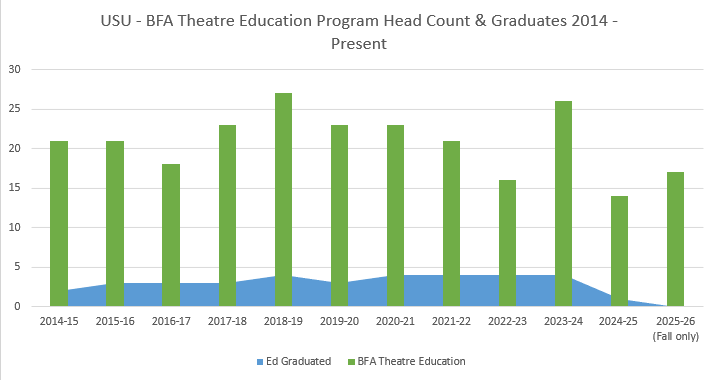
Three types of outcomes data are included herein: Enrollment and graduation figures over time, students' overall ratings based on program performance and portfolio reviews, and employment data for graduates.
Enrollment & Graduation
Enrollment Data is taken from USU Registered Students lists in Fall Semester of each year. Graduation Data is taken from Fall, Spring, & Summer Semester USU Graduation lists for each academic year.
| Dates | BFA Theatre Education | Ed Graduated |
|---|---|---|
| 2014-15 | 21 | 2 |
| 2015-16 | 21 | 3 |
| 2016-17 | 18 | 3 |
| 2017-18 | 23 | 3 |
| 2018-19 | 27 | 4 |
| 2019-20 | 23 | 3 |
| 2020-21 | 23 | 4 |
| 2021-22 | 21 | 4 |
| 2022-23 | 16 | 4 |
| 2023-24 | 26 | 4 |
| 2024-25 | 14 | 2 |
| 2025-26 (Fall Only) | 14 | 2 |
Employment
Nearly 100% of graduates from the program are employed directly in the field of theatre and/or education or enrolled in graduate school within a year of graduation. Students work as teachers at the elementary and secondary levels and also work for cultural institutions such as museums and theatre as well as government agencies.
Annual Review System
In additional to receiving holistic, summative evaluations in each category, all students also received substantive written comments from reviewers for each competency assessed indicating their strengths and specific opportunities to improve.
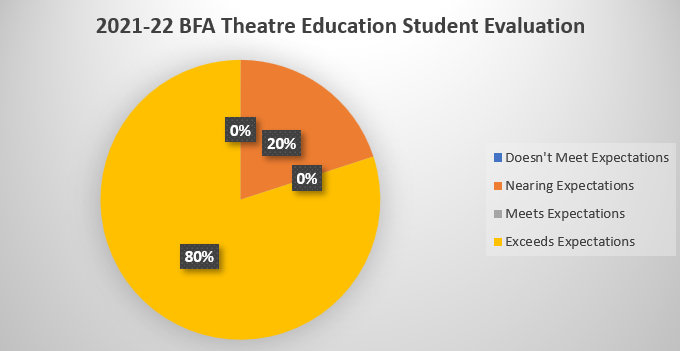
2021-22 BFA Theatre Education Student Evaluation
| Student | Doesn't Meet Expectations | Nearing Expectations | Meets Expectations | Exceeds Expectations |
|---|---|---|---|---|
| 1 | X | |||
| 2 | X | |||
| 3 | X | |||
| 4 | X | |||
| 5 | X | |||
| 6 | X | |||
| 7 | X | |||
| 8 | X | |||
| 9 | X | |||
| 10 | X | |||
| Total | 0 | 2 | 0 | 8 |
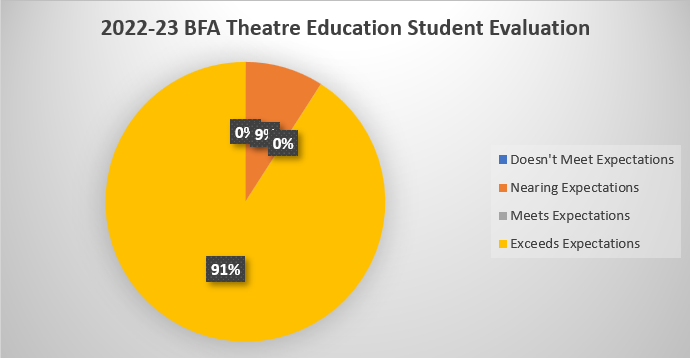
2022-23 BFA Theatre Education Student Evaluation
| Student | Doesn't Meet Expectations | Nearing Expectations | Meets Expectations | Exceeds Expectations |
|---|---|---|---|---|
| 1 | X | |||
| 2 | ||||
| 3 | X | |||
| 4 | X | |||
| 5 | X | |||
| 6 | X | |||
| 7 | X | |||
| 8 | X | |||
| 9 | X | |||
| 10 | X | |||
| 11 | X | |||
| Total | 0 | 1 | 0 | 10 |
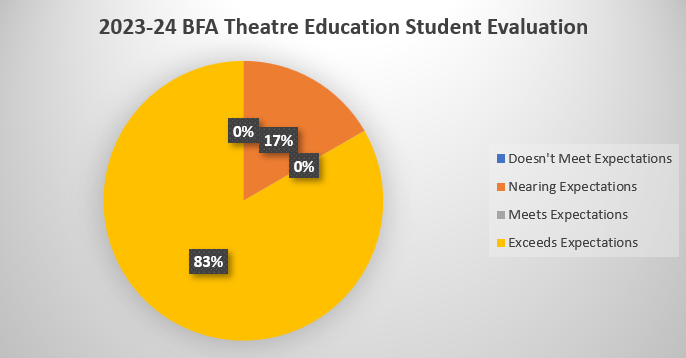
2023-24 BFA Theatre Education Student Evaluation
| Student | Doesn't Meet Expectations | Nearing Expectations | Meets Expectations | Exceeds Expectations |
|---|---|---|---|---|
| 1 | X | |||
| 2 | X | |||
| 3 | X | |||
| 4 | X | |||
| 5 | X | |||
| 6 | X | |||
| Total | 0 | 1 | 0 | 5 |
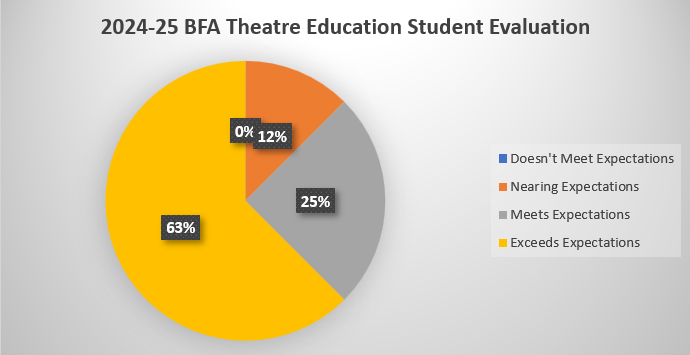
2024-25 BFA Theatre Education Student Evaluation
| Student | Doesn't Meet Expectations | Nearing Expectations | Meets Expectations | Exceeds Expectations |
|---|---|---|---|---|
| 1 | X | |||
| 2 | X | |||
| 3 | X | |||
| 4 | X | |||
| 5 | X | |||
| 6 | X | |||
| 7 | X | |||
| 8 | X | |||
| Total | 0 | 1 | 2 | 5 |
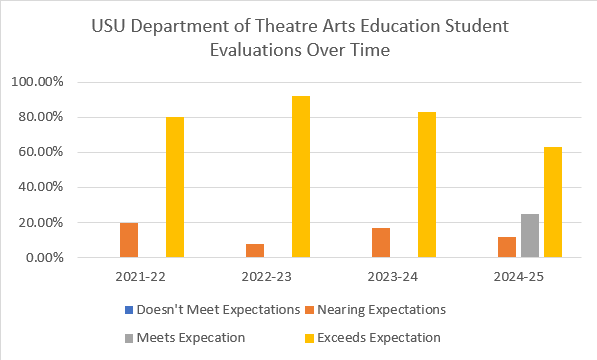
USU Department of Theatre Arts Education Student Evaluations Over Time
| Dates | Doesn't Meet Expectations | Nearing Expectations | Meets Expecations | Exceeds Expectations |
|---|---|---|---|---|
| 2021-22 | 0% | 20% | 0% | 80% |
| 2022-23 | 0% | 8% | 0% | 92% |
| 2023-24 | 0% | 17% | 0% | 83% |
| 2024-25 | 0% | 12% | 25% | 63% |
Data-Based Decisions
Based on the data presently available from previous iterations of the annual review, the theatre education faculty believe that student progress in the program meets or exceeds expectations, and that the best course of action at present is to continue with current practices and methods of evaluations. In future years, data will be re-assessed to determine if there are particular areas that warrant further investigation or possible programmatic changes.