Outcomes Data

Last updated Fall 2026

We collect data primarily from the APDP and the exit surveys, along with comprehensive exam and thesis/dissertation defense records. The APDP is collected every year for each student, so can show the trajectory as students progress through the program. The other data are from a single point in time. All data are anonymized, summarized, and displayed (in both table and visual format) on the department website by the end of each Fall semester. Graduate Program Co-Directors are responsible for data summaries, analysis, and visualization. Data are summarized, analyzed, and visualized independently for each of our four programs (Biology PhD/MS, Ecology PhD/MS). Once the data are posted, a link is shared with faculty, staff, and students in the department so that they may view progress toward Learning Outcomes for themselves. 

The tables below identify the data we collect, from where we obtain it, and the responsible party.

Metric What we need Where to get it Who can get it
Proportion of students passing comprehensive exams Records of examination Graduate School GPC
Proportion of students passing thesis/dissertation defense Records of examination Graduate School GPC
Proportion of students performing At or Above expectations for each outcome, as decided by the supervisory committee on the APDP Biology APDP records Biology Department GPC
Proportion of students performing At or Above expectations for each outcome, as determined by self-assessment on the APDP Biology APDP records Biology Department GPC
Proportion of graduating students that answer satisfied or very satisfied to each question  in an exit interview Exit interview survey records Biology Department GPC

Graduate Degrees by Academic Year

Academic years run Fall through Summer (for example, AY 2025-26 is Fall 2025, Spring 2026, and Summer 2026)

Academic Year MS PhD
2020-2021* 3 3
2021-2022 3 4
2022-2023 9 8
2023-2024 8 6
2024-2025 2 6
2025-2026 7 9
TOTAL 32 36

*AY 2020-2021 includes only the Spring and Summer terms

Graduate Productivity from CVs

We count grants and awards, publications, and presentations from the CVs that graduates attach to their thesis or dissertation on DigitalCommons@USU. Counts include only work done since the student started at USU and are provisional (about ±1 per student).
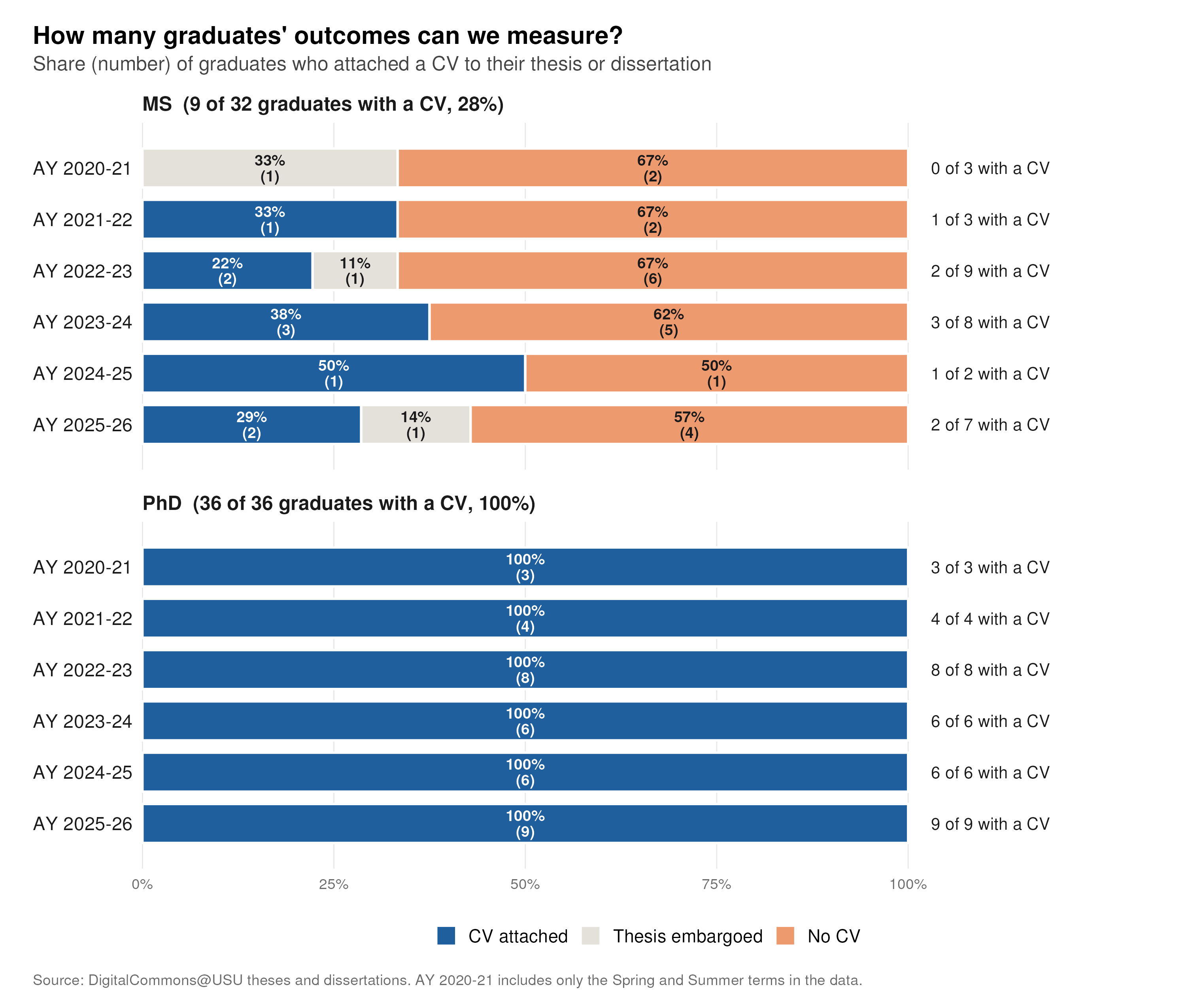
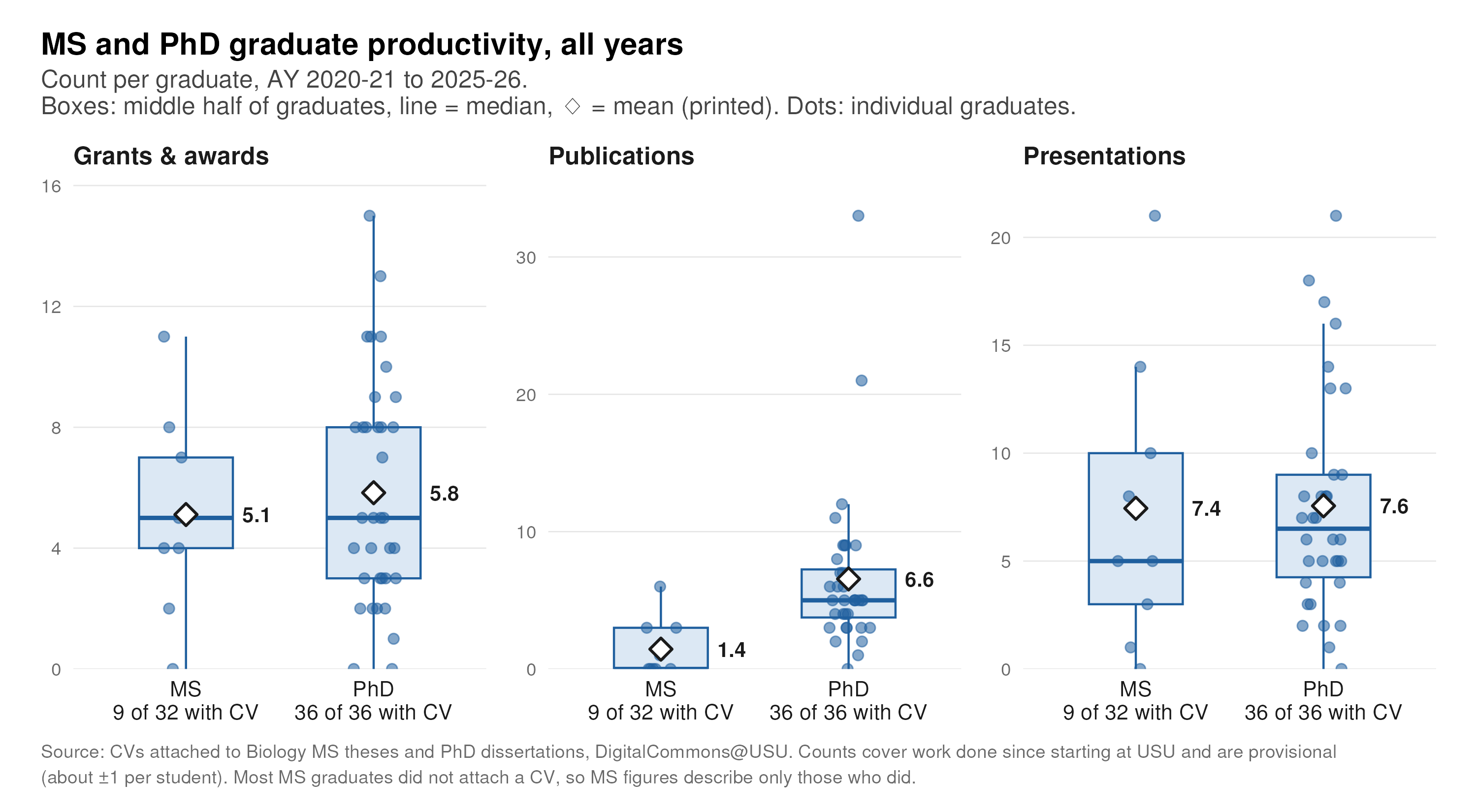
Fig. 1. How many graduates' outcomes can we measure? Percent (number) of Biology graduates, by degree and academic year, whose thesis or dissertation included a CV (blue), was under embargo and not publicly available (grey), or had no CV (orange). Text at right gives graduates with a CV out of all graduates that year. All 36 PhD graduates attached a CV, but only 9 of 32 MS graduates did, so MS results in Fig. 2 describe only those 9 students. AY 2020-21 includes only the Spring and Summer terms.

Fig. 2. MS and PhD graduate productivity, all years (AY 2020-21 to 2025-26). Number of grants and awards, publications, and presentations per graduate. Each dot is one graduate; boxes span the middle half of graduates, the line is the median, and the diamond and printed value give the mean. PhD graduates averaged 5.8 grants and awards, 6.6 publications and 7.6 presentations; MS graduates averaged 5.1, 1.4 and 7.4. MS values come from only the 9 MS graduates who attached a CV (Fig. 1) and may not represent all MS graduates.

PhD Graduates by Academic Year

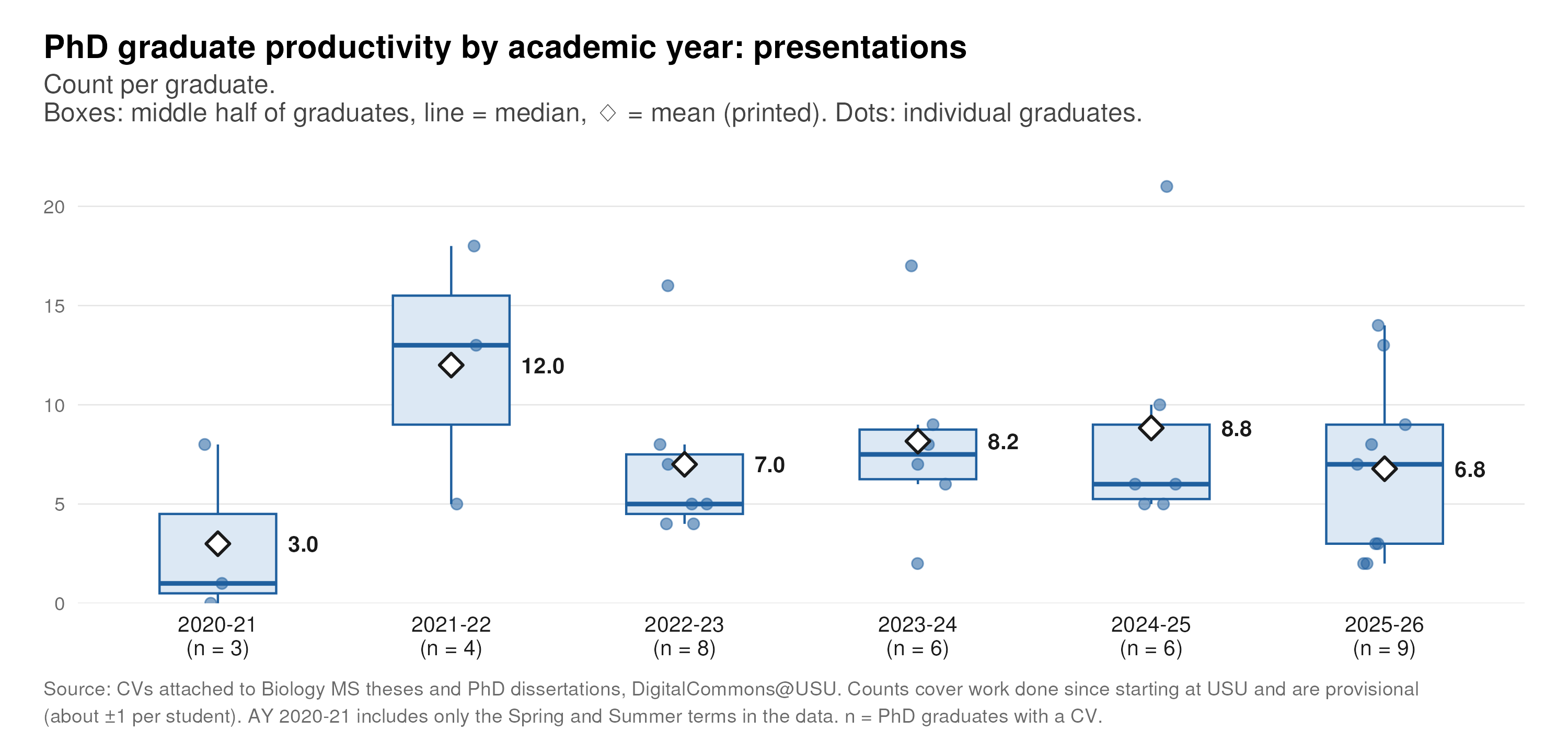
Figs. 3–5 show each measure separately for PhD graduates, one box per academic year (n = PhD graduates with a CV, 3 to 9 per year). Boxes, lines and diamonds are as in Fig. 2. MS graduates are not shown by year because too few attached a CV. AY 2020-21 includes only the Spring and Summer terms.
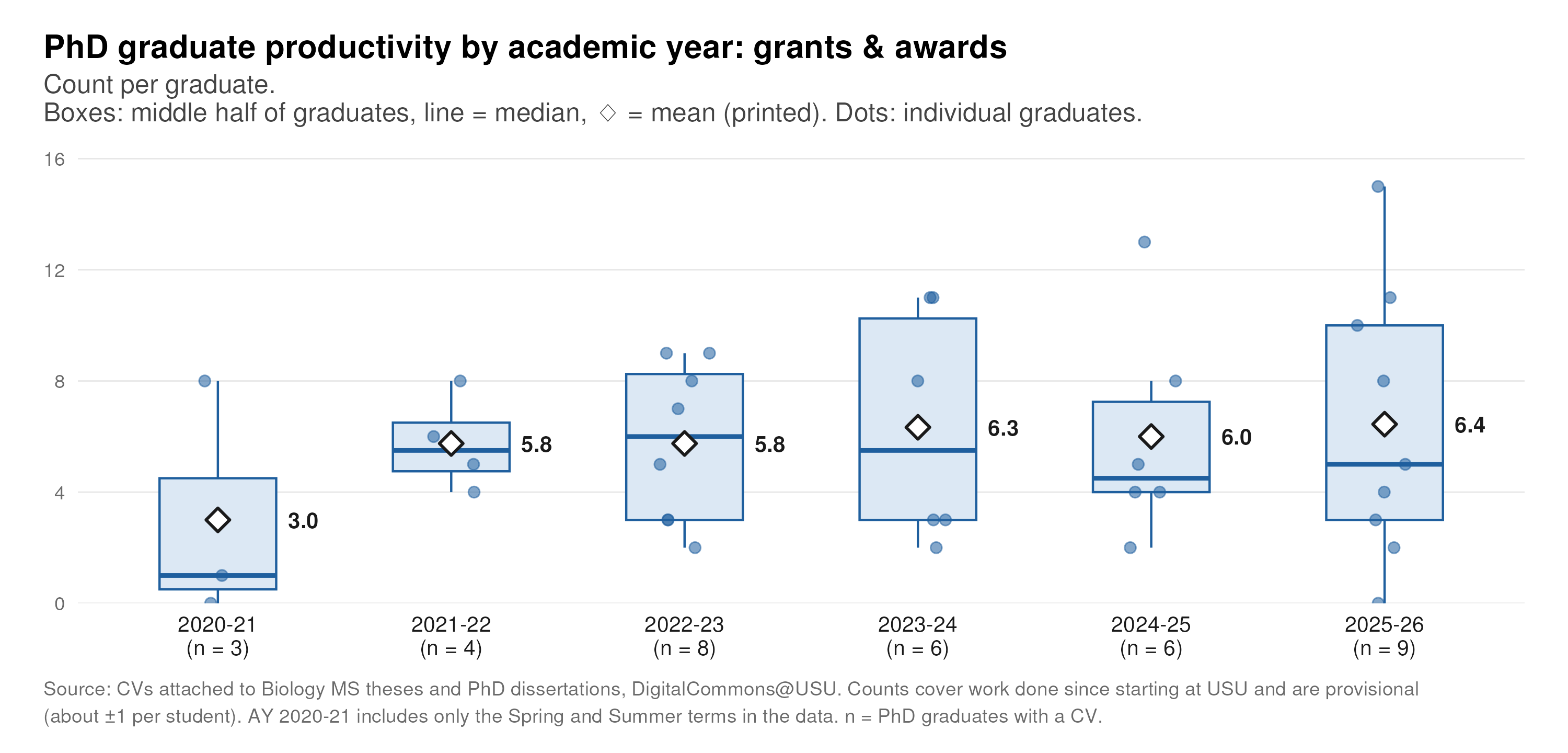
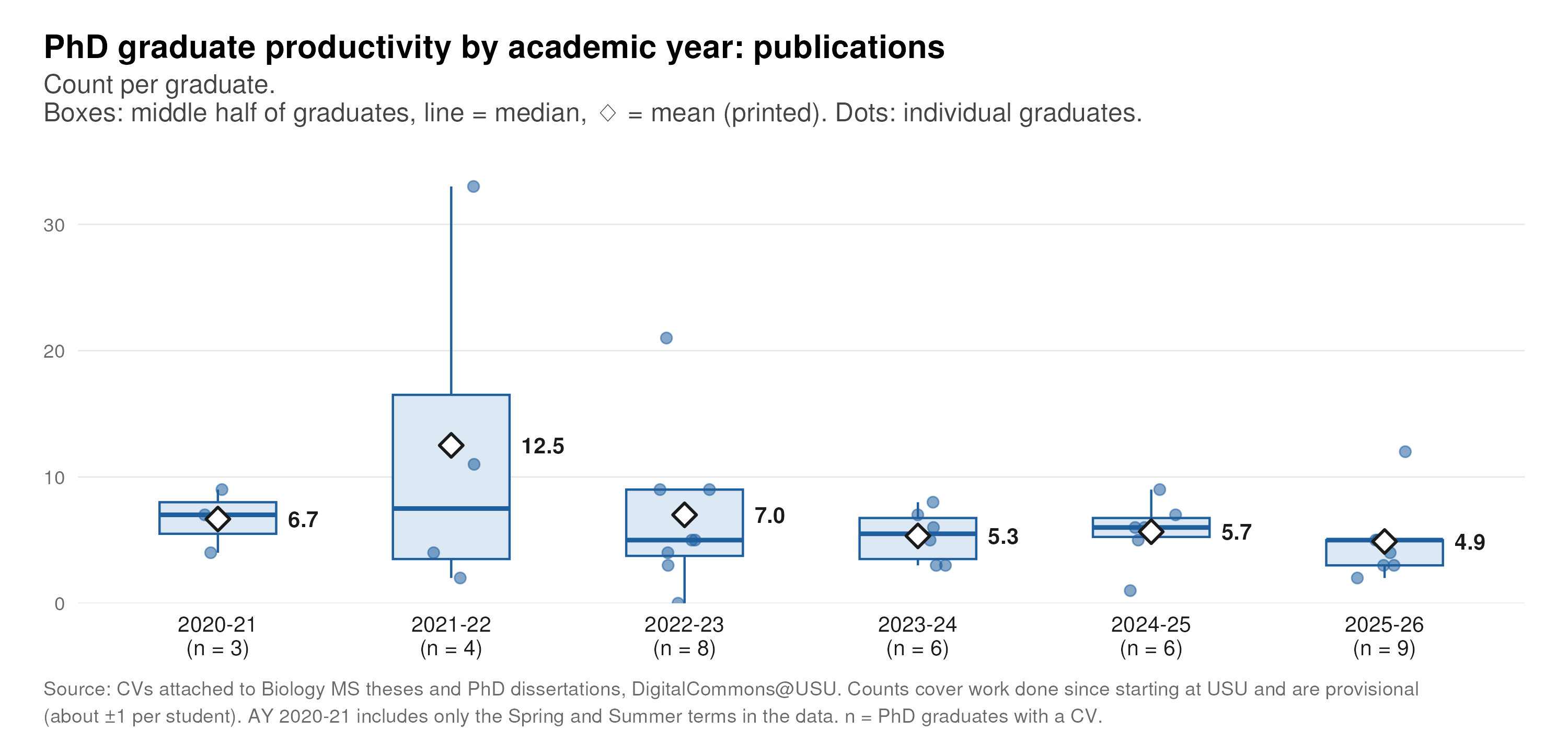
Fig. 3. Grants and awards per PhD graduate, by academic year. The mean has stayed between 5.8 and 6.4 since AY 2021-22, up from 3.0 in AY 2020-21, a partial year with 3 graduates.

Fig. 4. Publications per PhD graduate, by academic year. Means range from 4.9 to 12.5. With so few graduates per year, single students can move the mean a lot: the high mean in AY 2021-22 (12.5) reflects one graduate with 33 publications. Medians stay between about 5 and 7.5.

Fig. 5. Presentations per PhD graduate, by academic year. Means range from 6.8 to 12.0 after AY 2020-21 (3.0, a partial year with 3 graduates).

Mean per PhD Graduate, by academic year (values shown in Figs. 3-5)

Academic Year PhD Graduates Grants & Awards Publications Presentations
2020-2021* 3 3.0 6.7 3.0
2021-2022 4 5.8 12.5 12.0
2022-2023 8 5.8 7.0 7.0
2023-2024 6 6.3 5.3 8.2
2024-2025 6 6.0 5.7 8.8
2025-2026 9 6.4 4.9 6.8

*AY 2020-2021 includes only the Spring and Summer terms

Exit Survey: Satisfaction by Learning Outcome

Graduating students rate how satisfied they are that the program helped them reach each learning outcome (LO). Data shown are from the Biology Graduate Student Exit Survey, AY 2021-22 through AY 2025-26 (32 respondents; 9 in the most recent year). "Satisfied" means Extremely or Somewhat satisfied; blank answers are not counted. Bar labels give the percent and, in parentheses, the number of students.
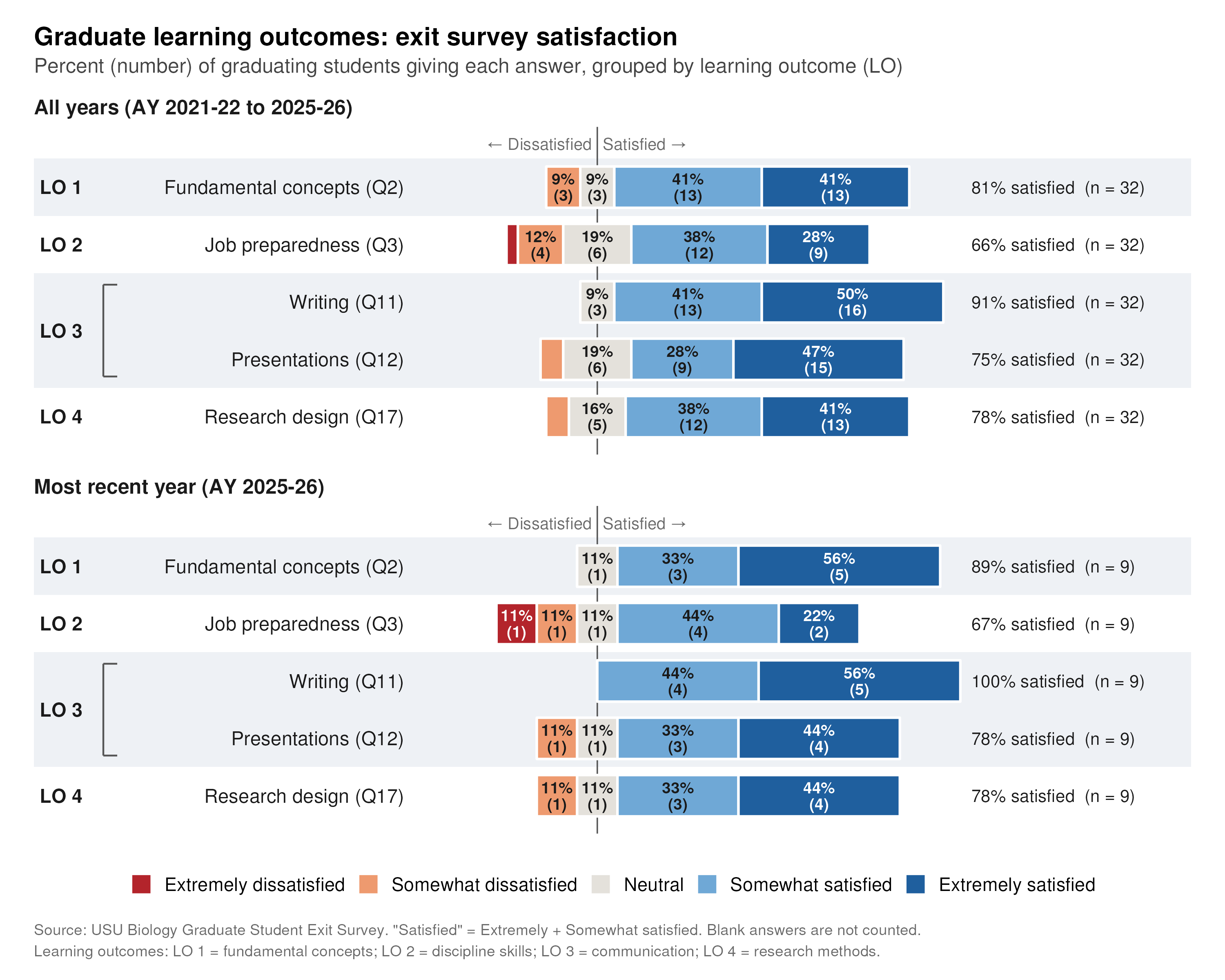
Fig. 6. Exit survey satisfaction for each learning outcome. Percent (number) of graduating students giving each answer, for all years combined (top, n = 32) and the most recent year (bottom, AY 2025-26, n = 9). Rows are grouped by learning outcome; writing and presentations both belong to LO 3 (communication). Bars are centered on Neutral, with dissatisfied answers to the left and satisfied answers to the right; text at right gives the percent satisfied. Across all years, satisfaction was highest for writing (91%) and lowest for job preparedness (66%). Small unlabeled segments (all years): 1 student (3%) extremely dissatisfied with job preparedness, and 2 students (6%) somewhat dissatisfied with presentations and with research design.

Each Learning Outcome by Academic Year

Figs. 7–10 show the same answers for each academic year (Fall + Spring + Summer). Yearly groups are small (3 to 11 respondents), so one student can move a bar by 10 to 33 percentage points; read year-to-year changes with caution.
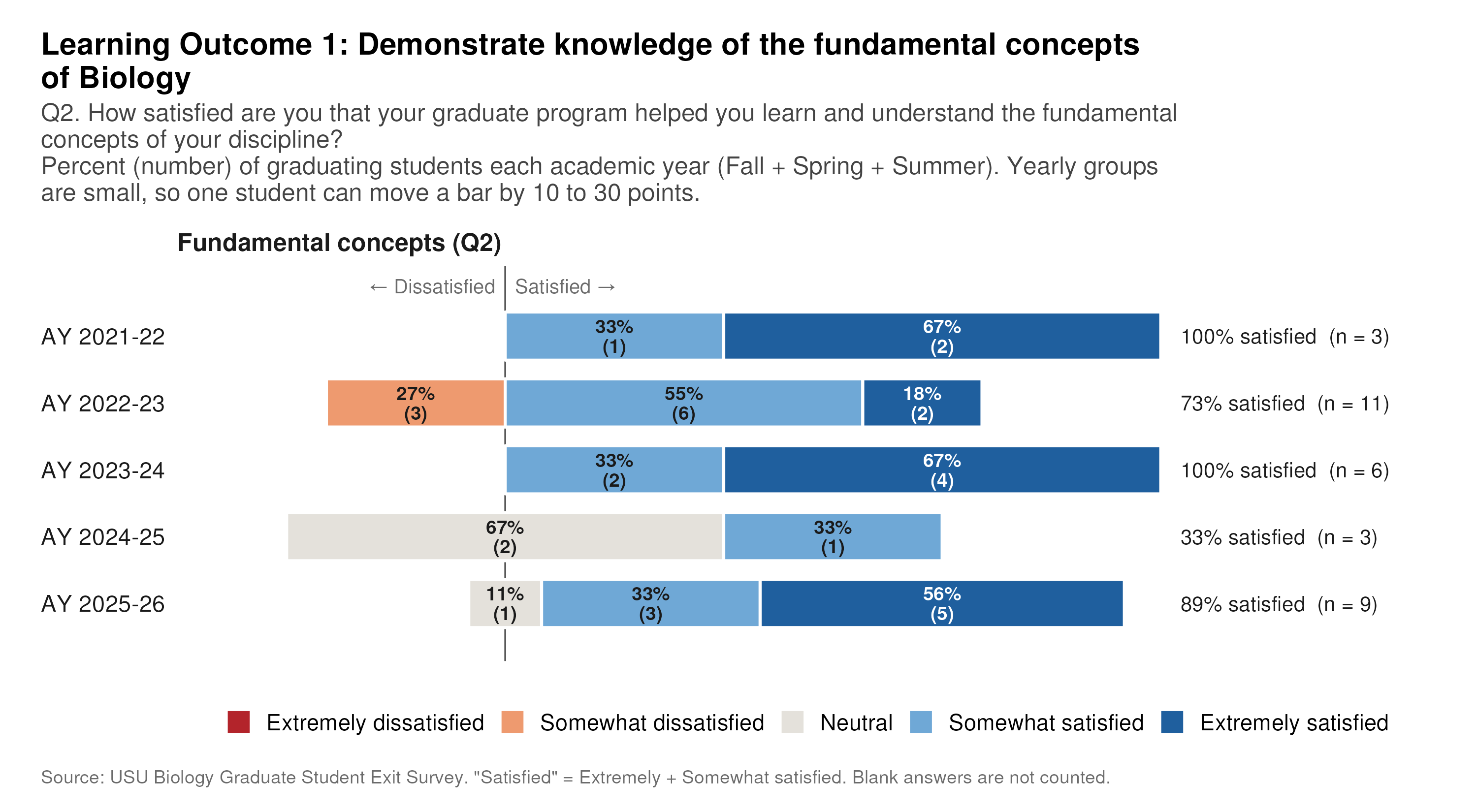
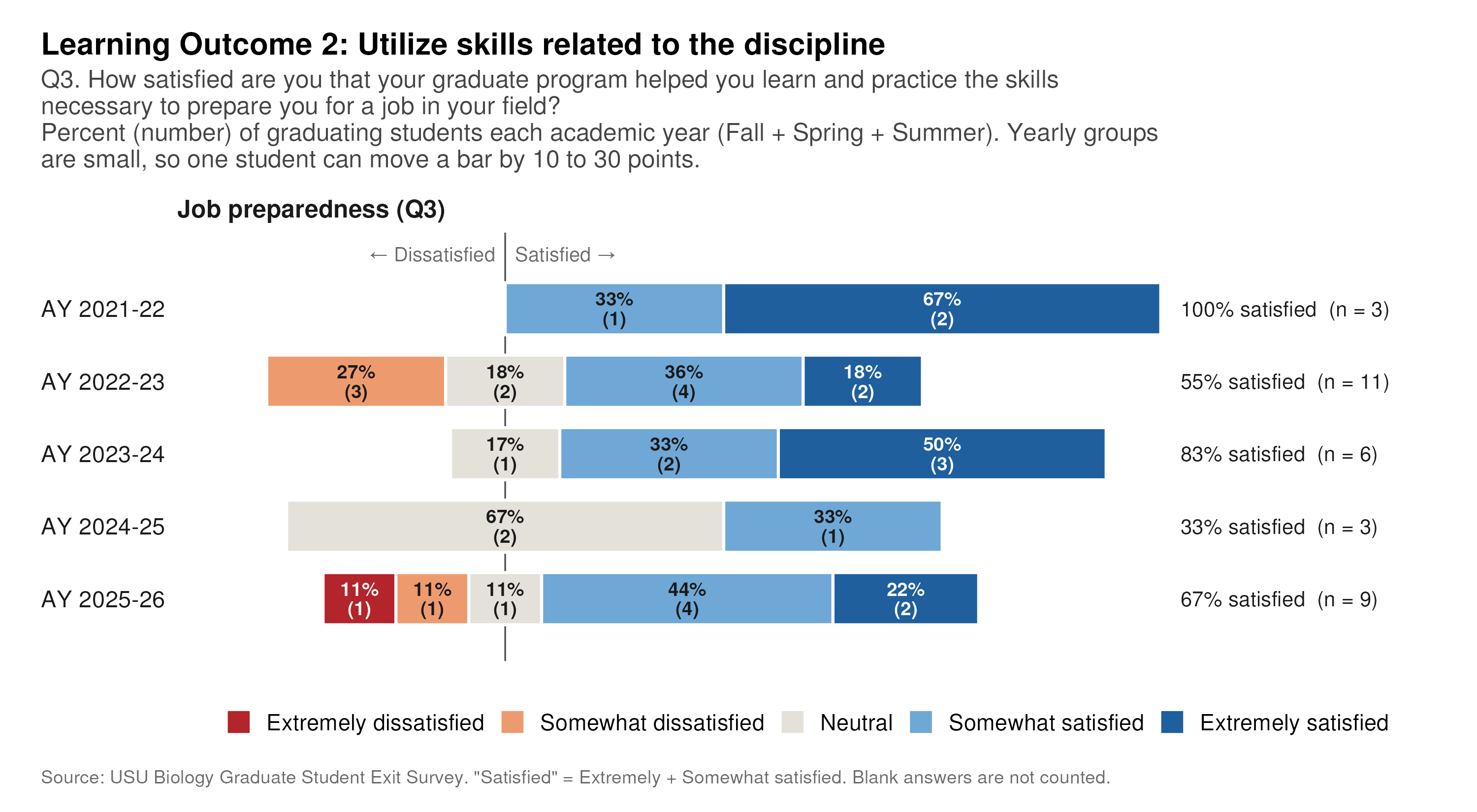
Fig. 7. Learning Outcome 1: Demonstrate knowledge of the fundamental concepts of Biology. Responses to Q2, "How satisfied are you that your graduate program helped you learn and understand the fundamental concepts of your discipline?" Satisfaction ranged from 33% (AY 2024-25, 3 respondents) to 100%, and was 89% in AY 2025-26.

Fig. 8. Learning Outcome 2: Utilize skills related to the discipline. Responses to Q3, "How satisfied are you that your graduate program helped you learn and practice the skills necessary to prepare you for a job in your field?" Satisfaction ranged from 33% to 100% and was 67% in AY 2025-26, when 2 of 9 students were dissatisfied. This is the lowest-rated learning outcome overall (Fig. 6).

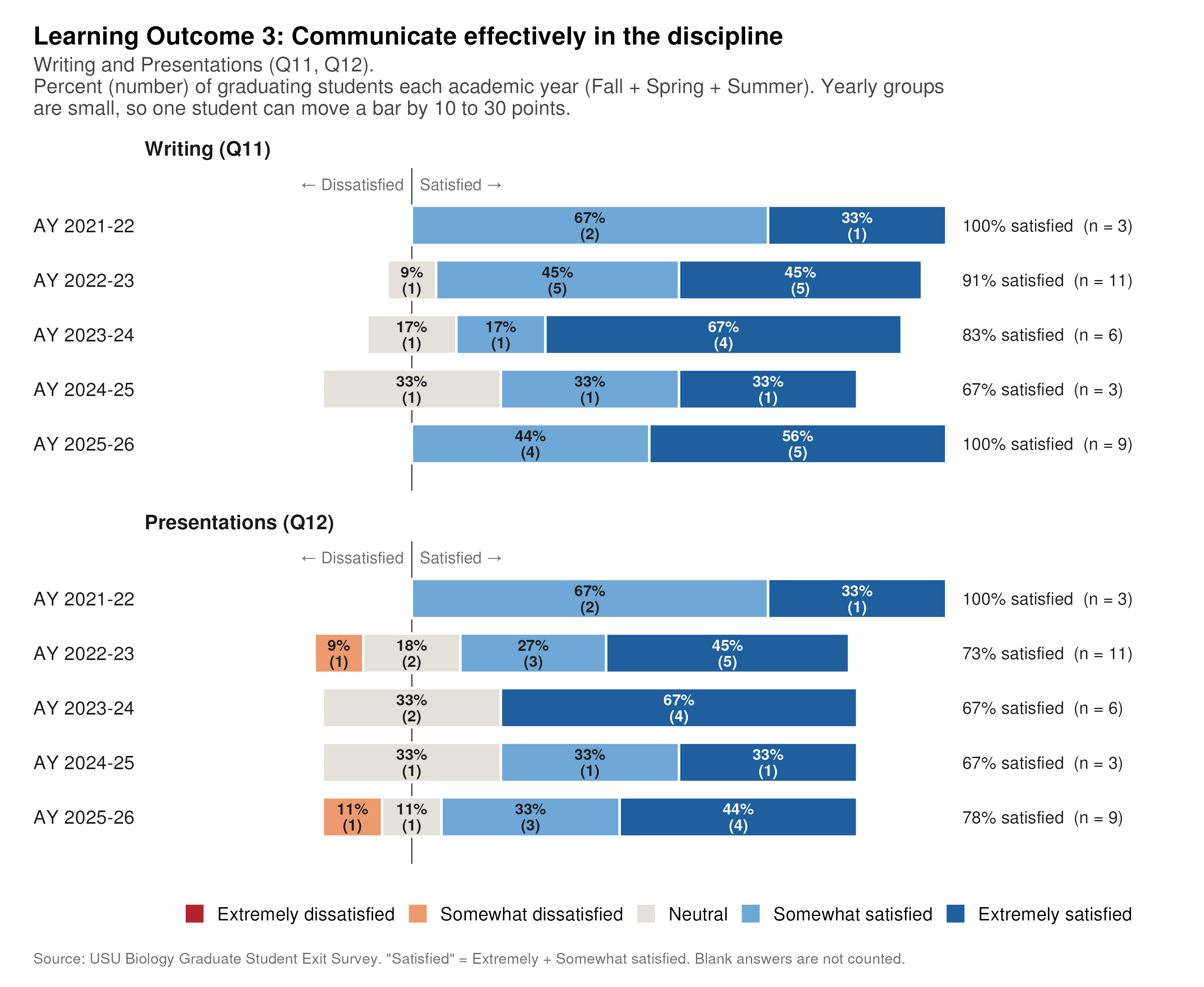
Fig. 9. Learning Outcome 3: Communicate effectively in the discipline. Responses to Q11, "How satisfied are you that your graduate program improved your writing skills?" (top), and Q12, "…improved your presentation skills?" (bottom). No graduate has been dissatisfied with writing, and all AY 2025-26 graduates were satisfied. Presentation satisfaction ranged from 67% to 100% and was 78% in AY 2025-26.

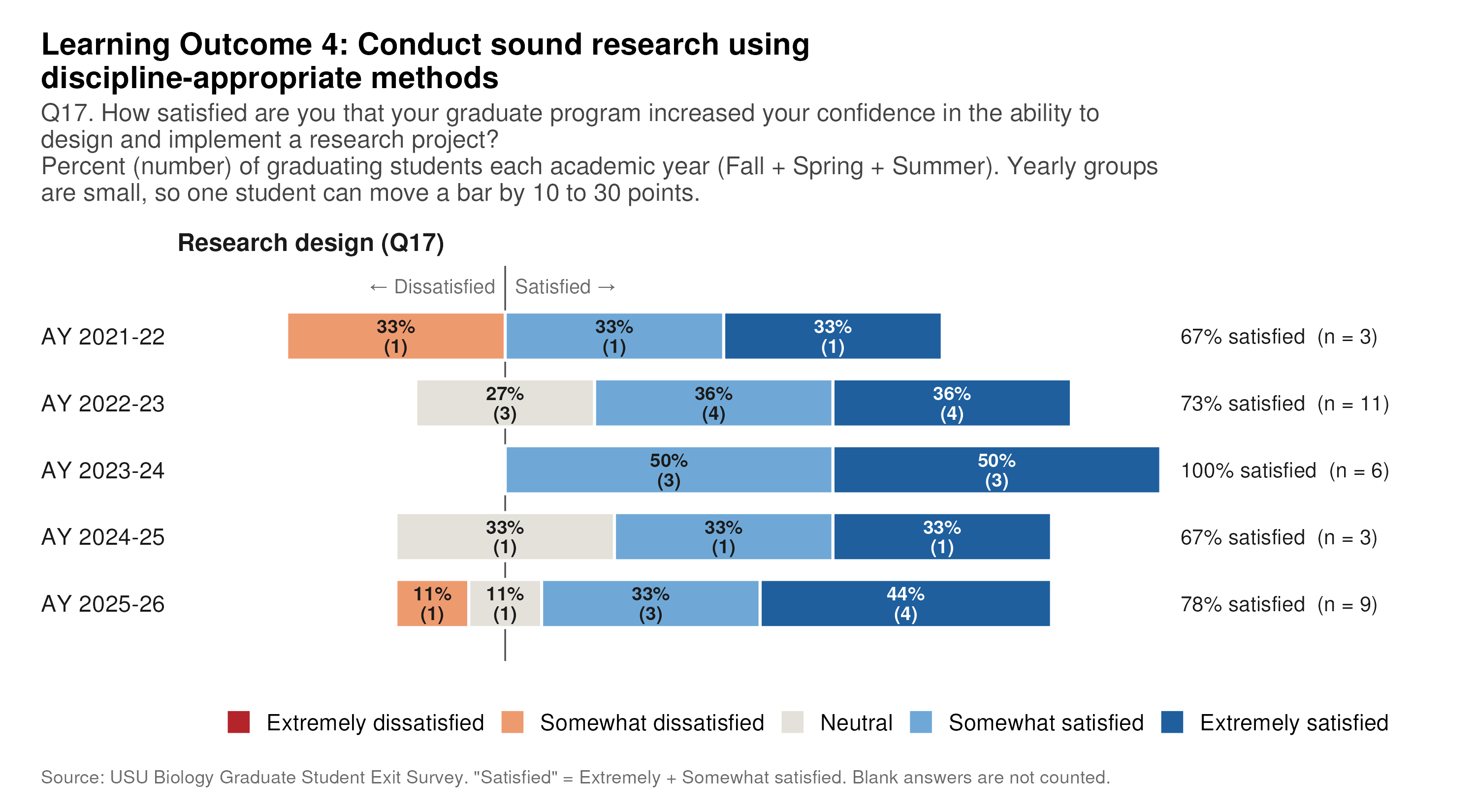
Fig. 10. Learning Outcome 4: Conduct sound research using discipline-appropriate methods. Responses to Q17, "How satisfied are you that your graduate program increased your confidence in the ability to design and implement a research project?" Satisfaction ranged from 67% to 100% and was 78% in AY 2025-26.