
Program Overview
Acting students receive comprehensive, progressive training in all areas of theatre with a specific focus on acting. The curriculum is a pre-professional pathway for those who desire a career in the performing arts and/or graduate studies in the performing arts.
Acceptance into the Acting Program is by application, audition, and interview. Retention is earned by personal growth, commitment, and faculty evaluation of satisfactory progress in end-of-semester evaluations and annual juries.
This is an undergraduate program in which students earn a Bachelor of Fine Arts. There is currently no graduate program in this area.
The curriculum is designed to reflect the standards mandated by the National Association of Schools of Theatre (NAST) as well as professional practices common in the fields of theatre, television, and film.
Standards for Professional Baccalaureate Degree in Acting - BFA
Per the National Association of Schools of Theatre (NAST – accrediting body): “Students enrolled in professional undergraduate degrees in theatre are expected to develop the knowledge, skills, concepts, and sensitivities essential to the life of the theatre professional. In any of many possible roles, the theatre professional must exhibit not only technical competence, but also broad knowledge of theatre, sensitivity to artistic style, and an insight into the role of theatre in the life of humankind.”
Acting requires mastery of an extremely diverse skill set. Actors must juggle the skills of performance, direction, movement, voice, and an academic’s awareness of literature, criticism, and history in order to create a believable character. To effectively engage with the theatrical ensemble actors must also have an acute awareness of and respect for all aspects of production, enabling them to effectively engage with and enhance the contributions of the technical and design team. Thus the actor must integrate (juggle) disparate skills at all levels of rehearsal and performance.
Actors are evaluated on their ability to seamlessly integrate the skills presented by their discrete and combined curriculum. Mastery signifies an integrated/holistic process, i.e. the work does not show, the result is believable because it is logical and skillful. Levels of acceptable skill competency toward the BFA Acting degree are:
- Integrated – Grade of A, 90%-100% of total points possible earned.
- United – Grade of B, 80%-89% of total points possible earned.
Unacceptable levels of skill competency toward the BFA Acting degree are:
- Combined – Grade of C, 70%-79% of total point possible earned.
Disintigrated – Grade of D or lower, 0%-69% of total point possible earned.
Unacceptable progress in one or more courses during a semester will result in a warning and probation. Continued lack of acceptable progress will result in dismissal from the course of study.
Learning Objectives / Assessment Plan
Learning objectives are achieved via readings of dramatic literature, criticism, history, scene and monologue assignments, improvisations, and specific skills exercises. Evaluation is based on written and oral examination, written evidence of research and role preparation, and performance assignments.
Students are expected to develop and demonstrate competencies in:
- Acting - the ability to live truthfully in imaginary circumstances, generated by dramatic literature or improvisation. This includes mastery of the following:
- Projecting one’s self believably in text and action into imaginary circumstances.
- Solo and ensemble improvisations.
- Ability to create convincing characters from all genres/styles studied.
- Script analysis techniques and generation of given circumstances, resulting in logical and complete generation of character.
- Specific demands of the styles demanded by majors periods and genres of dramatic literature.
- Script analysis for actors; i.e: scoring a script for objectives, tactics, obastacles, and units of theatrical action (beats).
- Adaptation, concentration of attention, circle of attention, the inner- and outer-creative states, emotion and sense memory, the process of experiencing, Magic If, mental images, subtext, supertask, and throughaction.
- Voice/Speech - knowledge, flexibility, strength, and control of the vocal apparatus. This includes mastery of the following:
- Vocal flexibility, control, breath support, range, and freedom from tension in rehearsal and performance.
- Clear, articulate, and expressive speech.
- Ability to use appropriate tools and systems to learn and perform dialects.
- Ability to perform in verse plays.
- Effective vocal choices for a variety of performance spaces and media types.
- Movement/Dance - strong, flexible, and controlled use of the body. This includes mastery of the following:
- Flexible, relaxed, strong, and controlled body for a range of stage movement disciplines (e.g., dance, mime, mask work, combat).
- Basic armed and unarmed stage combat.
- Use of the body as an instrument for characterization.
- Use of the body for changing time/rhythm demands and spatial relationships.
- Literature/History - knowledge script analysis and major literary and artistic genres of the past, the 20th and 21st Centuries, as well as acquaintance with World/non-Western theatre. This includes mastery of the following:
- Application of Aristotelean literary analysis methods and basic analysis of given circumstances allowing for believable character creation.
- Professional standards of rehearsal and performance (e.g., preparation, creativity/freedom, commitment to ensemble, flexibility of process).
- History of global performance traditions and dramatic literature from theatrical origins through the present.
- Basic elements of Shakespeare as literature (e.g., tragedy, comedy, history, classical structure, verse, prose, scansion).
- Professional Practice - practical skills to achieve and continue meaningful employment in the field. This includes mastery of the following:
- Basic business procedures of the actors profession (e.g., auditions, resumes, agents, unions, etc.).
- Strategizing and implementing ongoing professional development for actors.
- Role preparation (rehearsal and performance) for production casting.
- Elements for producing, preparing, and mounting a professional showcase in a professional venue in a major-market city.
Developmental progress on the above competencies is assessed by program faculty via mentorship, advising, and feedback in the classroom and the rehearsal hall.
Formal assessment
Formal assessment takes place via three categories.
The completion of required acting program courses with a minimum grade of B in all required acting courses.
Students complete 20 credits of course work within the prescribed theatre core curriculum, and an additional 60 units of course work in the acting emphasis; designed to guarantee a thorough knowledge of the discrete areas of performance: acting, voice, movement, literature and history. All courses must be completed with a strong, B or better, final grade.
End-of-the-Semester Evaluations
Students meet individually with all members of the performance faculty to assess progress in studio courses. Students receive a written evaluation from each faculty prior to the meeting. During the meeting discrete and overall achievement is evaluated and the student advised, if necessary, on further actions to achieve excellence in technique and artistry.
Annual Juries
Juries are conducted during the spring semester to assess student progress toward desired competencies in the performance capacity. Students receive written evaluations and ratings subsequent to the jury performance. The jury is comprised of the elements of a “general audition,” which includes the preparation and performance of two contrasting monologues and 16-bars of a musical number.
Rubrics
Students are assessed as either Excellent, Strong, Acceptable, Marginal, or Poor in their progress towards integrating the discrete areas of technique into a seamless whole. The acting curriculum is presented as a sequence of courses. One course builds upon another and the skills and techniques presented in one course are required in subsequent courses. Thus, continuance in the program is dependent upon a student earning a minimum rank of strong each semester.
BFA Acting Student Assessment Rubric
Outcomes Data
Summative assessment of student progress is based on final grades in the courses indicated below. Students must earn a grade of B- or higher in each of these courses. Each course involves a number of formative and summative assessments appropriate to nature of the course and briefly summarized below.
Courses Assessing Competence in Theatre History & Literature
THEA 3710 (Theatre History I), THEA 3720 (Theatre History II), ENGL 2300 (Intro to Shakespeare), ENGL 4300 (Shakespeare), HIST 3160 (Classical Drama & Society), THEA 4710 (Contemporary Theatre), THEA 4720: Musical Theatre History & Literature I, THEA 4730: Musical Theatre History & Literature II
Examples of Summative Assessments in Theatre History & Literature
Analytic essays, research papers, presentations on historical periods, written examinations.
Courses Assessing Competence in Script Analysis & Performance
THEA 1033 (Beginning Acting), THEA 1713 (Playscript Analysis), THEA 2000 (Scene Study), THEA 3610 (Directing), THEA 4760 (Playwriting), THEA 5610 (Directing II)
Examples of Summative Assessments in Script Analysis & Performance
Group and solo performances of scripted texts and improvised scenes, script scoring, examinations.
Courses Assessing Competence in Technical Theatre & Design
THEA 1513 (Stagecraft), THEA 2203 (Costume Construction), THEA 2555 (Production Practicum), THEA 3510 (Scene Design I), THEA 3520 (Costume Design I), THEA 3540 (Lighting Design I), THEA 3550 (Stage Management), THEA 3560 (Period Styles/Historic Interiors), THEA 3570 (Historic Clothing), THEA 1223 (Stage Makeup)
Examples of Summative Assessments in Technical Theatre & Design
Construction projects (scenic and costume), design renderings, examinations
Outcomes Data
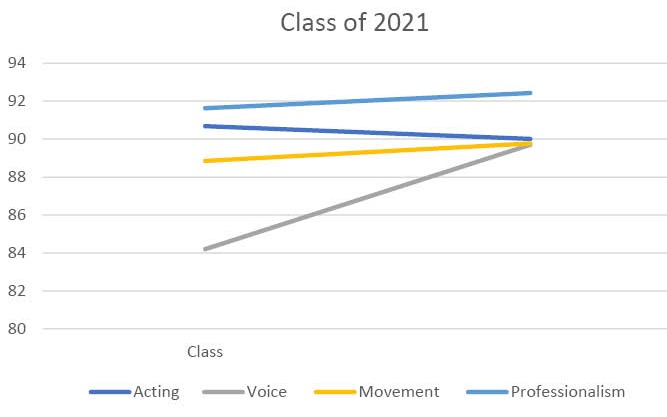
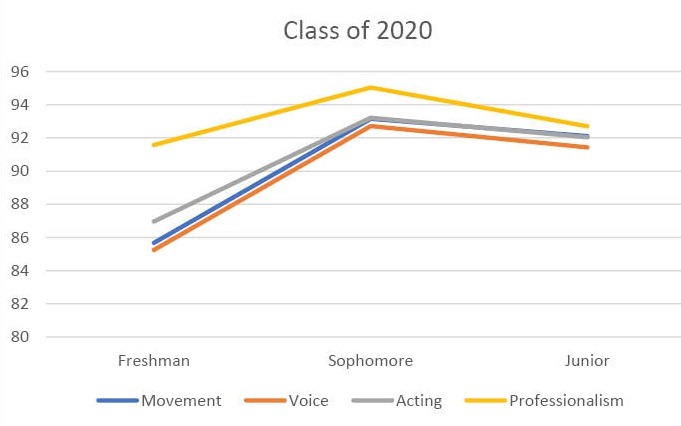
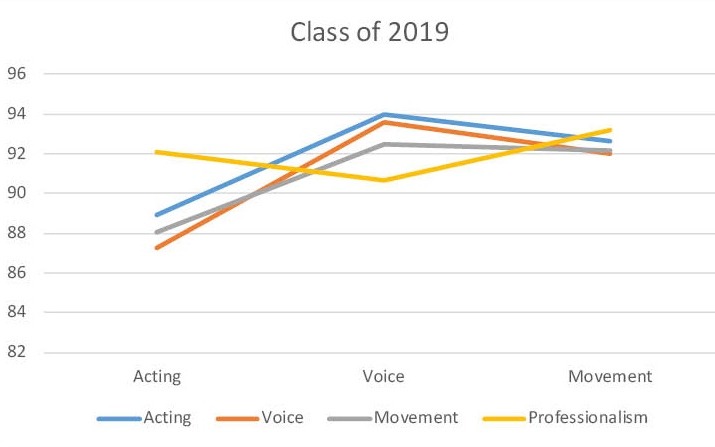
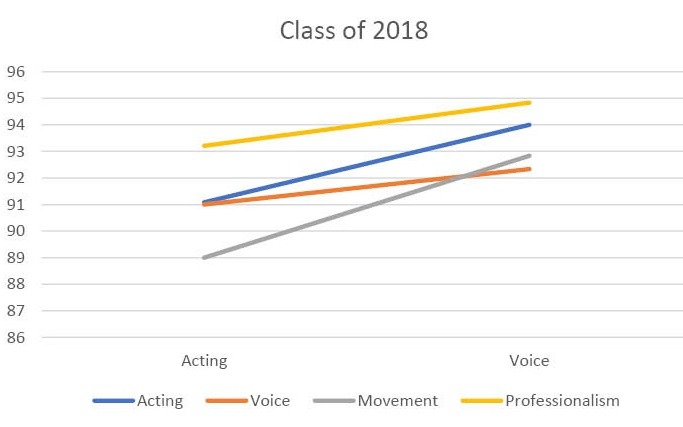
The revised acting curriculum will be graduating its first class this year, so data is not yet available. However, data from three cohorts graduating under a modified version of the curriculum demonstrate a strong level of professional employment and/or placement in a graduate training program. The past three cohorts have achieved 80% employment or placement in graduate programs. This is significant for a discipline that routinely employs 13-14% of dues-paying union members.
Data-Based Decisions
As indicated in the outcomes data section, rankings of student achievement using the rubrics described in the assessment plan is not yet available. In subsequent years, data will be evaluated to determine if programmatic changes are necessary.